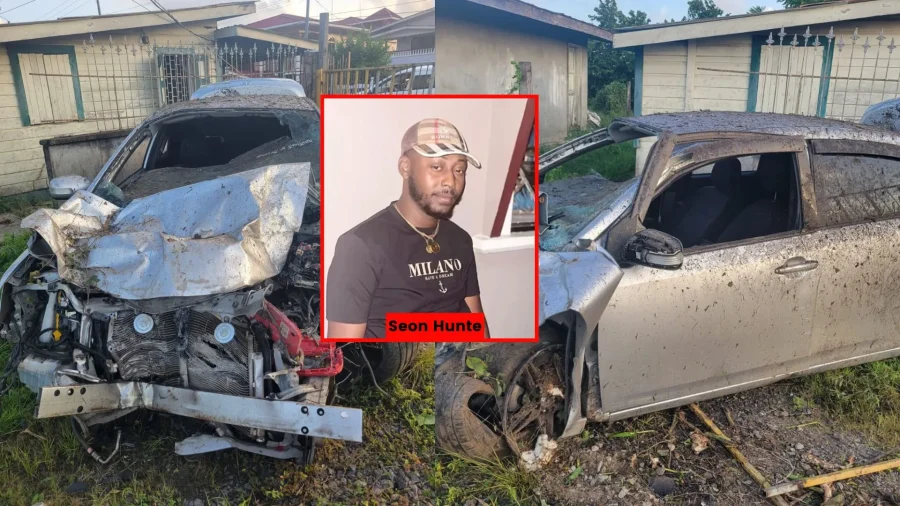
By Mark DaCosta- The tragic death of 34-year-old Seon Hunte has once again exposed the dangerous consequences of state-funded negligence along the Corentyne Coast. The Leader of the Opposition, Azruddin Mohamed, has drawn attention to a disturbing pattern: government-awarded contracts continue to enrich unqualified contractors who deliver substandard work, leaving behind hazardous roads that claim lives. His statement underscores the central thesis of this article — that the PPP government’s failure to enforce accountability in public works has created lethal conditions for ordinary citizens, while contractors pocket millions in taxpayers’ money without consequence.
Hunte’s fatal accident at Number 79 Village is not an isolated incident but part of a broader crisis of governance. The roadworks at Number 74 Village, Corentyne, Berbice, are emblematic of the problem. Instead of safe, reliable infrastructure, residents are confronted with abrupt drops, uneven surfaces, and poorly lit stretches of road. Crucially, there are no warning signs, barriers, or safety measures in place to alert drivers unfamiliar with the terrain. For those travelling at night or for visitors unaccustomed to the area, these roads become traps rather than thoroughfares.
The injuries suffered by Hunte — fractured skull, broken feet, and damage to his throat and spine — were catastrophic and preventable. They were not the result of reckless driving or personal error but of a system that has normalised negligence. When contractors are rewarded despite repeated failures, the inevitable outcome is unsafe roads and needless deaths. The PPP government’s alleged complicity lies in its refusal to hold these contractors accountable. Instead, millions of dollars continue to be funnelled into projects that endanger rather than protect the public.
The Ministry of Public Works bears direct responsibility for this breakdown, says a commentator. Its mandate is to supervise, monitor, and ensure that all public infrastructure meets safety standards. Yet, under PPP stewardship, oversight has collapsed. The ministry has allowed contractors to operate with impunity, ignoring basic safety protocols and leaving communities vulnerable. This is not simply administrative incompetence; it is a betrayal of the public trust. When a government fails to safeguard its citizens on something as fundamental as road safety, it forfeits its legitimacy.
Mohamed’s call for accountability is timely and necessary. He insists that both the contractors and the supervising ministry must answer for their failures. His words resonate with a population weary of excuses and empty promises. “We deserve safe roads, not death traps,” he declared, capturing the frustration of a nation that has seen too many lives lost to preventable accidents. The statement is not just political rhetoric; it reflects the lived experience of communities across Berbice and beyond.
The PPP’s defenders may argue that infrastructure development is ongoing and that progress takes time. But progress cannot be measured in ribbon-cuttings and inflated contracts while citizens are buried due to negligence. True development requires accountability, transparency, and a commitment to public safety. None of these qualities are evident in the PPP’s handling of roadworks. Instead, what we see is a government more concerned with rewarding loyal contractors than protecting lives.
The broader implications are stark. Unsafe roads hinder economic activity, discourage investment, and erode public confidence in governance. Families are left grieving, communities are destabilised, and the nation’s reputation suffers. For a country striving to modernise and attract international partnerships, such failures are not merely local tragedies; they are national embarrassments.
According to the commentator, “ the death of Seon Hunte should serve as a turning point. It is a reminder that corruption and negligence are not abstract concepts but forces that kill. The PPP government must be held to account for its role in perpetuating this cycle. Until contractors are punished for shoddy work and ministries are compelled to enforce standards, our roads will remain perilous, and our citizens will remain at risk.
In the end, this tragedy is not just about one man’s death. It is about a system that prioritises political patronage over public safety, a government that has failed to protect its people, and a nation that deserves far better. The opposition leader’s statement has laid bare the truth: under the PPP, negligence is funded by the state, and lives are the price we pay.