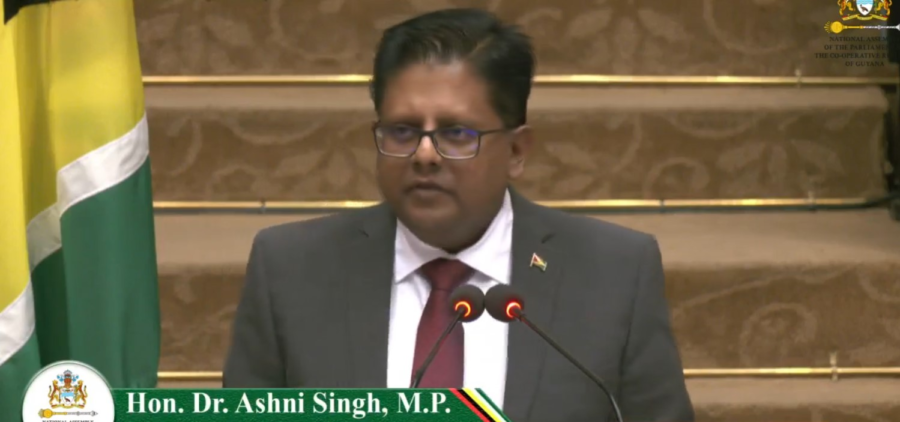
Guyana’s largest-ever National Budget of $1.558 trillion was presented in the National Assembly on Monday, January 26, 2026, during what was described as the longest budget presentation in the country’s history, exceeding five hours.
The budget was delivered by Senior Minister in the Office of the President with responsibility for Finance, Dr. Ashni Singh, under the theme “Putting People First.” Government officials said the fiscal plan outlines spending priorities for the coming year, major social support measures, infrastructure investments and renewed commitments to key productive sectors.
Dr. Singh described the budget as a people-centred blueprint aimed at translating Guyana’s robust economic growth into tangible improvements in the daily lives of citizens, with emphasis on health, education, housing and support for vulnerable groups.
However, opposition parliamentarians criticised both the substance of the budget and its presentation. Members of the opposition noted that “Putting People First” was used wholesale as the central slogan of A Partnership for National Unity (APNU) during the 2025 general election campaign, arguing that the policies announced do not align with the message implied by the theme.
The $1.558 trillion allocation represents an increase of approximately 12.7 per cent over the previous year’s budget and nearly a 307 per cent rise since 2021, reflecting the scale of government spending expansion. Revenue projections are supported by oil-sector earnings, including profit-oil and royalty receipts, and the government stressed that no new taxes are being introduced.
Key sectoral allocations include $183.6 billion for education, $161.1 billion for healthcare, $159 billion for housing, $78.3 billion for social protection, more than $196 billion for infrastructure and transport, and $119.4 billion for investments in the energy sector.
Several measures aimed at boosting household income were announced, including an increase in the old-age pension from $41,000 to $46,000 per month, higher public assistance payments, restoration of $100,000 national cash grants for adult Guyanese, and an increase in the monthly income tax threshold to $140,000.
In the productive sector, Dr. Singh announced plans to advance preparatory work for the re-opening of the Bauxite Company of Guyana Incorporated, which was shut down in 2020 following labour disputes and industrial unrest. Government officials indicated that restoration of critical systems is expected to allow production to resume later in 2026.
The budget drew sharp criticism from opposition figures. Forward Guyana Movement (FGM) Member of Parliament Amanza Walton-Desir said the budget failed to address critical national issues, particularly inflation and migration.
Walton-Desir referenced an Inter-American Development Bank report that warned of rising inflationary pressures in Guyana, arguing that the government’s response was insufficient. She said the budget “answered that warning with paltry increases,” adding that such measures “are not putting people first,” in reference to the budget’s stated theme.
She also criticised the absence of a comprehensive migration policy, noting that despite repeated commitments, none has been implemented. “For the third year we are hearing about a migration framework, yet this government has not created one,” Walton-Desir said, warning that the situation has resulted in “pressure on public services, labour market chaos and rising national security concerns.”
Summing up her assessment, Walton-Desir said: “Same budget. Bigger numbers. Same impact. Plenty for friends, family and favourites.”
Opposition Leader Azruddin Mohamed also criticised the budget, saying it failed to live up to its stated theme and prioritised large contracts over direct benefits to ordinary citizens. He described the pension increase as “far below what had been promised” during the election campaign.
Other opposition members from APNU described the budget as underwhelming, questioning the scale of social assistance adjustments, continued subsidies to state-owned enterprises such as GuySuCo, and the government’s response to the rising cost of living.
Government representatives defended the budget as a balanced response to current economic conditions, maintaining that the expanded allocations reflect a strategic investment in people, infrastructure and long-term national development.
Debate on the 2026 National Budget is expected to continue in the National Assembly in the coming days.