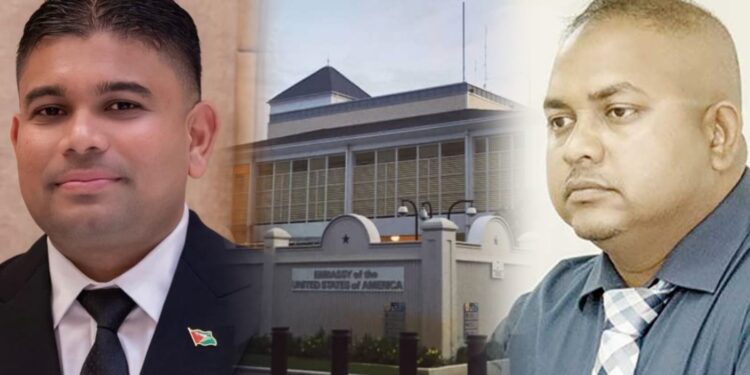
Yesterday, Acting Chief Justice Navindra Singh heard arguments in the High Court on a bid by Senior Counsel Roysdale Forde to temporarily halt extradition proceedings against businessmen Nazar “Shell” Mohamed and his son, Azruddin Mohamed. The stay application seeks to pause the Magistrate’s Court hearing scheduled for January 6, 2026, pending a constitutional challenge to the Fugitive Offenders (Amendment) Act of 2009.
Forde argued that proceeding with the extradition while the constitutionality of the law remains unresolved could violate the Mohameds’ right to liberty and cause irreparable prejudice, potentially resulting in their incarceration before the High Court issues a ruling. He also challenged the legality of the “Authority to Proceed” used to initiate the extradition, describing it as a nullity. The application follows Principal Magistrate Judy Latchman’s rejection of a request to refer constitutional questions to the High Court.
Highlighting concerns about public commentary by government officials, Forde pointed to statements made by President Irfaan Ali, Attorney General Anil Nandlall, and Vice President Bharrat Jagdeo, which he said cast negative aspersions on his clients. He also noted delays in Parliament that have prevented Azruddin Mohamed from formally assuming the role of Leader of the Opposition. The named officials publicly weighed in on the case, even though, in Guyana, matters that are sub judice are usually not discussed and state officials are expected to uphold common law principles. The sub judice rule, a voluntary restraint in Commonwealth countries, functions to prevent public commentary from prejudicing ongoing legal cases, balancing free speech with fair trials.
Forde further cited jurisprudence from the Courts of Appeal in Trinidad and Belize, noting that legal challenges to extradition can be pursued before the committal process concludes, underscoring the Mohameds’ entitlement to timely judicial review.
Attorney General Nandlall opposed the stay, describing it as “frivolous and vexatious” and an abuse of the judicial process. He accused the Mohameds’ legal team of “twisting” the Fugitive Offenders Act to manufacture delay and warned that their strategy could stall the extradition for up to five years. “This is a strategy of delays and attempts to dilate,” Nandlall said, hinting at possible political motives. He suggested that if the defence’s argument were accepted, a person could evade extradition and enter politics, effectively making political office a refuge against prosecution, and urged the court to “decipher” the defence’s intentions.
Nandlall stressed that extradition in Guyana, governed by the 1938 Convention Treaty framework, is intended to be a swift matter of international cooperation, not prolonged domestic litigation. He emphasised that the Constitution does not allow constitutional referrals at the committal stage and highlighted built-in appeal mechanisms for both sides, warning that undue delays could harm Guyana’s international credibility.
Azruddin Mohamed, elected in the recent General and Regional Elections, is widely regarded as the presumptive Leader of the Opposition after his party, We Invest in Nationhood (WIN), secured 16 seats in the 65-member National Assembly. The A Partnership for National Unity (APNU) secured 12 seats and the Forward Guyana Movement one, giving the opposition a total of 29 seats per declaration by the Guyana Elections Commission (GECOM). The extradition request originates from the United States, where both Mohamed and his father face charges including money laundering, tax evasion, and conspiracy in connection with an alleged US$50 million gold smuggling scheme.
Acting Chief Justice Singh adjourned the matter to January 5, 2026, when a ruling is expected on whether the stay will be granted. Meanwhile, Guyana engaged a Jamaican legal team, paid over US$60,000 per appearance, to represent the State’s interests in the proceedings.