When the British Parliament abolished slavery in 1834 and full freedom arrived in 1838, few expected that the formerly enslaved in British Guiana would rewrite the economic rules of empire. Yet what unfolded was one of the most remarkable grassroots economic transformations in the post-emancipation British world.
Across the colony, freed Africans pooled meagre savings, marched to plantation offices with bags of coins, and purchased abandoned or bankrupt sugar estates—lands transformed into autonomous communities. Historians widely regard this as the first and only mass village movement of its kind in the entire British Empire.
Today, it stands as the living foundation of Guyana’s Co-operative Movement.
THE SEED OF CO-OPERATION: THE POST-EMANCIPATION VILLAGE MOVEMENT (1839–1850)
The watershed moment came in November 1839, when 83 freed Africans from five plantations pooled and painstakingly saved about 30,000 guilders—equivalent to roughly US $10,000—to purchase Plantation Northbrook on the East Coast of Demerara, a property of nearly 500 acres that they renamed Victoria Village, marking the Caribbean’s first communal village purchase.
The story has been passed down with near-mythic imagery. Some carried their money in wheelbarrows, the coins so heavy that bags tore and metal rims clattered against the dirt road. Plantation attorneys were stunned by the sight—barefoot labourers pushing wheelbarrows overflowing with copper and silver to buy the very land they once worked in bondage. This was economic resistance in its purest form.
Throughout the 1840s and 1850s, other villages followed—each the result of pooled savings, collective decision-making, and a shared determination to own land such as:
Victoria (East Coast Demerara)
Buxton–Friendship (ECD)
Beterverwagting
Plaisance
Queenstown (Essequibo Coast)
Lichfield (West Coast Berbice)
Golden Grove
Belladrum
Kingelly (West Coast Berbice)
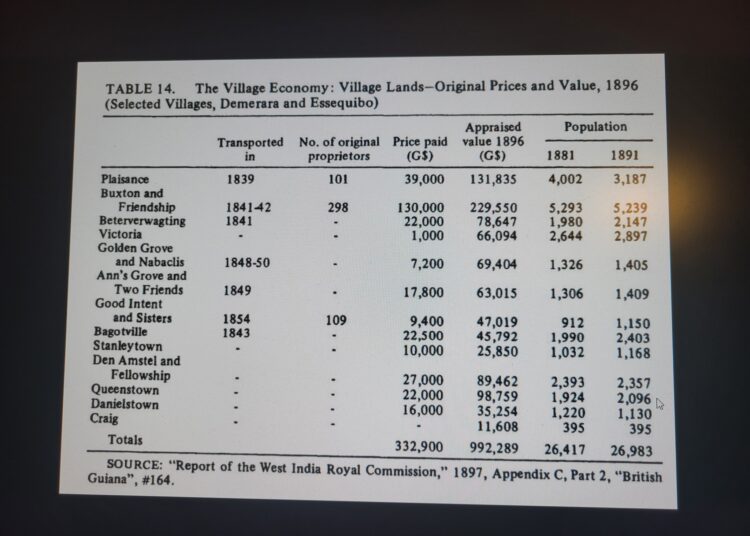
These communal villages were developed by freed Africans. Families combining earnings from rice cultivation, ground provisions, fishing, and small trades. Drainage systems, church grounds, main access paths, and community boundaries were maintained collectively, reflecting the same self-governance system that defined the early Village Movement.
These communities were not individual private land purchases. They were cooperative democracies. Villagers held common property, elected councils, and enforced rules on land use, taxation, drainage, and labour.
By the 1850s, formerly enslaved African Guyanese collectively owned over 15,000 acres, a staggering achievement by any 19th-century colonial standard. This became the philosophical foundation upon which modern Guyana later built its identity as the Co-operative Republic.
CO-OPERATION BECOMES NATIONAL IDEOLOGY
During the independence movement of the 1960s, political leaders revisited the legacy of Victoria, Kingelly, Buxton, Lichfield, and other communal villages. Their collective land purchases were framed as the moral core of a new economic model.
After independence in 1966, Guyana adopted a Tri-Sector Economy:-
1. Public Sector
Control of major industries such as sugar, bauxite, energy, and transport.
2. Private Sector
Commerce, entrepreneurship, and trade.
3. Co-operative Sector
A uniquely Guyanese innovation—rooted in the village movement’s cooperative land ownership.
By 1970, when the country declared itself the Co-operative Republic, sending a message that Guyana’s future would be modelled on the communal spirit that birthed villages like Victoria, Kingelly, Lichfield, and Buxton.
THE PRIDE AND PURPOSE OF CO-OPS
- Economic Upliftment
- Land access
- Community employment
- Village-based agricultural production
- Credit unions offering affordable loans
- Social Transformation
- Shared maintenance of roads and drainage
- Community-run schools and burial societies
- Local democratic governance
- Cultural Identity
To many Guyanese—even today—the co-operative movement represents dignity earned through sacrifice, resilience, and unity.
THE MODERN CO-OPERATIVE LANDSCAPE
Guyana’s co-ops now span:
• Agricultural Co-operatives
Including rice, fishing, cattle, and cash-crop groups.
• Credit Unions and Friendly Societies
The backbone of working-class finance.
• Housing Co-operatives
Pooling resources to acquire or distribute land.
• Retail and Service Co-operatives
Shops, transportation groups, craft enterprises.
• Workers’ Co-operatives
Teams that assume control of abandoned or idle assets.
More than 1,300 co-operatives are registered, though many struggle with reporting, governance issues, or political interference.
THE LEGACY: A BLUEPRINT FOR RESILIENCE
African Guyanese built a nation from the ground up, without gifts, without handouts, and often without recognition. They transformed land they purchased into thriving villages, laying the foundation for a cooperative ethos that still shapes Guyana today.
Guyana’s co-operative story is not merely economic history. It is the soul of a people who refused to leave freedom to chance.
From Victoria to Kingelly, from Belladrum to Beterverwagting, formerly enslaved families turned plantations into communities—sometimes pushing their life savings in wheelbarrows to claim the land beneath their feet
As Guyana undergoes unprecedented economic expansion, the lessons of the early co-operative villages remain profoundly relevant- Progress is strongest when pursued together.
We call on all members and beneficiaries of co-operatives to work diligently and with unwavering commitment to keep these societies alive and thriving. These co-operatives are not just organisations. They are the hard-won wealth and legacy of our communities. Remain vigilant, for there are those who seek to dismantle them and seize what you have collectively built.