Venezuela is at “maximum preparedness” and ready to respond to any possible U.S. military overture, the country’s president, Nicolás Maduro, said on Monday. But after U.S. President Donald Trump said the U.S. had attacked a vessel close to Venezuela on Tuesday and pointed the finger squarely at Maduro, the big question remains: Would the U.S. actually carry out large-scale attacks on the Latin American country, or even invade?
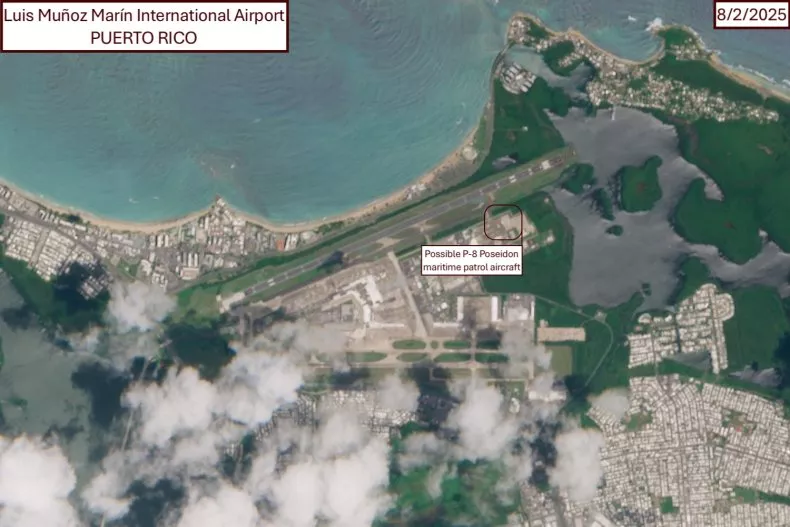
The answer is likely to be no. Experts are skeptical that an ongoing U.S. military buildup in the southern Caribbean and nearby waters is the first steps to an invasion. But the deployment of—among others—three destroyers, at least one submarine and an amphibious ready group (ARG) filled with Marines is a further deterioration in the poor relationship between Washington and Caracas that appears to have spooked Maduro.
‘Republic In Arms’
U.S. officials said last month that Washington was deploying three destroyers armed with advanced missiles and thousands of personnel to the waters off Venezuela as part of a drive to combat Latin American drug cartels and gangs.
Maduro on Monday said eight vessels—plus a nuclear submarine—armed with 1,200 missiles deploying to the region were a “historic threat” to Latin America, calling the deployment “extravagant, unjustifiable, immoral and absolutely criminal.” The U.S. warships and the nuclear-powered fast-attack submarine were expected to arrive this week, Reuters reported on Thursday, citing an anonymous U.S. official. Newsweek has reached out to the Pentagon for comment via email.
The Venezuelan leader said he would declare a “republic in arms” if the U.S. military attacked. Maduro has already vowed to place 4.5 million “militiamen” in defense of Venezuela.
Washington and Caracas do not have formal diplomatic relations, the ties between the U.S. and Venezuela are strained and there’s no appearance of a personal rapport between U.S. President Donald Trump and Maduro.
U.S. Attorney General Pam Bondi said last month that U.S. authorities were doubling the reward for information leading to Maduro’s arrest to $50 million, accusing the Venezuelan leader of collaborating with organized crime, like the country’s Tren de Aragua gang. Maduro has for years faced U.S. drug trafficking charges and batted away U.S. accusations of narco-terrorism.
Trump has long criticized Maduro and said during his first administration he would not rule out military action against his rule in Caracas.
Speaking to reporters in the White House on Tuesday, the Republican said the U.S. had struck a “drug-carrying boat” earlier in the day. In a follow-up post to his Truth Social platform, he said U.S. Southern Command forces “conducted a kinetic strike” on what he described as “Narcoterrorists” working for Tren de Aragua in international waters.
Trump said the strike killed 11 people, and that no U.S. personnel were injured. Sharing footage that he said showed the operation, the president said Tren de Aragua was “operating under the control of Nicolas Maduro, responsible for mass murder, drug trafficking, sex trafficking, and acts of violence and terror across the United States and Western Hemisphere.”
“Please let this serve as notice to anybody even thinking about bringing drugs into the United States of America. BEWARE! Thank you for your attention to this matter!!!!!!!!!!!” he added.
Will U.S. Invade Venezuela?
It seems unlikely, and the U.S. has not signaled any resolve to invade.
“No one in their right mind thinks that with 4,500 people you can invade a country that’s got mountains, jungle and multiple urban centers,” Christopher Sabatini, a senior research fellow for Latin America at the British think tank, Chatham House, told the Guardian newspaper. “This is all performance on both sides.”
James Story, who served as U.S. ambassador to Venezuela from 2018 to 2023, told the newspaper that the military presence was likely “a show of force” rather than a “utilization of force.”
“Intent is always difficult to read,” William Freer, a research fellow in national security at the U.K.-based Council on Geostrategy, told Newsweek. “The Trump administration has shown clear signs of frustration with Venezuela’s role in the flow of drugs to the U.S. but has shown no signs so far of clear intent for direct military action.”
Where the U.S. has recently intervened militarily—in Syria, Yemen and Iran—involvement has come after threats or attacks on U.S. forces and allies, added Carlos Solar, a senior research fellow for Latin American security at the Royal United Services Institute think tank.
“In strict terms, Venezuela has neither carried out such actions nor developed threats serious enough to justify American military intervention, such as the Houthi-led attacks or Tehran’s nuclear program,” Solar told Newsweek. “That said, political leaders ultimately determine what constitutes a sufficiently dangerous threat to warrant military action.”
Freer added: “More likely this is an attempt to put pressure on Maduro to take firmer action against cartels operating from Venezuela.”
What Would U.S. Intervention Look Like?
Imaginings typically render U.S. Marines landing in Venezuela, Solar said, but “even if such an operation were to occur, it would only take place at a much later stage.”
The U.S. would likely launch a wave of initial strikes using its long-range Tomahawk cruise missiles, taking out as many of Venezuela’s defenses and assets that Caracas could use against U.S. forces as possible, Solar said. U.S. soldiers would also home in on Venezuela’s logistics, ammunition storage sites, radars, telecommunication sites and areas for launching drones, he said.
“The U.S. has carried out similar operations this year in the Middle East with notable precision and effectiveness, often against actors better equipped than Venezuela’s Bolivarian Armed Forces,” Solar said. “This approach minimizes U.S. material and personnel losses while severely degrading the adversary’s military capabilities.”
Venezuela would struggle to hit back with its small, dubiously effective aircraft fleet, “under-serviced frigates” and an “aging submarine,” Solar said. The U.S. would likely come out as the victor in a second wave of torpedoes, guided munitions and surface-to-air missiles the deployed force boasts, Solar said.
Venezuela’s top brass pledged allegiance to Maduro, but there is likely to be burgeoning concern in the military ranks about the impact of Western sanctions and embargos, weapons pipelines and maintenance issues, Solar said.
The chatter around Venezuela has evoked for some memories of when then-President George H.W. Bush authorized U.S. troops to invade Panama in an operation framed as a mission to bring Panama’s leader, Manuel Noriega, “to justice” in 1989.
The Panamanian dictator was indicted in the U.S. for drug trafficking and was accused of rigging elections. But more than 20,000 soldiers descended on Panama—far outnumbering the 4,500 thought to be in or on the way to the region.
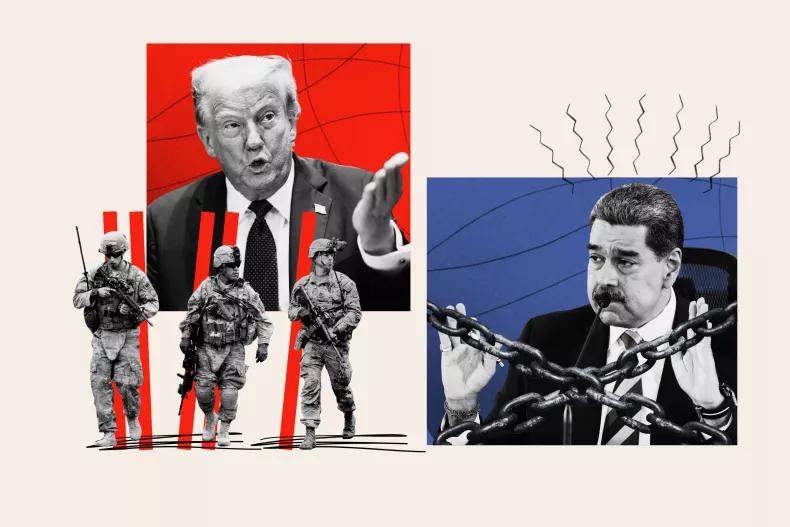
The Trump-Maduro relationship is “transactional,” Solar said. The U.S. in July said it had successfully completed a prisoner swap with Venezuela, and The Wall Street Journal reported that oil giant Chevron had regained its ability to pump oil in Venezuela from Trump officials. The administration had suspended Chevron’s ability to operate in Venezuela in February, a major blow to Maduro’s government.
“Maduro hoped that this cooperation would mark the beginning of continued engagement, but it is increasingly clear that Trump remains unmoved,” Solar said.
Several Latin American nations condemned the U.S. plans to bolster its presence. The Cuban Foreign Ministry said on Thursday that the U.S. presence was a “dangerous action” and an “aggressive show of force against the sovereignty and self-determination of the peoples of Latin America and the Caribbean.”
Cuba said that U.S. “claims associating the legitimate government of Venezuela and its President Nicolas Maduro with criminal organizations involved in illegal drug trafficking is an absurd pretext that is unfounded.” The U.S., along with many European and Latin American countries, does not recognize Maduro as the legitimate winner of the country’s July 2024 election. Newsweek