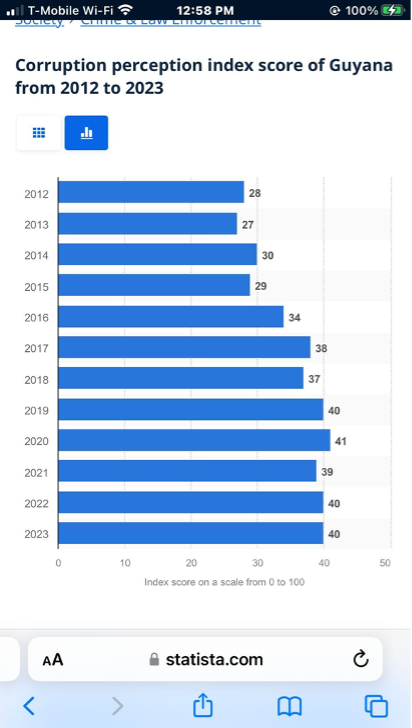
Empirical Rating Evidence herein for GUYANA, under the PPPC in 2020 at 41; 2021 at 39; 2022 at 40 and 2023 at 40.
https://worldpopulationreview.com/country-rankings/corruption-perceptions-index-by-country
Berlin, 30 January 2024 – The 2023 Corruption Perceptions Index (CPI) released today by Transparency International reveals that the judiciary in the Americas is failing to fulfil its crucial role as a check on other branches of government.
The lack of JUDICIAL INDEPENDENCE undermines the RULE of LAW, promotes CORRUPTION, and leads to IMPUNITY for the CORRUPT and POWERFUL. With the region’s average score holding at 43 and two-thirds of countries ranking below 50, addressing this issue is IMPERATIVE for the effective FIGHT AGAINST CORRUPTION.
AMERICAS HIGHLIGHTS
The CPI ranks 180 countries and territories by their perceived levels of public sector corruption on a scale of zero (highly corrupt) to 100 (very clean).
- Canada (76) and Uruguay (73) are at the top of the regional ranking with more robust checks and balances.
- Venezuela (13), Haiti (17) and Nicaragua (17) have the lowest scores in the region, with widespread impunity and lack of independence of the judiciary.
- Only two countries, Guyana (40) and Dominican Republic (35), have improved their CPI scores over the past decade, while the others have either stagnated or significantly declined.
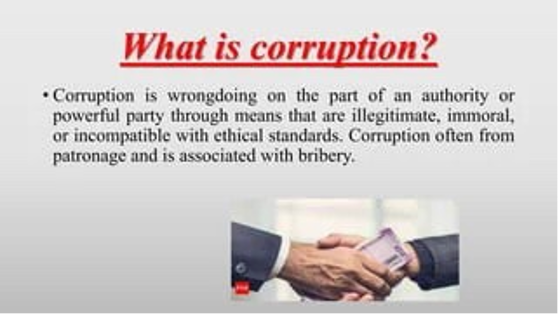
GLOBALLY. A contract may be VOIDABLE for qualified LEGAL reasons. These can include a failure to disclose a MATERIAL FACT by one party or the other; a misrepresentation or MISTAKE in the contract; fraud; TERMS THAT ARE UNCONSCIONABLE; or a breach of contract.
In Guyana, economic hardship, institutional weaknesses, criminal justice inefficiencies, as well as racial fractures in society provide fertile grounds for corruption.
Corruption in GUYANA can be attributed to several factors.
- Economic Hardship: Guyana has faced economic challenges, which can create an environment conducive to corruption. When people struggle to meet their basic needs, they may resort to corrupt practices to survive or gain an advantage.
- Institutional Weaknesses: Weak institutions, including inadequate regulatory frameworks and enforcement mechanisms, contribute to corruption. When institutions lack transparency, accountability, and efficiency, corrupt practices can thrive.
- Criminal Justice Inefficiencies: A justice system that fails to effectively investigate and prosecute corruption cases allows wrongdoers to act with impunity. When perpetrators face little consequence, corruption becomes more prevalent.
- Racial Fractures in Society: Guyana has a diverse population with various ethnic and racial backgrounds. Historical tensions and divisions can exacerbate corruption, as different groups may vie for power and resources.
- Natural Resource Sectors: The exploitation of natural resources (such as oil and minerals) can be particularly susceptible to corruption. The management of revenue from these sectors requires robust governance and transparency to prevent misuse.
In recent years, Guyana’s corruption ranking has fluctuated. While efforts have been made to address corruption, continued vigilance and systemic reforms are essential to combat this pervasive issue. Remember that addressing corruption involves multifaceted approaches, including legal reforms, public awareness, and strengthening institutions.
HOW TO STOP CORRUPTION: 5 KEYS
There is no silver bullet for fighting corruption. Many countries have made significant progress in curbing corruption; however, practitioners are always on the lookout for solutions and evidence of impact. Here are five ways that citizens and governments can make progress in the fight against corruption:
1. End impunity
Effective law enforcement is essential to ensure the corrupt are punished and break the cycle of impunity, or freedom from punishment or loss.
Successful enforcement approaches are supported by a strong legal framework, law enforcement branches and an independent and effective court system. Civil society can support the process with initiatives such as Transparency International’s Unmask the Corrupt campaign.
2. Reform public administration and finance management
Reforms focusing on improving financial management and strengthening the role of auditing agencies have in many countries achieved greater impact than public sector reforms on curbing corruption.
One such reform is the disclosure of budget information, which prevents waste and misappropriation of resources. For example, Transparency International Sri Lanka promotes transparent and participatory budgeting by training local communities to comment on the proposed budgets of their local government.
3. Promote transparency and access to information
Countries successful at curbing corruption have a long tradition of government openness, freedom of the press, transparency, and access to information. Access to information increases the responsiveness of government bodies, while simultaneously having a positive effect on the levels of public participation in a country.
Transparency International Maldives successfully advocated for the adoption of one of the world’s strongest rights to information law by putting pressure on local MPs via a campaign of SMS text messages.
4. Empower citizens
Strengthening citizens demand for anti-corruption and empowering them to hold government accountable is a sustainable approach that helps to build mutual trust between citizens and government. For example, community monitoring initiatives have in some cases contributed to the detection of corruption, reduced leakages of funds, and improved the quantity and quality of public services.
To monitor local elections, Transparency International Slovenia produced an interactive map that the public populated with pictures and reports of potential irregularities in the election. As a result, cases of public funds being misused to support certain candidates were spotted.
5. Close international loopholes
Without access to the international financial system, corrupt public officials throughout the world would not be able to launder and hide the proceeds of looted state assets. Major financial centers urgently need to put in place ways to stop their banks and cooperating with offshore financial centers from absorbing illicit flows of money.
The European Union recently approved the 4th Anti-Money Laundering Directive, which requires EU member-states to create registers of the beneficial owners of companies established within their borders. However, the directive does not require these registers to be made public. Similarly, the Norwegian, UK, and Ukrainian governments have all approved legislation requiring companies to disclose information about their owners, although these have yet to come into force.
How to stop corruption: 5 key ingredients – News – Transparency.org
What can be done in Guyana to minimize, reduce and wipe out Corruption and improve Guyana’s Global Rating on the Corruption INDEX with 180 Countries?
7 Suggestions to REDUCE Corruption are:
- RESTART SARA with Experienced Staff from Guyana, DIASPORA, Caricom, and Globally, including Certified FRAUD Examiners (CFE)
- Appointment of the TOP 2 Judges without further delay.
- Strengthen GRA with experienced staff from Guyana, Diaspora and Globally, at competitive salaries and conditions of employment to attract and retain staff, for improved TAX COMPLIANCES, with CFE’s.
- Employ Subject Matter Experts as Projects’ ENGINEERING Managers to be FULLY responsible for PROJECTS MANAGEMENT for the construction of Buildings, Roads, and Public Infrastructures.
- Strengthen the Guyana Police Force Department responsible for investigations, fraud, and corruption with experienced staff from Guyana, Diaspora and Globally, at competitive salaries and conditions of employment.
- Recruit 1 of REPUTABLE CONSULTING COMPANY, Ernst & Young, Deloitte & Touche, Arthur Andersen, KPMG, or Price Waterhouse Coopers, for a COMPENSATION REVIEW and RECOMMENDATIONS for the PUBLIC SECTOR, including State Agencies and Corporations, to ATTRACT and RETAIN Skilled Staff. Around 67,000 PUBLIC Employees.
- To include the Opposition, Private Sector, Trade Unions, Civil Society and Diaspora Persons, to serve on ALL Commissions and Boards.