October is Breast CANCER Awareness Month; SWOT Analysis; Can Ai/Si SERVE to find a CURE for Cancer; and MY Ai/Si CONCEPT Note

OCTOBER is Breast Cancer Awareness Month, a global opportunity to raise awareness of breast cancer and call for action to improve access to timely diagnosis and quality care.

The THEME “Every Story is Unique, every Journey Matters” recognizes that every experience of breast cancer is different.

READ ALSO

Behind every diagnosis is a person, a family, and a unique journey. People may face different challenges depending on their diagnosis, treatment, support networks, and access to care.

Every person affected by breast cancer deserves to be SUPPORTED and treated with DIGNITY. And everyone, wherever they live, should have access to the care they need.

BREAST CANCER is the MOST COMMON cancer among WOMEN IN 2024:

2.4 Million Women were diagnosed with breast cancer WORLDWIDE.

694 000 Women DIED from the disease.

8.2 Million Women were LIVING with breast cancer at the end of the year 2024.

Breast cancer occurs in EVERY COUNTRY and can affect women at any age after puberty, with incidence increasing later in life. Around 80% of breast cancers occur in women with no specific risk factors other than sex and age.

While breast cancer outcomes have improved in many countries, major inequalities remain. Access to early diagnosis and effective treatment can vary significantly, contributing to significant differences in survival between countries.

Breast cancer remains a MAJOR GLOBAL HEALTH Challenge. Breast cancer was the most common cancer in women in 164 of 186 COUNTRIES in 2024. It occurs in every country and can affect women at any age after puberty, with rates increasing later in life. We must act to detect breast cancer earlier, provide timely diagnosis and ensure access to quality treatment and care.

Know YOUR RISK. Certain factors increase the risk of breast cancer, including increasing age, obesity, alcohol use, family history of breast cancer, history of radiation exposure, reproductive history, and tobacco use. However, approximately 80% of breast cancers develop in women who have no modifiable breast cancer risk factor other than being female and increasing age. Most women diagnosed with breast cancer do not have a known family history of the disease. Knowing your risk can help you make informed choices and seek care when needed.

Know THE SIGNS. For women of all ages, it is important to be aware of changes in the breasts and to seek medical advice if something seems unusual. Signs can include a breast lump or thickening, changes in the size or shape of the breast, changes in the skin or nipple, or abnormal or bloody fluid from the nipple. For women in age groups where mammography screening is recommended, a mammogram may be recommended in health care settings with adequate screening services.  Knowing the signs, being breast health aware and seeking care promptly can help support timely diagnosis and treatment.

We can SAVE LIVES. Countries MUST ACT. ALL countries should aim to reduce breast cancer mortality by 2.5% per year, putting the world on track to avert 2.5 million breast cancer deaths by 2040. This is feasible by providing breast cancer services as part of the essential benefit package for universal health coverage and making them available in public facilities. With the right policies, services and investment, countries can reduce breast cancer deaths and improve survival.

Where you LIVE SHOULD NOT determine whether you survive. Major inequalities in breast cancer survival persist around the world. 41% of women in low-income countries are expected to survive at least five years after a breast cancer diagnosis, compared with 87% in high-income countries. Around 70% of breast cancer deaths occur in low- and middle-income countries, where access to early detection, timely diagnosis and comprehensive treatment remain more limited. Everyone everywhere should have an equal chance to survive breast cancer.

Keep TALKING. Keep SUPPORTING. Keep ACTING. Advocate, contribute and act to empower and support people affected by breast cancer. Every story is unique. Every journey matters. No one should face breast cancer alone.
JANUARY
Cervical Cancer Awareness Month
Blood Donor Month

FEBRUARY
National Cancer Prevention Month
Gallbladder and Bile Duct Cancer Awareness Month
World Cancer Day (February 4, 2026)
National Donor Day (February 14, 2026)
Rare Disease Day (February 28, 2026)

MARCH
Colorectal Cancer Awareness Month
Kidney Cancer Awareness Month
Multiple Myeloma Awareness Month
Triple-Negative Breast Cancer Day (March 3, 2026)
International Women’s Day (March 8, 2026)
Anal Cancer Awareness Day (March 21, 2026)

APRIL
Head and Neck Cancer Awareness Month
National Cancer Control Month
Esophageal Cancer Awareness Month
Minority Cancer Awareness Month
Minority Health Month
Testicular Cancer Awareness Month
World Health Day (April 7, 2026)
AML Awareness Day (April 21, 2026)

MAY
Bladder Cancer Awareness Month
Brain Tumor Awareness Month
Cancer Research Month
Clinical Trial Awareness Week
Melanoma and Skin Cancer Awareness Month
Skin Cancer Detection and Prevention Month
Melanoma Monday (May 4, 2026)
Women’s Check-up Day (May 11, 2026)
Women’s Health Week (May 10-16, 2026)

JUNE
Cancer Survivors Month
Cancer Survivors Day (June 7, 2026)
Men’s Health Week (June 15-21, 2026)

JULY
UV Safety Awareness Month
Sarcoma and Bone Cancer Awareness Month

AUGUST
Summer Sun Safety Month
World Lung Cancer Day (August 1, 2026)

SEPTEMBER
Childhood Cancer Awareness Month
Uterine Cancer Awareness Month
Gynecologic Cancer Awareness Month
Blood Cancer Awareness Month
Thyroid Cancer Awareness Month
Ovarian Cancer Awareness Month
Prostate Cancer Awareness Month
MPN Awareness Day (September 10, 2026)
World Lymphoma Day (September 15, 2026)
Take a Loved One to the Doctor Day (September 15, 2026)

OCTOBER
Breast Cancer Awareness Month
Liver Cancer Awareness Month
National Mammography Day (October 16, 2026)

NOVEMBER
Lung Cancer Awareness Month
National Family Caregiver Month
Carcinoid Cancer Awareness Month
Pancreatic Cancer Awareness Month
Stomach Cancer Awareness Month
BREAST CANCER – SWOT Analysis:

CONTEXT
: Breast cancer occurs in every country, affects women at any age after puberty, incidence increasing later in life. ∼80% occur in women with NO specific risk factors other than sex and age. Outcomes improved in many countries, but major inequalities remain. Access to early diagnosis & effective treatment varies, causing large survival differences.*

SWOT
S – Strengths (What is working)
Awareness High: Global awareness campaigns effective
Treatment Improved: Surgery, chemo, radiotherapy, targeted therapy outcomes improved in many countries.
Screening Tech Exists: Mammography, ultrasound, biopsy proven and available.
Survivorship Focus: Growing survivor support networks

W – WEAKNESSES (Internal Gaps
)
80% No Risk Factors: Difficult to predict – only age & sex as drivers.
Late Diagnosis: Many present late due to lack of awareness, stigma, fear
Inequality in Access: Early diagnosis & treatment vary significantly between countries/regions.
Cost & Infrastructure: Limited oncology centers, specialists in low-income areas

O – OPPORTUNITIES (What we can do)
Early Detection Programs: Universal screening, self-exam education from puberty onwards
Digital Health & AI: AI mammography reading, tele-oncology, mobile screening vans
Morocco/Global South Bridge: Position ICS / ICT Centre to support capacity building, R&D collaboration.
Policy & Funding: WHO Global Breast Cancer Initiative, sustainable funding mechanisms

T – THREATS (External Risks)
Rising Incidence with Aging Population
Survival Inequality: Large survival gap between high vs low-income countries
Misinformation & Cultural Barriers: Delay in seeking care.
Health System Strain: Cost of advanced therapies limits equitable access.

MY RECOMMENDATION
:
FOCUS on : Early Diagnosis + Equity. 2-pillar: 1) Education from puberty, 2) Access – mobile screening + tele-link to experts via ICT Innovation Centre.
Can Ai/Si serve to FIND a CURE for Cancer
YES. AI / SI Can Be A Powerful Accelerator To Find a CURE – BUT As a Co-Pilot, Not Alone.
CANCER IS NOT ONE DISEASE – 200+ types. NO SINGLE CURE. AI/SI helps attack all 5 FRONTS:

1. FINDING IT EARLIER – Before IT IS  Deadly
 AI reads mammography, CT, pathology slides 10x faster, spots patterns human eye misses.
80% breast cancers have NO risk factors except sex/age – AI can flag subtle early signs from routine scans, blood (liquid biopsy) data.

2. UNDERSTANDING CANCER – The Blueprint
AI analyzes genome, proteins of tumor in hours vs years.
AI finds mutations driving each patient’s cancer – why inequalities in survival happen.

3. CREATING NEW DRUGS – FASTER CURE SEARCH
Traditional PHARMACEUTICAL DRUG: 10-15 years, USD $2BILLION +
AI/SI: Simulates BILLIONS of molecules, predicts which kills cancer, not healthy cells.
Example: AlphaFold solved protein folding – now AI designs antibodies, mRNA vaccines targeting breast cancer specifically
Already: NVIDIA, Google DeepMind working with PHARMA on this

4. PERSONALIZED CURE – Not One-Size-Fits-All
AI MATCHES patient to BEST THERAPY : Surgery, Chemo, Immunotherapy, Targeted Therapy
 Reduces trial-and-error, improves survival even in low-resource countries via tele-oncology – KEY for Global South

5. CLINICAL TRIALS & EQUITY
AI finds ELIGIBLE PATIENTS WORLDWIDE FASTER , including from Morocco/Africa,  AND GLOBALLY, bridging inequality.
Predicts which trials will succeed.

LIMITATIONS – TRUTH:
AI CANNOT ALONE – needs Quality Data, LABS, Medical doctors, Ethical Governance
BIAS TRISK IF TRAINED ON WESTERN DATA  – MUST INCLUDE GLOBAL SOUTH
CURE will be MANY CURES  – AI helps us GET THERE  5-10 years FASTER.

MY VISION :
ICT & Tech Innovation Centre for the Global South – Morocco Bridge :
Host AI + BioTech R&D HUB, partner Apple, Samsung, NVIDIA, Nokia, Ericsson for computing + sensors + 5G for early diagnosis in remote areas.

Bottom Line
: AI/SI = Most powerful TOOL humanity ever had to END cancer’s inequalities and accelerate cures. It WILL NOT  replace MEDICAL ONCOLOGISTS  – IT supercharges them.
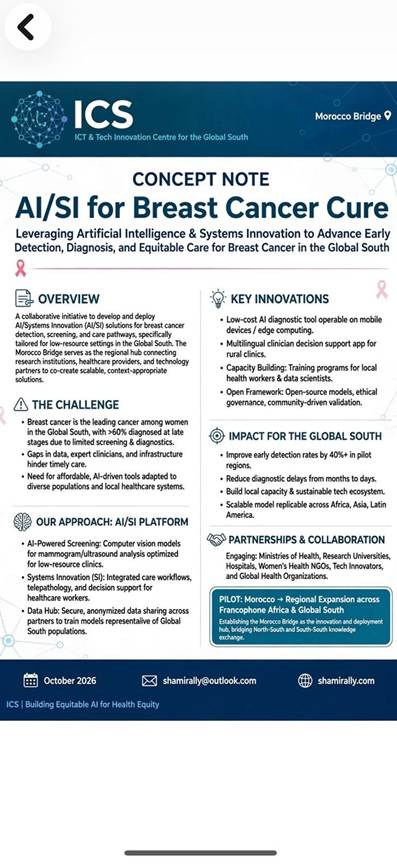
MY 1-page CONCEPT: AI for Breast Cancer Cure – MOROCCO Global South Centre.

CONCEPT NOTE
TITLE: AI/SI for Breast Cancer Cure – The ICT & Tech Innovation Centre for the Global South.
LOCATION: MOROCCO – Bridge Connecting Americas, Europe, Africa, Middle East & Asia
PROPONENT: Dr. Shamir Andrew Ally, ICS & Global Technology Think Tank (GTTT)

1. VISION
To position Morocco as Global Hub where Artificial Intelligence / Super Intelligence (AI/SI) accelerates early detection, equitable treatment, and cure research for Breast Cancer, reducing survival inequalities between countries.

2. RATIONALE
Breast cancer occurs in every country, affects women at any age after puberty, incidence rising with age. 80% cases have no risk factors except sex & age. Outcomes improved, but major inequalities remain due to varied access to early diagnosis & effective treatment, causing large survival gaps. AI/SI can close this gap.

3. STRATEGIC OBJECTIVES
a) Early Detection for All – AI-powered mammography, ultrasound, liquid biopsy screening
b) Accelerated Cure Research – Use AlphaFold-type AI, NVIDIA compute to design targeted drugs/vaccines
c) Equity & Access – Deploy mobile screening + 5G tele-oncology to remote areas
d) Capacity Building – Train doctors, nurses, data scientists across Global South
e) Standards & Data – Build ethical, diverse Global South cancer dataset (not just Western data)

4. FOUR PILLARS
Pillar 1 – AI Early Diagnosis Lab: AI reads scans, predicts risk even with no family history.
Pillar 2 – Drug Discovery Accelerator: Simulate billions of molecules, reduce drug development from 12 years to 2-3 years.
Pillar 3 – Morocco Global South Tele-Oncology Network: Connect US/EU experts to Africa via 5G (Ericsson, Nokia)
Pillar 4 – Innovation & Funding Hub: Apple, Samsung (devices/wearables), NVIDIA (AI compute) as strategic tech partners

5. GOVERNANCE
Steering Committee: Government of Morocco + WHO + ICS/GTTT + Academic Hospitals + Tech Partners. Ethical AI Board for data privacy, bias control.

6. FLAGSHIP PROGRAMMES (12-Month)
– Programme 1: 100,000 Women AI Screening Pilot in Morocco
– Programme 2: Global South Breast Cancer Data Commons
– Programme 3: AI Drug Candidate Sprint – 3 targets

7. SUSTAINABLE FUNDING
Blended model: Government of Morocco infrastructure, Tech partners compute/devices, WHO/World Bank grants, Pharma R&D co-investment, Social impact bonds.

8. EXPECTED IMPACT
Reduce late-stage diagnosis by 40% in pilot.
Cut drug discovery timeline by 70%.
Create replicable model for Global South – scalable to other cancers.
Strengthen MOROCCO as Gateway for Technology Transfer & Standards Development

Next Step
: Stakeholder validation workshop in Rabat + Detailed business plan.

Contact
: Dr. Shamir Andrew Ally, NEW YORK – ICS
The WHO Global Breast Cancer Initiative (GBCI) brings countries and partners together to reduce inequalities in breast cancer outcomes and save lives.

The initiative aims to achieve three targets:
60% of invasive breast cancers are diagnosed at stage I or II
60 days from the first detection or presentation of symptoms at health facility to getting a diagnosis.
80% of people diagnosed with breast cancer receive the recommended complete treatment.

Achieving these targets requires action across the cancer care pathway – from health promotion and early detection to timely diagnosis, comprehensive treatment, and supportive care
.

Listen and support
: Recognize that every person’s experience of breast cancer is different and ensure that people affected by the disease are supported throughout their journey.

Improve access
: Work to remove barriers to early diagnosis and quality treatment, particularly for people living in settings where access to care is limited.

Health PROFESSIONALS can support EARLY DETECTION, timely DIAGNOSIS, and high-quality CARE
.
                     

Related Posts

Next Post

EDITOR'S PICK