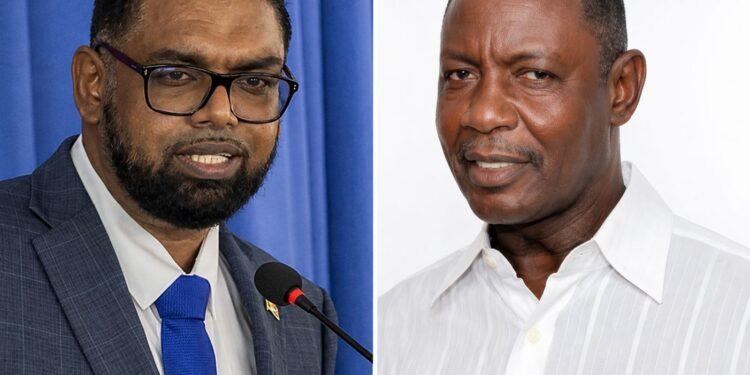
By Mark DaCosta- Nearly thirteen months after the arrests of Opposition Leader Azruddin Mohamed and his father, businessman Nazar Mohamed, the United States’ bid to have them stand trial in Florida has yet to reach a verdict. The extradition hearing was adjourned on Thursday, 26 November, to 17 December. Only two prosecution witnesses have testified so far, and the defence has not finished cross-examining the second. With a constitutional appeal still pending and a separate bail challenge due days later, our nation faces a protracted legal contest. It is one that will test the patience of the public as well as the courts.
Before Chief Magistrate Judy Latchman, the Georgetown proceedings have crawled along since the Mohameds were taken into custody on 31 October 2025. The committal hearing proper began on 6 January 2026. Senior Superintendent Prem Narine, head of the Guyana Police Force’s Special Branch, first entered the witness box on 3 September, almost three months ago, and the questioning has not yet ended. Washington wants both men to answer an eleven-count federal indictment from Florida, which alleges wire fraud, mail fraud, money laundering, conspiracy and customs violations. American prosecutors claim a gold export scheme deprived the authorities of more than US$50 million in taxes and royalties. Both men deny any wrongdoing and are fighting the request.
The tempo of the case has divided the two sides. Defence lawyers insist that thorough questioning is indispensable, both to probe the evidence and to support their claim that the extradition effort is politically motivated. The prosecution has complained of delay. The case has also been slowed by several legal challenges, including proceedings before the Caribbean Court of Justice. In September, the Chief Magistrate defended her court’s management, saying the complexity and public importance of the matter demanded care and that the court, not the parties, would set the pace.
Three separate proceedings are now in play, and they are often confused.
The first is the committal hearing, the one currently before the Chief Magistrate. It is not a trial. The court is not asked whether the Mohameds are guilty of the alleged offences. Its task is narrower: to decide whether the legal and treaty requirements for surrender have been met. If the magistrate decides in favour of the prosecution and commits the Mohameds, the case does not end there. They would still have avenues of challenge in the higher courts, and under the usual extradition framework the final decision would rest with the executive. If she declines to commit, the request would fail at this stage and the men would be discharged. Whatever the outcome, a Guyanese court would not be passing judgment on the substance of the American allegations. That would be left to a United States court.
The second is the constitutional appeal, which hangs over the entire process. The magistrate’s ruling on committal depends on how that appeal turns out. Its result could clear the way for a ruling, or complicate and delay one. This is why even a completed cross-examination would not bring the matter to a close.
The third is the bail dispute, which runs separately from the extradition question itself. On 21 December, four days after the committal hearing resumes, acting Chief Justice Navindra Singh will hear the Director of Public Prosecutions’ application to overturn the Chief Magistrate’s decision to keep Azruddin Mohamed’s bail at $150,000. If the DPP succeeds, his freedom pending the outcome could be curtailed or made subject to tougher conditions. If it fails, he remains on bail on the current terms. Bail concerns the terms on which a person is held while a case proceeds. It says nothing about whether he should be extradited.
There is a wider significance. Mohamed is no ordinary defendant, since he leads the parliamentary opposition. His lawyers’ argument that the process is politically driven therefore carries a weight that goes beyond the courtroom, and the prosecution will not want its case to appear to be at the mercy of political currents. The cost of the delay falls on both sides, since justice and public confidence in it suffer when a high-profile case drags on without resolution.
For ordinary Guyanese, the lesson is that extradition is a layered process in which no single hearing settles everything. The coming weeks, with 17 December and 21 December in close succession, may show whether the case is finally gathering pace or merely entering another long chapter.