by Randy Gopaul
The President’s address today was not a statement on national security, it was a declaration of war on dissent, dressed up in the language of counterterrorism. What we witnessed was a transparent attempt to criminalize criticism, silence opposition, and manufacture a crisis where none exists.
Let us be clear about what is actually happening here. The President speaks of “incendiary statements” and “organized criminal conspiracy” with the solemnity of a man addressing a genuine terrorist threat. But no one, not the man on the street, not the independent observer, not even the government’s own evidence, believes that a Molotov cocktail thrown at an empty transformer constitutes terrorism. In fact, most people believe the incident to be contrived. It is reported that two individuals, captured on CCTV, threw improvised devices at a facility. No damage was reported. No one was hurt. This is a criminal act, and if it did happen, it should be prosecuted as one. But to elevate this to a national security crisis, to invoke “terrorism-related offenses,” to speak of “intellectual authors” and “centrally coordinated conspiracies”, this is not law enforcement. This is political theater of the most dangerous kind.
The President’s selective memory is breathtaking. This is the same Irfaan Ali who, while in opposition, led aggressive protests against the government of the day. This is the same party whose supporters looted and burned vehicles. This is the same political movement whose supporters shouted down President David Granger, drowning out the democratically elected head of state with jeers and intimidation. Where was the “incendiary statements” legislation then? Where was the “terrorism-related provisions” when PPP supporters were disrupting public order? Where was the urgent national address when the targets were on the other side of the political divide?
The double standard is not subtle. It is the entire point. The President speaks of “constitutional freedom” and “lawful and peaceful things” as if these are concessions he is graciously permitting, rather than rights the Constitution guarantees. He warns that these rights “do not extend to violence, intimidation, destruction of property, or criminal incitement”, a statement so banal it would be unremarkable were it not for the clear implication: we will decide what counts as incitement, and we will decide who counts as a criminal.*
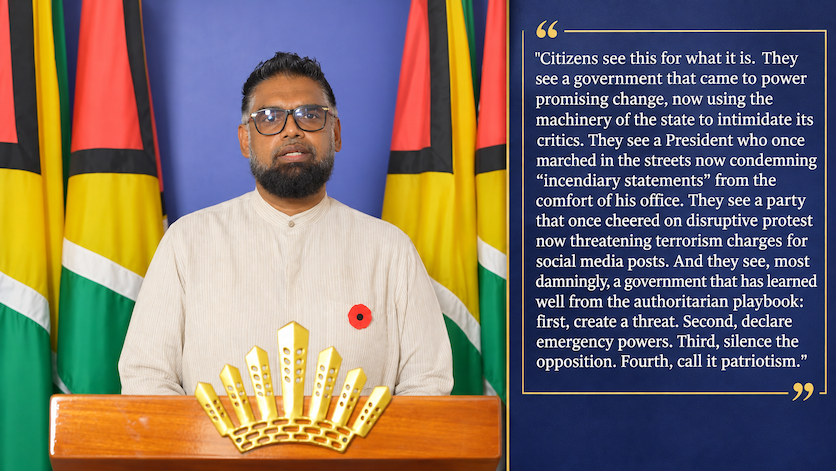
Citizens see this for what it is. They see a government that came to power promising change, now using the machinery of the state to intimidate its critics. They see a President who once marched in the streets now condemning “incendiary statements” from the comfort of his office. They see a party that once cheered on disruptive protest now threatening terrorism charges for social media posts. And they see, most damningly, a government that has learned well from the authoritarian playbook: first, create a threat. Second, declare emergency powers. Third, silence the opposition. Fourth, call it patriotism.
This is not national security. This is a slide into autocracy. The President’s assurance that “Guyana will not be allowed to become a haven for organized criminal networks” is rich coming from a government that has done nothing to address the real criminal networks that plague our communities, the drug traffickers, the human traffickers, the corrupt officials who line their pockets while citizens struggle. Instead, the government has chosen to invent a threat from the very people it was elected to serve.
We call on all Guyanese to reject this dangerous overreach. The right to dissent is not a privilege granted by the President. The right to criticize the government is not a “terrorism-related offense.” The right to assemble, to speak, to protest, these are the birthright of every Guyanese, and no amount of self-righteous rhetoric from the Office of the President will change that.
President Ali has shown his true colors tonight. He is not interested in protecting citizens. He is interested in protecting power. And he will use every tool at his disposal, including the language of terrorism, the threat of prosecution, and the weight of the state to do it.
We see you. We hear you. And we will not be silenced.
Guyana belongs to all of us, not to one man or two men, not to one party, and not to a government that has forgotten who it was elected to serve.*