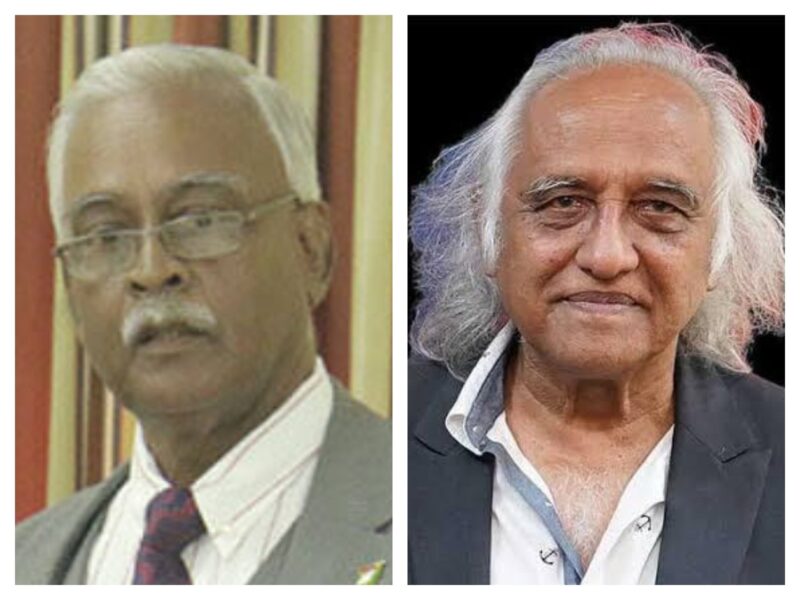
Attorney-at-Law Christopher Ram has taken Guyana’s access-to-information dispute to 13 diplomatic, regional and international organisations, accusing the Ali administration of failing to defend citizens’ right to know while Commissioner of Information Charles Ramson Sr. appeals a High Court ruling requiring him to act on outstanding information requests.
In a press release dated October 24, Ram said he had written to the heads of mission of the European Union, United States, China, United Kingdom, Canada and India, as well as CARICOM, the Inter-American Commission on Human Rights, the United Nations Human Rights Committee, the International Monetary Fund (IMF), the Extractive Industries Transparency Initiative, Transparency International and the World Justice Project.
Ram said he had asked the organisations to intervene within their respective mandates, including urging the Government to address the dispute, seeking accountability for possible violations of the right to information, and examining how the Government records and pays taxes on behalf of oil companies.
He has also asked the World Justice Project to conduct a fresh household survey in Guyana, citing its 2026 Rule of Law Index, which ranks the country 81st out of 143 countries and 50th out of 51 high-income countries.
Ram argued that updated household data would make it more difficult for the Government to dismiss concerns about the rule of law on the grounds that existing assessments rely on outdated information.
The international appeal follows a September 28 ruling by Justice Nicola Pierre, who held that the Commissioner of Information is a public authority under the Access to Information Act 2011.
According to Ram, the judge found that the Commissioner’s failure to determine his requests within the statutory 60-day period amounted to a refusal. The court also rejected the position that applicants must first approach other agencies holding the information before the Commissioner is required to act.
Justice Pierre ordered Ramson to decide the requests by November 27.
However, Ram said Ramson filed an appeal on October 16, arguing that he is not a public authority under the Act and that the judge effectively rewrote the legislation. The Commissioner also maintains that applicants must initially seek information directly from the relevant public agency.
Ram warned that if the appeal succeeds, the office established to give practical effect to citizens’ right to information could be left without enforceable duties to those seeking disclosure.
He further cautioned that continued litigation, potentially extending to the Caribbean Court of Justice (CCJ), could leave the legislation’s practical enforcement in limbo for a year or longer.
The appellate court will ultimately determine the proper interpretation of the law.
Ram also highlighted the case of environmental activist Danuta Radzik, whose requests for environmental permits and hazardous-waste records relating to the Gas-to-Energy project allegedly remained unanswered for a year.
He said Radzik has since approached the court and sought an order requiring Ramson to pay legal costs personally.
The Gas-to-Energy project, a major government initiative intended to transport offshore natural gas to the coast for electricity generation, has attracted scrutiny over public expenditure, environmental safeguards and transparency.
The dispute over access to its environmental records raises broader questions about the ability of citizens and environmental advocates to examine the potential consequences of major public projects when requests for official information remain unresolved.
Ram also questioned the Government’s compliance with its own legislative responsibilities.
He noted that the Access to Information Act places key obligations on the minister responsible for information, a portfolio President Irfaan Ali retained in October 2025.
According to Ram, the minister is required to lay an annual report on the operation of the Act before the National Assembly. He said that, to his knowledge, no such report has been tabled since the legislation came into force.
He also questioned whether the required statements identifying documents held by public authorities had been published by the Commissioner with the minister’s approval.
Ram further recalled that the Inter-American Commission on Human Rights held a hearing on the issue in November 2025, which he said the Government did not attend.
He has now placed Attorney General Anil Nandlall on notice, arguing that the administration should intervene if it is genuinely committed to transparency and accountability.
“The Commissioner defies the courts, the President looks away, and the Government says nothing,” Ram said.
He maintained that taking the dispute overseas was not a step he took lightly, but said he had done so because he believed domestic avenues had failed to secure meaningful action.
The case now has implications beyond Ram’s individual requests. Its outcome could help determine how effectively citizens, journalists and civil society organisations can use Guyana’s access-to-information legislation to scrutinise government decisions, public spending and projects involving the country’s oil wealth.