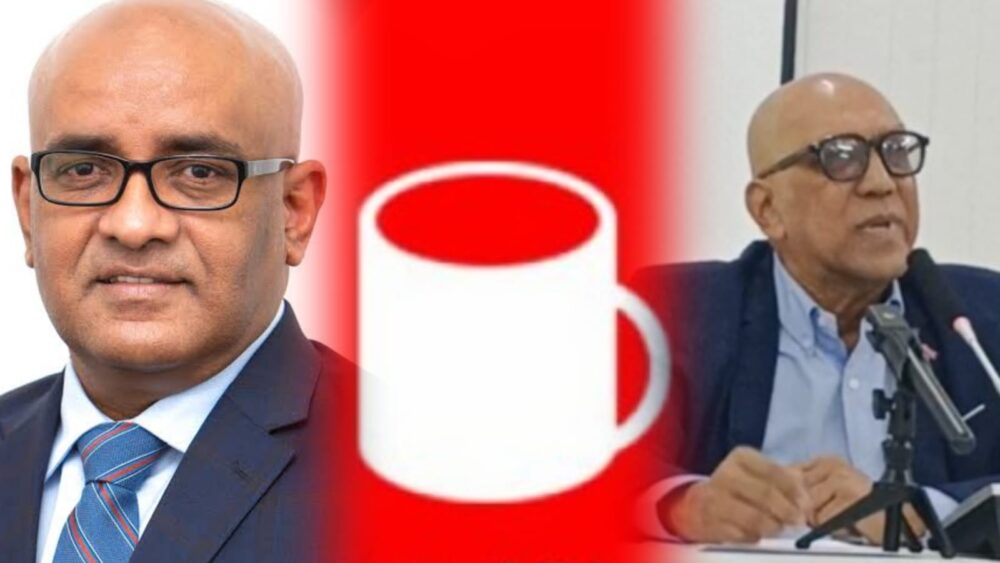
Vice President Bharrat Jagdeo’s sudden appeal for political cooperation between the People’s Progressive Party (PPP) and the People’s National Congress (PNC) has triggered pointed questions about whether his call for national unity is driven by genuine reconciliation or anxiety over the ruling party’s political future.
In three consecutive commentaries published by Village Voice News between October 16 and 18, political commentator GHK Lall scrutinised Jagdeo’s remarks at an October 14 evening of reflection honouring former PNC leader Robert Corbin, questioning why a politician long associated with fierce partisan confrontation is now advocating cooperation with his historical rival.
Lall’s central argument is that Jagdeo’s intervention cannot be divorced from Guyana’s changing political landscape, particularly the emergence of Azruddin Mohamed’s We Invest in Nationhood (WIN) as a formidable political force.
At the gathering, Jagdeo declared that the two traditionally dominant political parties would eventually have to find common ground.
“We believe that the future of Guyana would involve at some level and some fashion, whatever that framework may be, these parties working together. They have to, of necessity.”
The vice-president also warned that both parties risked political extinction if they failed to adapt to changing public expectations.
For Lall, the remarks represented a striking departure from the political hostility that has characterised relations between the two parties for decades.
In his October 16 commentary, Bharrat Jagdeo at Robert Corbin’s Gathering, Lall acknowledged the appeal of political inclusion but questioned the timing of Jagdeo’s conversion to the idea.
He wrote:
“When Bharrat Jagdeo finally comes around to this what he called enlightened place, it was worth the wait.”
Lall argued that Corbin and Jagdeo had previously demonstrated that engagement across political divisions was possible, raising questions about why the principles of cooperation had not translated into more substantive political change.
WIN’s emergence changes the political equation
In his October 17 article, Jagdeo’s Corbin Funeral Symphony – Pt II, Lall sharpened his criticism, suggesting that Jagdeo’s concern about the possible extinction of both parties might reflect apprehension about the ruling party’s own vulnerability.
He questioned why the PPP, having secured a parliamentary majority in the September 2025 general elections, would publicly raise the prospect of its political demise.
Lall pointed to the emergence of WIN as a potential factor in Jagdeo’s calculations, arguing that the new political force could disrupt the established parties’ traditional electoral dominance.
His argument is that an appeal for cooperation between the PPP and PNC could also serve a strategic purpose: countering a new competitor capable of attracting voters dissatisfied with the established political order.
In his October 18 follow-up, Lall: Jagdeo at Corbin’s Salute -Pt III, he challenged the vice-president to explain who would ultimately benefit from the proposed rapprochement.
“The Guyanese people? Or the PPP?”
Lall also questioned whether Jagdeo’s appeal was consistent with President Irfaan Ali’s One Guyana initiative, arguing that calls for national cohesion must translate into meaningful political inclusion rather than remain rhetorical commitments.
Corbin’s legacy raises questions of accountability
The debate carries particular significance because Corbin, who died on October 4, was involved in efforts to reduce political tensions and advance democratic reform during Jagdeo’s presidency.
In April 2003, the two leaders signed a constructive engagement agreement, followed by a communiqué in May, addressing parliamentary reform, constitutional changes, accountability and equitable development.
Those commitments provide important historical context for Jagdeo’s latest appeal. They also raise questions about why previous efforts at political cooperation struggled to produce lasting institutional change.
Former government minister Dr Henry Jeffrey revisited that record in his October 2026 Future Notes commentaries, questioning the implementation of the agreements and the persistence of winner-take-all politics. His analysis underscores the distinction between negotiating political commitments and delivering meaningful reform.
Jagdeo’s remarks have not resulted in any publicly announced formal partnership between the PPP and PNC.
Ultimately, Lall’s three-part critique places the vice-president’s intervention under scrutiny: is this a genuine effort to overcome Guyana’s longstanding political divisions, or a strategic response to a changing electoral landscape?
The answer will depend not on the language of unity delivered at a memorial gathering, but on whether the political leadership translates its declarations into concrete measures that broaden participation, strengthen accountability and build public trust.