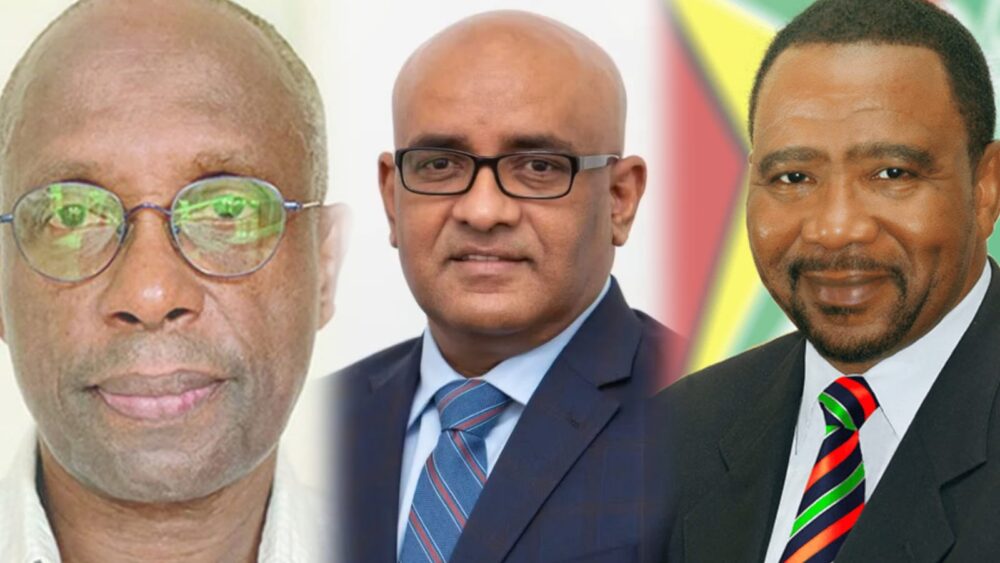
More than two decades after then Leader of the Opposition Robert Corbin and then President Bharrat Jagdeo signed an agreement aimed at easing Guyana’s political crisis and advancing democratic reform, the commitments remain a reminder of the country’s unresolved struggle over political inclusion and the exercise of power.
In two October articles in his Future Notes column, former People’s Progressive Party/Civic (PPP/C) government minister Dr Henry Jeffrey revisits Corbin’s 2003 initiative, arguing that the failure to implement key agreements exposed the limits of political dialogue without sustained commitment from those in power.
Jeffrey’s reflections follow Corbin’s death on October 4, 2026, and examine the former Opposition Leader and People’s National Congress Reform (PNCR) leader’s efforts to end the political impasse that had contributed to the party’s boycott of Parliament.
The negotiations culminated in a constructive engagement agreement on April 16, 2003, followed by a communiqué signed by Jagdeo and Corbin on May 6. The agreement covered parliamentary reform, constitutional changes, public accountability, equitable development and measures intended to improve relations in Guyana’s ethnically divided society.
But Jeffrey’s account suggests that the agreement’s central weakness was not a lack of proposals, but the failure to translate commitments into timely action.
Corbin blamed bad governance
In an address to the nation on August 17, 2003, Corbin described a country grappling with rising living costs, unemployment, business closures, poverty and deteriorating conditions in marginalised communities. He also highlighted a worsening security situation involving violent crime, killings, kidnappings and robberies.
Corbin rejected the argument that the political impasse itself was responsible for the economic crisis, instead blaming government policy.
“My Party and I contended then, as we do now, that the economic crisis was not a result of the political impasse, but a direct result of ill thought out, lopsided, incoherent and discriminatory policies. In short, bad governance…”
The agreement sought to address these concerns through stronger parliamentary oversight, constitutional reform and institutions designed to promote accountability and protect citizens’ rights. These included the Ethnic Relations Commission, Public Procurement Commission, Human Rights Commission, Women and Gender Equality Commission, Indigenous Peoples’ Commission and Rights of the Child Commission.
It also called for transparent criteria governing the distribution of land and house lots, investigations into discrimination complaints, reforms to strengthen local government autonomy and more equitable access to state-owned media.
For depressed communities, the agreement called for the release of $608 million for identified Phase II projects and a comprehensive development programme. Region Ten was specifically earmarked for measures to create employment, improve public utilities and encourage investment.
The commitments represented a broad agenda for reform. Yet, according to Jeffrey, implementation soon became a source of contention.
Jeffrey says delays undermined agreement
Jeffrey, who was education minister at the time, said he helped facilitate the negotiations after challenging then presidential secretariat head Dr Roger Luncheon to give him two weeks to bring the PNCR back into Parliament.
He said the negotiations themselves were conducted by Jagdeo and Luncheon for the PPP/C, and Corbin and Lance Carberry for the PNCR.
The talks concluded in the early hours of May 6, 2003. By August, however, Corbin was publicly questioning the pace of implementation.
“Regrettably, the time and energy spent to obtain the results achieved so far suggest that deliberate efforts are being made to retard implementation.”
Jeffrey said he agreed with Corbin’s assessment, maintaining that delays affected almost every one of the approximately two dozen agreements in the communiqué.
He also recalled that, after the negotiations ended, influential PPP members reportedly accused their party’s negotiators of exceeding their mandate. Jeffrey said this raised concerns about whether the government had adequately monitored the process and was genuinely committed to implementing its outcome.
His account points to a fundamental problem: an agreement between political leaders cannot guarantee reform if the wider political leadership does not support the commitments made.
‘Winner-take-all’ politics remains central
Jeffrey also cited former United States president Jimmy Carter, who expressed doubts in 2004 about the Jagdeo administration’s willingness to pursue substantive dialogue and share political authority.
“Jagdeo is an intelligent and capable leader, but he takes full advantage of the ancient ‘winner take all’ system in Guyana.”
Carter’s assessment, reproduced in Jeffrey’s column, questioned whether the government would undertake meaningful institutional reform or allow parliamentary representatives to be elected directly by their constituencies rather than through party lists under the proportional representation system.
Jeffrey broadened the discussion to Guyana’s ethnic and political divisions, drawing on economist Sir Arthur Lewis’s argument that deeply divided societies require substantial ethnic groups to participate in decision-making.
He also criticised the PNCR, arguing that Corbin and the A Partnership for National Unity and Alliance for Change (APNU+AFC) coalition government, which won the 2015 general elections, failed to adequately address Guyana’s ethnic realities. The coalition was led by David Granger, then leader of the PNCR and chairman of APNU, who became President, while Moses Nagamootoo of the Alliance for Change served as Prime Minister.
The result, in Jeffrey’s analysis, is a political system in which commitments to inclusion have repeatedly struggled to become lasting institutional arrangements.
Corbin’s 2003 initiative laid out proposals for a more accountable and inclusive system of government. Jeffrey’s retrospective raises the question of why those commitments proved so difficult to fulfil—and whether Guyana’s political leaders are prepared to move beyond negotiated promises towards reforms that give meaningful effect to shared governance.