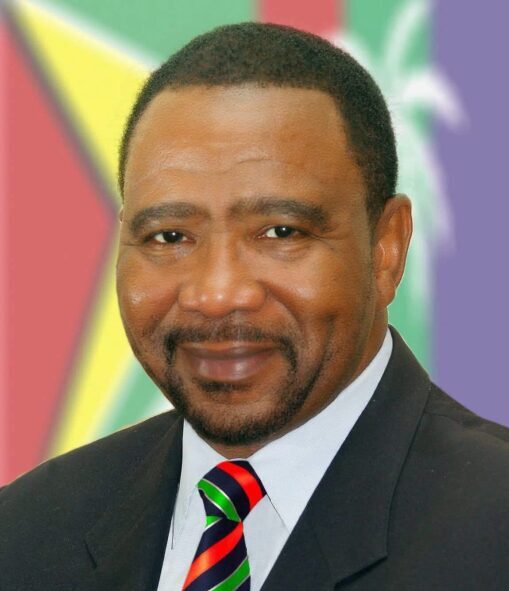
By Lurlene Nestor- A.R. Bernard observes that “Humility is not weakness, but rather strength under control.” I believe this quote exemplifies Robert Herman Orlando Corbin’s character. In his reflective poem “The Road Not Taken,” renowned American poet Robert Frost presents a traveller confronted with two paths, ultimately choosing the one less travelled. I have often thought that Frost’s traveller was Robert Corbin, whose approach to political leadership differed from that of many politicians of his time and place.
Robert Corbin was the architect of modern-day coalition politics in Guyana, a fierce proponent of party unity, an advocate for young people, a dedicated public servant, a patriotic son of the soil and a steadfast protector of the People’s National Congress Reform (PNCR). As I reflect on his life, I recognise these as just some of the landmarks along the road he chose to travel — “The Road Not Taken.”
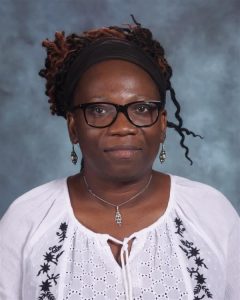
Although I knew of Robert Corbin, I met him for the first time in 1999, a year before he was elected Chairman of the PNCR at the party’s congress in 2000. At the Guyana Young Socialist Movement (GYSM) congress that year, I was appointed National Secretary of the party’s youth arm.
I believe our true camaraderie began during that period. A few days after the congress, Mr. Corbin contacted me and asked that we meet at Congress Place the following day. I agreed.
During that meeting, he asked about my involvement in the GYSM, my plans for the organisation, my views on youth issues and several other matters. I sensed that he was trying to understand my outlook and aspirations. He assured me that he would always be available to support the GYSM and reminded me that his own political activism had begun in the party’s youth arm.
Mr. Corbin took great pleasure in sharing insights and fascinating anecdotes about the history of the Young Socialist Movement. He recounted his interactions with the party’s founder and leader, discussed national issues and reflected on the political lessons he had learned. Sometimes, his stories sent him into fits of laughter. Through those conversations, I recognised a man who genuinely believed in young people and their potential.
That impression was reinforced throughout my time leading the GYSM. Mr. Corbin consistently opened doors for young comrades, sometimes personally seeking employment opportunities for them. He would ask me about a member’s qualifications, skills and talents, then use his connections to help secure employment, occasionally enlisting his wife, Mrs. Corbin, in those efforts. His office was accessible to GYSM members, who knew they could approach him for guidance and assistance.
My friend Paul Cort and I were recently reflecting on Mr. Corbin’s humility and kindness when Paul recalled an evening after a concert at Congress Place. Paul had no transportation to Den Amstel on the West Coast of Demerara. Rather than simply arranging a taxi, the party leader offered to drive him there himself, then travelled all the way back across the Harbour Bridge to reach his own home. That was the nature of Robert Corbin. He understood why Paul had been at Congress Place late and considered it his responsibility to ensure that he got home safely. Such acts of kindness were not unusual for him; they reflected his deeply humane character.
When I left his office after that first meeting, I knew I had encountered an extraordinary human being, patriot and leader. Our conversation had been rich and inspiring. I learned much about the history of the PNCR, but, more importantly, I experienced a form of leadership that made young people feel valued, respected and comfortable. For a man of such knowledge, talent and political experience, his grace and humility were remarkable. He exemplified the spirit of “The Road Not Taken” — a path that many with far less talent and experience would struggle to follow.
I left that meeting feeling ten times more committed to the PNCR than when I had arrived. Yes, it was about the party! Nothing in our conversation suggested that he considered himself greater than the organisation he served. For Mr. Corbin, the party was bigger than any individual or leader, and party unity was paramount.
His stories and advice consistently returned to the themes of unity, service and country. Conversations with him were never simply about himself; they were about the party, the nation and the responsibilities of leadership. He was a reservoir of knowledge about party politics and government, and every interaction offered an opportunity to learn.
Mr. Corbin was also an attentive listener. Mary Barra, chief executive officer of General Motors, has described listening as a foundational leadership skill that helps leaders uncover unseen problems and opportunities. Mr. Corbin embodied that principle. He listened to understand, not merely to respond. Sometimes he would sit quietly, eyes closed and head slightly bowed, absorbing everything being said. When he eventually opened his eyes, he could recall the details of the conversation and ask probing questions about matters that had not been explicitly stated.
I experienced this firsthand on Easter Sunday morning in 2001. At about 7:00 a.m., two GYSM members informed me that I had been selected from the party’s list to serve as a Member of Parliament. I was furious. I had not expected the appointment and immediately decided to seek out the party’s chairman, hoping he would help reverse the decision. In a deeply perturbed state, I rode my bicycle to Congress Place.
Once there, I explained why I did not want to become a parliamentarian. I suggested other people who could fill the position and told him I was already carrying considerable responsibilities in the GYSM, was in the second year of my second degree and had a full-time job. I explained that when I signed the document for Parliament, I believed I was merely helping the party complete its slate of 65 potential candidates.
Mr. Corbin sat quietly and listened until I had finished. He then leaned back in his chair and began by reassuring me that he understood my concerns. With characteristic tact, he explained that although I had not personally submitted my name, other party entities had put me forward. It was the party and its members, he reminded me, who had expressed confidence in me and wanted me to serve.
With a kind chuckle, he asked, “Comrade, you don’t want me to tell the leader and the party comrades you rejected them; you know I couldn’t tell the Founder Leader that.” He spoke of LFSB with immense reverence.
Mr. Corbin then shared his own political journey, recalling that he, too, had been in his twenties when elected to Parliament and entrusted with senior government responsibilities. He spoke candidly about how public service had delayed his studies and forced him to put aside scholarship opportunities because President Burnham needed him in continuous service to the country. Yet he encouraged me to believe that I could balance my responsibilities.
Before we concluded, he looked directly at me and said, “Comrade, the one thing I will not tell you to do is take time out from your studies. I will not tell you to give up on what you are doing at UG.”
Those words have remained with me. As I rode home, I reflected on the sacrifices Mr. Corbin had made for his party and country. His example forced me to examine my own reservations and recognise that I was thinking too narrowly about my personal circumstances. Although I still had concerns about accepting another responsibility, his story left me inspired, grateful and more committed to the party and the people whose sacrifices had helped pave the way for others.
Another defining period in Mr. Corbin’s political journey was his service as interim leader of the PNCR following the sudden passing of Desmond Hoyte in December 2002. Anyone familiar with PNCR politics knows that the party has a strong tradition of internal democracy, with members eager to contest leadership positions when they become available. In the period following Mr. Hoyte’s death, there was considerable speculation about a leadership contest, with Robert Corbin, Vincent Alexander and Raphael Trotman among the names being discussed.
From the outside, some might have mistaken Mr. Corbin’s apparent lack of interest in campaign manoeuvring for indifference. In reality, he remained focused on the broader needs of the party, including establishing committees to organise the special congress required to elect a new leader.
While supporters of prospective candidates were seeking backing from GYSM comrades, Mr. Corbin appeared preoccupied with ensuring that the party’s affairs were properly managed. I was unaware of who might have been campaigning on his behalf, although he clearly enjoyed considerable support.
At a meeting convened by the GYSM executive for prospective candidates, our leadership announced that we had decided to support Mr. Corbin for the position of leader. Both Raphael Trotman and Vincent Alexander then indicated that they, too, supported him. The meeting ended shortly afterwards.
A visibly perplexed Mr. Corbin thanked the GYSM and both gentlemen before leaving the secretariat. About 15 minutes later, his driver came to tell me that the chairman wanted to see me. When I arrived at his office, he asked, “Lurlene, what happened there? How did the GYSM pull off something like this?”
I explained the discussions that had led to our decision. He took out a Cuban cigar, held it unlit between his fingers and sat back, still appearing astonished. Then he remarked, “Comrade, you and the GYSM almost gave three men heart attacks.”
I understood that he was also concerned about being accused of orchestrating the meeting, as he was often blamed for developments in which he had played no part. He was willing to shoulder blame to prevent conflict and protect party unity. American humourist Arnold H. Glasow observed that “A good leader takes a little more than his share of the blame, a little less than his share of the credit.” That description captures much of what I witnessed in Mr. Corbin: he often accepted more than his fair share of criticism while declining credit for his accomplishments.
One such accomplishment was his role in advancing modern coalition politics in Guyana. In my view, he worked quietly to forge meaningful relationships, including with former political adversaries, yet received insufficient public recognition for his contribution. His priority was often to ensure that the work was done rather than to claim the credit.
He was also blamed for identifying David Granger as a potential presidential candidate, although I was the person responsible for recruiting Granger. When I informed Mr. Corbin that I had recruited a candidate, he laughed and remarked, “Everybody getting a candidate, like you all were waiting for me to go.” We laughed together before he asked who my candidate was. When I told him it was David Granger, he responded, “Comrade, you think Granger will run; anyway, I am party leader, comrade, my job is to ensure everybody gets a fair chance.”
I explained that I was not asking him to campaign for my candidate. I simply wanted him, as party leader, to know that I had brought someone forward, just as he knew about the other candidates. Mr. Corbin took great care to protect the integrity of the party’s internal elections. He understood that the process was a new initiative he had introduced and wanted it conducted fairly to safeguard the party’s image.
“The party’s image must be protected” was one of his constant refrains. Yet even as he worked to preserve the PNCR’s reputation and protect Burnham’s legacy, he continued to shoulder blame that others might have rejected.
Robert Herman Orlando Corbin, the man who travelled “The Road Not Taken”, has now completed his earthly journey. He endured public pressure while remaining kind and forgiving towards those who opposed him, rarely speaking disparagingly of others. His contributions to public service and nation-building are part of Guyana’s history, while his disciplined and unifying leadership within the PNCR has left a lasting imprint.
None of us is without imperfections. Mr. Corbin, like the rest of us, was human, with strengths and shortcomings. Yet the humility, generosity and commitment to service that I witnessed in him will remain an enduring part of my memories. I pray that God grants his soul eternal rest. I have so many more stories to tell.
As I close, I recall one of Mr. Corbin’s favourite Bible passages, Ecclesiastes 3:1–8: “There is a time for everything, and a season for every activity under the heavens…” He would remind us that there is a time for every purpose, and that his time has now come to answer the call to his eternal home.
My children know that I had the privilege of knowing a great man, a great leader and a humble servant named Robert Corbin.
I extend my sincere condolences to his wife, children, brother Charles, extended family and the entire PNCR family. Thank you for sharing this humble human being with Guyana and the party he served. May God comfort you with fond memories, and may his soul rest in perfect peace.