The University of Guyana’s Fourth Graduate Research Symposium concluded last Friday with a strong focus on how research, collaboration and interdisciplinary thinking can help Guyana and the wider Caribbean respond to increasingly complex development challenges.
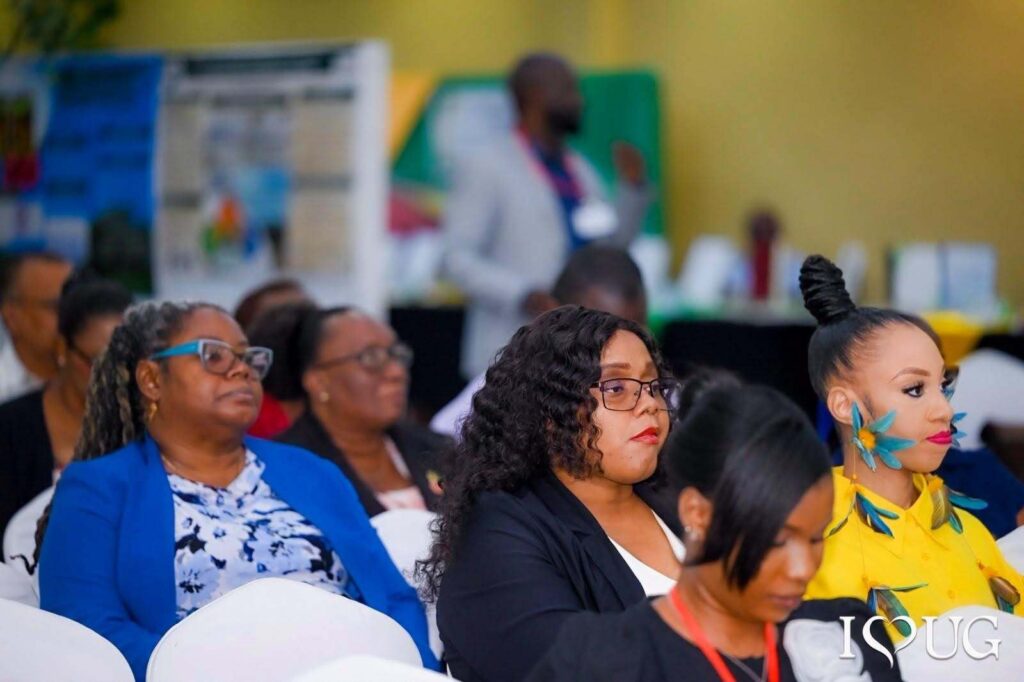
The symposium was held from Wednesday, September 30 to Friday, October 2, 2026, at the Ramada Princess Hotel, Georgetown, under the theme “Resilience for the 21st Century: Navigating Complexity Through Multidisciplinary and Interdisciplinary Collaboration.” It brought together graduate researchers, academics, government representatives, development partners and other stakeholders from Guyana and the wider Caribbean, with an estimated 100 participants joining sessions daily in person and virtually.
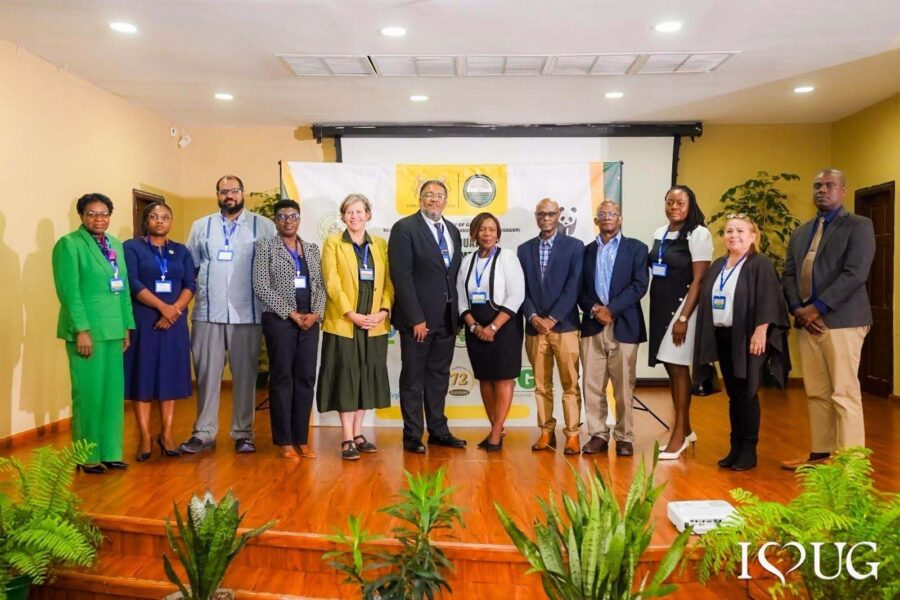
In her remarks at the opening ceremony, Dean of the University of Guyana School of Graduate Studies (UGSGSR), Professor Paulette Bynoe, highlighted its significance in amplifying the work of graduate researchers, while facilitating constructive feedback and engagement beyond their individual disciplines. While emphasising that graduate research should extend beyond a thesis or dissertation, she said, “Research is about equipping our researchers to ask important questions, interrogate evidence, engage with different perspectives and ultimately contribute knowledge that can inform policy, professional practice and decision-making.”
Representatives from the collaborating institutions reinforced the importance of connectedness between research and national priorities and practical action. To this end, Biodiversity Specialist at the Ministry of Natural Resources, Dr. Colin Henry, highlighted the need to consider resource management through economic, social and environmental lenses, while underscoring the value of graduate research in sustainable resource management, environmental monitoring and ecosystem restoration. “Resilience requires looking at resource extraction from combined economic, social, and ecological lenses,” Dr. Henry said, noting that graduate research on Guyana’s soils, forests, rivers and mining areas can provide empirical evidence to support effective and sustainable environmental policy.
In centering the role of evidence and open inquiry in informing policy and decision-making as Guyana undergoes significant economic and social transformation, UNDP Resident Representative, Ms Katy Thompson, said, “Resilience for us is around the capacity to ask difficult questions, to review evidence, to develop policy based on that evidence, and to be open to challenging our assumptions.” Similarly, Project Specialist with IICA, Ms Jenelle Blackman, highlighted the need for research that translates from knowledge to practical solutions, investment and adoption, particularly in agriculture and rural development. Meanwhile, Vice President of Conservation International Guyana, Mr. Curtis Bernard, described the symposium as an investment in knowledge, dialogue and people, while Conservation Director of WWF-Guianas, Ms. Aeisha Williams, further highlighted evidence-based research as essential to developing solutions for people and nature.
The importance of interdisciplinary research was further underscored by Professor Emanuel Cummings, who noted that many of the challenges confronting societies today cannot be addressed within a single discipline. He cited climate change, public health, artificial intelligence, economic inequality and other complexities as distinct yet intertwined and noted the University’s interdisciplinary education and research within its graduate programmes to build human capacity while driving development.
The keynote address, “Researching for Resilience,” was delivered by Professor Michael Taylor, former Dean of the Faculty of Science and Technology at The University of the West Indies, Mona Campus. Drawing on examples including flooding, extreme heat and El Niño, Professor Taylor examined how disruptions increasingly compound over time, cascade across interconnected systems and complicate human development. He challenged researchers to consider whether their work is helping societies anticipate emerging challenges and respond at a pace and scale that match the disruptions being faced. “The ultimate test of resilience cannot simply be whether our infrastructure survives. It must also be whether people are able to continue to live, develop, and thrive, notwithstanding disruption,” he said.
Professor Taylor called for a new approach to resilience research centred on Vision, Integration and Partnership (VIP). On vision, he encouraged researchers to anticipate emerging challenges, vulnerabilities and interactions rather than simply respond after disruption occurs. He also noted the potential of artificial intelligence and other technologies to help researchers identify patterns and integrate information, while maintaining the importance of human judgement and critical thought. “In a rapidly changing world, anticipation itself becomes part of resilience,” he said.
The second element, integration, requires researchers to move beyond disciplinary silos while recognising the value of disciplinary expertise. Professor Taylor stressed that complex resilience challenges require researchers to work across fields and develop questions collectively. “It demands the humility to recognize when our own individual discipline is just not enough,” he said. “It means asking, can we frame the problem together? Can we develop the questions together? And can we understand how the pieces interact together?” Professor Taylor said.
Partnership, the third element, calls for stronger connections between researchers, communities, governments, the private sector and civil society, as well as greater collaboration between Guyana and the wider Caribbean and Amazon region. “Partnership changes the research question,” Professor Taylor said, emphasising that meaningful collaboration can influence not only how research is conducted but also how its findings are applied. “For resilience is not achieved when our next paper is published. But rather, when the knowledge in that table changes what happens next,” he concluded.
Across the three-day technical programme, researchers examined resilience from a range of disciplinary and sectoral perspectives. Day One focused on knowledge, culture and creative expression in building resilient societies, as well as human health, well-being and systems of care in a changing world. Presentations explored how culture, health, social systems and knowledge can contribute to resilience and strengthen responses to changing conditions.
Day Two shifted attention to sustainable food, agriculture and forest systems; engineering, technology and digital innovation; and economic, social and governance systems. Graduate researchers examined issues including climate-resilient agriculture, food security, renewable energy, flood risk, river surveillance, economic development, public safety, taxation and inflation.
The symposium also featured research from participants beyond Guyana, including Bangladesh, Bermuda, Jamaica, Brazil, Trinidad and Tobago and Belize. Their presentations added regional and international perspectives on issues including climate-resilient health systems, nurse migration, surrogacy, legal education, racial equity and climate resilience.
The final day focused on planetary resilience, environmental change, natural systems and Earth processes. Presentations addressed urban development, river ecosystems, climate change and informal settlements, environmental governance, biodiversity, drainage infrastructure, community revitalisation and food-price shocks.
The technical sessions collectively demonstrated the breadth of research required to understand and respond to resilience challenges, while reinforcing the importance of connecting knowledge across disciplines and translating research findings into practical responses.
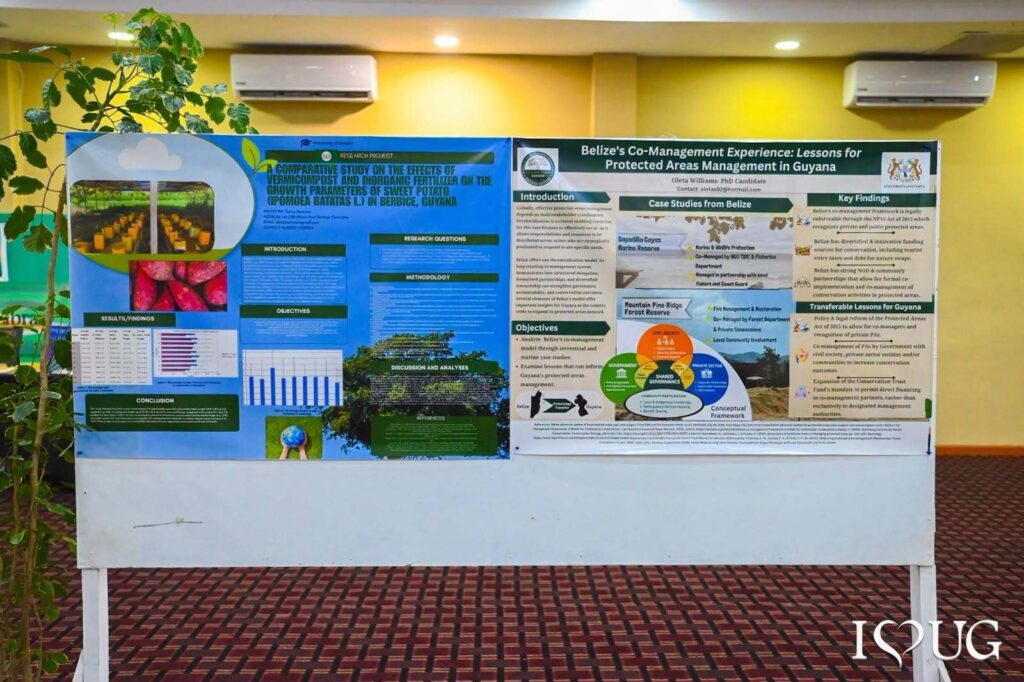
Day three also featured three-minute and five-minute research competitions, alongside poster and oral presentations, giving graduate researchers opportunities to communicate their work to diverse audiences in concise and accessible formats. The symposium also recognised outstanding graduate research through its awards and presentation competitions. Mr. Asaad Abdool received the Best Oral Presentation Award, while Ms. Oleta Williams received the Best Poster Presentation Award. The Outstanding Graduate Research Award was presented to Ms. Uoreanna Aalayah Lake, with Mr. Renee France receiving the Emerging Graduate Research Award. Mr. Leonard Oxford won the 5-Minute Competition, while Dr. Louisa Daggers was awarded first place in the 3-Minute Competition.
The symposium concluded with a report on key findings and discussions, and remarks from graduate-student representative, Dr. Louisa Daggers, and closing remarks from Professor Judith Rosales of the School of Graduate Studies and Research.
Please see link to photos and video highlight of the symposium: https://sgsr.uog.edu.gy/2026-university-guyana-school-graduate-studies-ugsgsr-4th-graduate-symposium