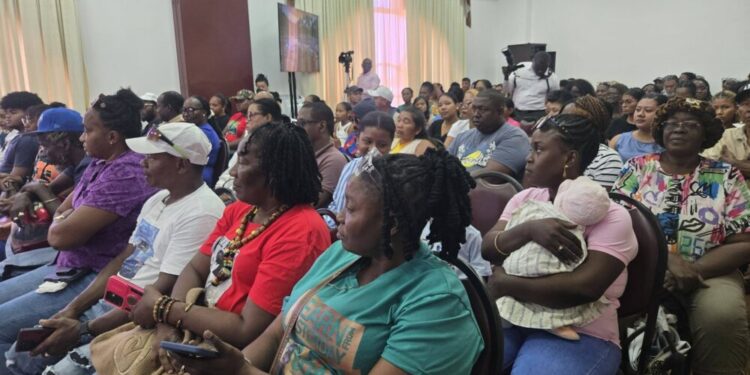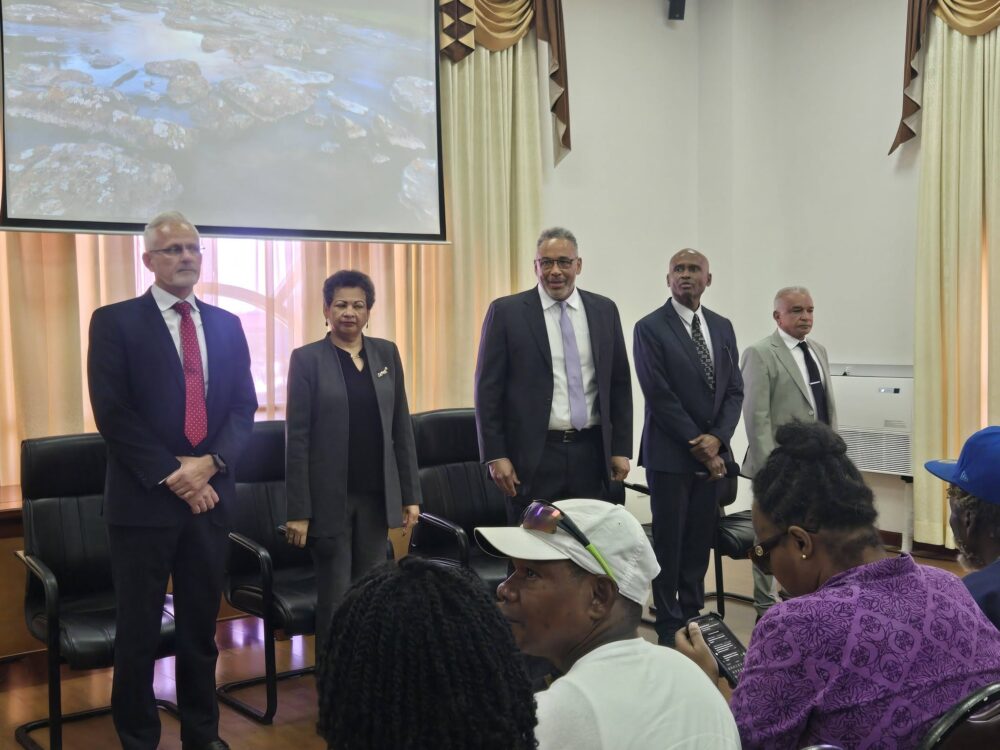
The families of those killed and survivors of the MV Barima tragedy were told Wednesday that BK International is being lined up by the Government to salvage the sunken vessel, a development that came as the Commission of Inquiry met face-to-face with relatives for the first time.
The disclosure was made during the Commission’s meeting with affected families at the Arthur Chung Conference Centre, almost three months after the vessel sank on July 18 with more than 170 people aboard. The wreck remains underwater off the Essequibo Coast and is considered a potentially critical source of evidence in determining what caused the disaster.
Commissioner Dr. Andrzej Jasionowski, a Polish naval architect and marine engineer, said he met the prospective salvage team on Tuesday to discuss how the vessel could be recovered while protecting its evidentiary value. He said negotiations were still being finalised but indicated that salvage operations could begin this month.
Families and many Guyanese only learned on Wednesday, at the Commission’s meeting at the Arthur Chung Conference Centre, that the Government was moving to have BK International salvage the Barima.
The disclosure came nearly three months after the vessel sank and as relatives continue to seek answers about the disaster and the recovery of those still believed to be inside the wreck.
Three companies submitted bids for the salvage operation—BK International, Industrial Fabrication Inc. and Netherlands-based KMS B.V. BK International submitted the lowest bid, approximately G$1.034 billion, under a “no cure, no pay” arrangement.
Jasionowski stressed that the wreck must not simply be dragged from the seabed in a manner that could destroy evidence.
“The plan will be careful because if you lash it, it’s very easy to break it and what happens is the recovery becomes cut and scrap metal.”
He said the vessel retains substantial forensic value despite having remained underwater for nearly three months.
“Near 100%, the ship will give us clues that we seek on its state as it sank.”
The significance of the disclosure was heightened by the fact that the vessel is believed to still contain bodies and cargo, making the recovery potentially crucial to both families seeking closure and the Commission seeking answers.
Commission Chairman Justice Godfrey Smith of Belize told relatives that the inquiry had undertaken considerable preparatory work since its appointment, including developing rules, identifying witnesses and examining documentation, particularly records relating to the vessel’s certification.
“Of course, for something this serious and complex, we have to do preparatory work.”
Smith said the Commission would examine the circumstances surrounding the sinking without beginning with predetermined conclusions.
“There is no wrong question. We would have no answer. That is why we are starting from this point.”
He said the commissioners intended to be thorough in examining the evidence and determine, as far as possible, how and why the tragedy occurred.
“I believe we can know how and why it has happened.”
Commissioner Nyree Dawn Alfonso, a Trinidadian attorney with expertise in admiralty and maritime law, also assured families that she would bring her experience to the investigation.
The Commission has been tasked with examining the vessel’s seaworthiness, passenger and cargo operations, crew qualifications and conduct, regulatory oversight, search-and-rescue efforts and other factors that may have contributed to the disaster.
The July 18 tragedy claimed 73 lives, while 30 people remain unaccounted for and 76 survived, according to the latest figures reported by the Goverment.
Formal public hearings are scheduled to begin on October 14, with more than 100 witnesses expected to testify.