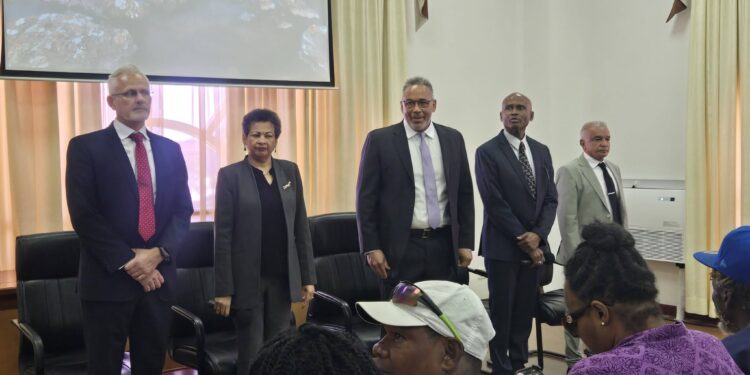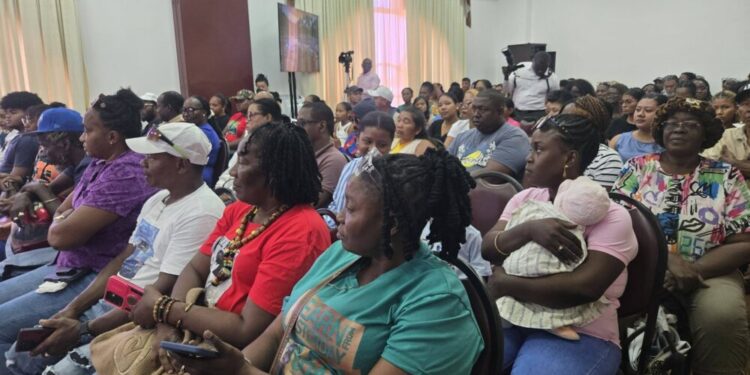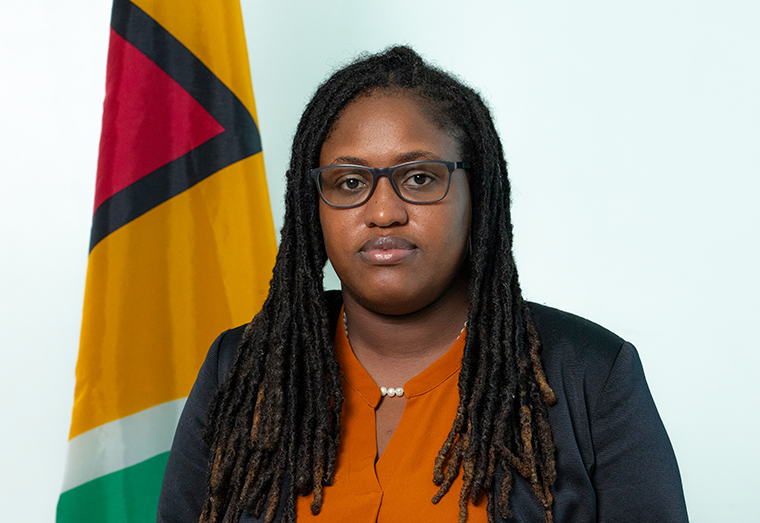
Elton Bollers grew up on the East Coast of Demerara, first in Plaisance and later in Paradise. On September 7, 2026, he took the oath as an Attorney-at-Law before the High Court. He told the Court that those communities “shaped much of who I am.”
The son of Lloyd Bollers and Enid Smith, he brings to the legal profession a résumé few new attorneys can match. He is a farmer, a former national athlete, and an economist who spent years in international development at the Inter-American Development Bank and the World Bank. He has also been a university lecturer and has published peer-reviewed research.
His petition was moved by Attorney-at-Law Ronald Daniels and Ms. Shaunella Glen, and granted by Justice Nigel Niles.
“Deliberate effort, discipline and determination”
In his address, Bollers said his reasons for choosing the law were “not only academic. They are deeply personal.” Growing up, he saw how “circumstances, decisions and systems could change the trajectory of a person’s life,” sometimes “closing doors, narrowing futures and leaving scars.” He declined to tell those stories because “those are not my stories to tell,” but said he carries them with him.
“There were times when I did what I could, but what I could do was not enough,” he said. Over time, that feeling became resolve: “I wanted to be in a position to do more than watch. I wanted to be able to stand up and represent.”
He also spoke about the pressure young people in his community face to take easier paths with quicker rewards. “I chose the straight and narrow, even when it was harder and the rewards seemed further away,” he said. He described the road that brought him to the Bar as one of deliberate effort, discipline and determination.
Farming taught him patience. “As a farmer, and the land has a way of teaching you patience,” he said. “You cannot rush a harvest. You prepare the ground, you plant, you tend it through good seasons and bad, and you trust that the work will bear fruit. The law, I have learned, is no different.”
From economist to advocate
His education began at North Georgetown Primary and St. Rose’s High School. He earned a B.Sc. in Economics at the University of Guyana and an M.Sc. in Economics with Distinction at The University of the West Indies, St. Augustine. He then went back to school, which he described as “learning to be a beginner.” He completed a Bachelor of Laws through the University of London and a Legal Education Certificate at the Eugene Dupuch Law School in The Bahamas. There he won the Joseph B. Lewis Prize and the HLB Acme Advisers Prize for Law Office Management, Accounting & Technology.
He has lectured at the University of Guyana, the University of the West Indies, the Bertram Collins College of the Public Service and the JTW Management Institute. He has also published peer-reviewed articles in local and international journals. His legal training included an internship at the Office of the Public Defender in The Bahamas and supervised family-law work at the Eugene Dupuch Legal Aid Clinic.
Explaining how these strands came together, Bollers told the Court: “Economics taught me to analyse systems. Academia taught me to question them. My experiences taught me to care about the people affected by them. And the law gives me the means to act.”
Sport and service have also been part of his life. He served as General Secretary and Assistant Treasurer of the Athletics Association of Guyana and as President of the Police Progressive Youth Club.
Gratitude and sacrifice
Bollers said the hardest cost of his studies was time away from his daughter, “time I cannot get back.” He told her: “I want you to grow up in a country where the law protects everyone equally, and I hope to help build it.”
He thanked his parents for his first legal training, drawing laughter: “From Dad, I learned how to argue a case. From you [Mom], I learned how to resolve one. An advocate needs both.” He also thanked his partner, his siblings, the Chief Public Defender and staff of the Public Defender’s Office, his lecturers at the Eugene Dupuch Law School, and his friends and colleagues.
He said he hopes his journey shows young people from communities like his “that their beginnings do not have to define their future.” They can go further than they once imagined, he said, “without ever having to forget, or be ashamed of, where you came from.”
Looking ahead
“Being called to the Bar is not an arrival at the end of a journey,” Bollers said. “It is an invitation to begin serving in a new way.” He closed with a farmer’s image: “You reap what you patiently sow. Today, I begin a new season.”
He plans to set up his own law firm and to add legal scholarship to his research on the Caribbean.