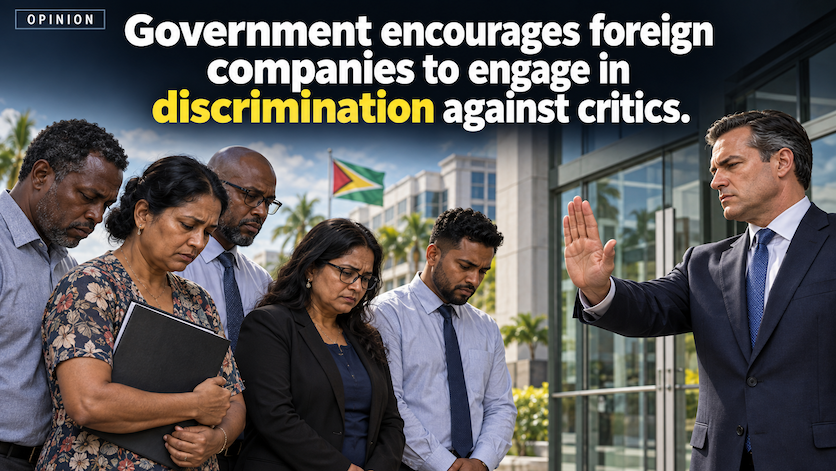
Foreign companies are guests of the state and should not contribute to conflict, discrimination or confusion among the citizens of Guyana.
Citizens of Guyana who are progressive and even partially conscious want improvements. Many of these critics held the APNU accountable, just as they are now holding the PPP accountable. It is because of their work and their sacrifices that changes are made, and that formerly oppressed people begin to benefit from the nation’s patrimony. But this publication has received increasing complaints that foreign companies are discriminating against individuals and NGOs identified by the PPP. This must stop. Foreign companies must stay out of politics.
This publication has received reports that ministers and government leaders have approached foreign companies, albeit informally, to dissuade them from offering support to people and programs and opportunities which benefit citizens of Guyana. Some are even encouraged to fund competition programs to undermine programs managed by local Guyanese who are not beholden to the PPP government.
The temptation is understandable, when the ruling party offers preferential treatment, faster approvals, or the promise of future deals in exchange for cooperation, it can seem like good business sense to play along. But what is true, and what every foreign executive in Georgetown needs to understand, is that the same PPP folks who gaff with you will stab you in the back at the first opportunity. Additionally, we share this free tip; if you are represent a foreign company applying to do a deal and you have been waiting months for “approval,” you are being duped by the PPP. The delay is not bureaucracy. They either plan to steal your idea with another company or they’re exercising leverage and testing your willingness to be used. Government leaders can make any deal happen in this country in days.
So foreign companies must stay out of politics. Obey the local laws. Allow equal access to opportunity and your business will survive when the government changes, additionally, you will not contribute to civil conflict which inevitably happens when people are disenfranchised and they decide to no longer endure.
This is not merely ethical advice. It is wise. The foreign company that allows itself to be enlisted as an instrument of one party’s vendetta today will find itself on the wrong side of the ledger tomorrow. Your “loyalty” will be entered into evidence. Your contracts, your licenses, your operating rights, all will be reviewed by the incoming government with the same suspicion you helped to cultivate. This is not a hypothetical risk. It is the plain logic of a country where political power alternates and where the wounds of past conflicts remain fresh.
The United Nations Global Compact is explicit that businesses operating in high-risk environments should adopt policies across racial, religious and ethnic divides on hiring and workplace practices, develop anti-corruption and human rights policies, and establish strategic social investment as part of genuine stakeholder engagement. The International Chamber of Commerce adds that companies in governance crises should avoid hasty decisions under pressure and use their influence to mitigate adverse human rights impacts. Discriminating against critics and cooperating with political suppression directly violates both.
Yet the complaints keep coming. Individuals and NGOs are being quietly blacklisted. Access is being denied. Opportunities are being withheld. And the common thread in these complaints is that the names on the list are those the PPP has identified as its opponents. This is not neutrality. This is complicity. And it is being carried out, in some cases, by companies that claim to uphold international standards and corporate social responsibility.
The business case for staying out of politics is as strong as the moral one. Legal risk is real; Guyanese law prohibits discrimination on the basis of political opinion, and foreign companies that cooperate with suppression may face local litigation and international arbitration. Reputational risk is real; international investors and consumers increasingly scrutinise corporate conduct in high-risk countries, and entanglement in political persecution carries a price. Market risk is real; when power changes hands, the company that was seen as a tool of the outgoing regime becomes a target of the incoming one. And operational risk is real; a business that depends on political favour for its survival has no independent foundation and will not survive the next election.
So what should foreign companies do? Stay politically neutral. Do not give special treatment to any party. Do not cooperate with any act of political suppression. Obey local law, especially anti-discrimination and labour law, and ensure that all Guyanese citizens, regardless of political affiliation, enjoy equal access to employment and business opportunity. Establish transparent grievance mechanisms so that all stakeholders, including critics, can raise concerns fairly and without fear of retaliation. Document every instance of political pressure. If a government official asks you to discriminate against a specific individual or organisation, keep a written record. This is not only legal protection. It is insurance for the next change of government. And apply international standards, the UN Global Compact, ICC guidance, and the UN Guiding Principles on Business and Human Rights, because these standards exist precisely to protect businesses from this kind of pressure.
Guyana stands at a moment of extraordinary opportunity. The nation’s patrimony is beginning to flow, and the question of who benefits is being contested in the public square. That contest is healthy. It is the work of a functioning democracy. But foreign companies are not players in that contest. They are guests. And guests who take sides in a family quarrel should not be surprised when they are asked to leave.
Stay out of politics. The progressive citizens of Guyana, those who sacrificed to hold power accountable, deserve foreign partners who respect their struggle, not foreign companies that help to punish it. The choice is yours, and the record you create today will be read by the government of tomorrow.