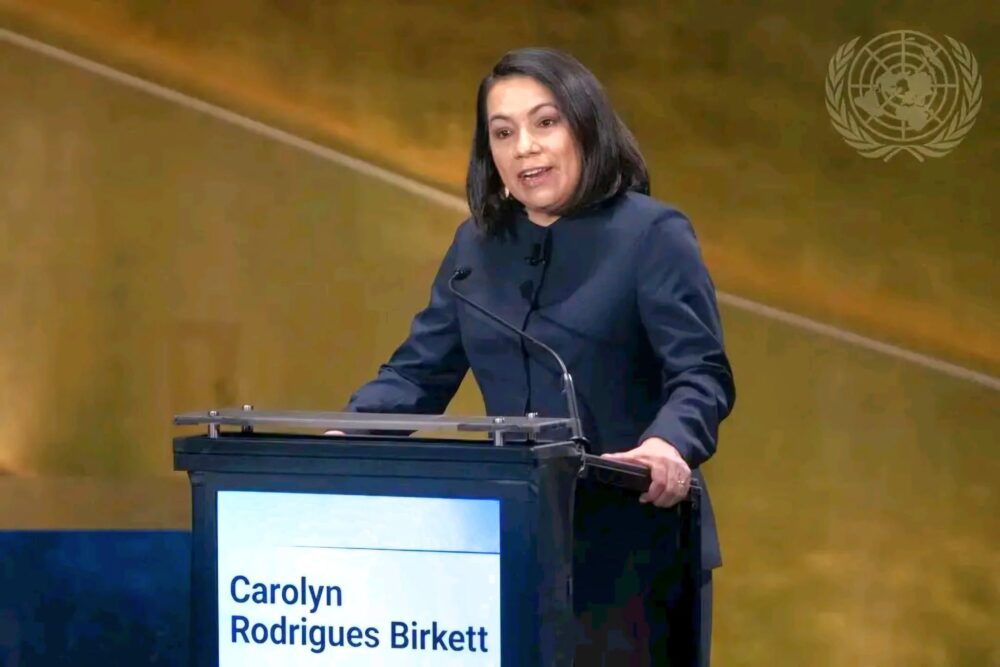
Barbados Prime Minister Mia Amor Mottley has thrown her country’s full support behind Guyana’s Carolyn Rodrigues-Birkett for United Nations Secretary-General, but the endorsement comes at a critical point in a contest where a reported U.S. veto could make the Caribbean campaign impossible to advance.
Mottley declared Barbados’ support during her address to the 81st UN General Assembly on Thursday, joining the wider CARICOM position behind Rodrigues-Birkett.
“Barbados joins its sister member states in the Caribbean community in pledging its full support for the candidature of Ambassador Carolyn Rodrigues-Birkett of Guyana.”
She added
“At a moment when the international community is being called upon to renew its faith in multilateralism, we believe that Ambassador Rodrigues-Birkett brings to this task the experience, the skills and the understanding to serve the entire membership of this organisation.”
Mottley’s endorsement strengthens the public display of Caribbean unity behind Rodrigues-Birkett, but whether that political support can overcome opposition from Washington is the central question now surrounding the Guyanese diplomat’s candidacy.
The New York Times has reported that the United States opposes Rodrigues-Birkett’s candidacy, citing her description of Israel’s conduct in Gaza as “genocide,” and will veto her candidacy. The U.S. Government has not publicly announced a formal veto decision.
President Irfaan Ali has rejected reports suggesting that Washington has communicated a decision to Guyana.
“I’m very pleased to say that during this week at the United Nations, I’ve engaged many stakeholders in relation to the candidacy of Carolyn Rodrigues, and I can say without a shadow of a doubt that the response has been overwhelming and very positive.”
The institutional hurdle remains significant. The Secretary-General is first recommended by the 15-member Security Council and must secure at least nine votes without a veto from any of the five permanent members. The General Assembly then formally appoints the nominee.
That means CARICOM support, even if expanded beyond the region, cannot by itself overcome a U.S. veto.
The latest secret Security Council straw poll also shows that Rodrigues-Birkett has not yet secured the nine “encourage” votes required in a formal recommendation. She received eight encourage, six discourage and one no opinion in the September 18 poll. Rebeca Grynspan of Costa Rica received nine encourage votes, five discourage and one no opinion.
The results are not a formal vote and do not determine the final outcome, but they demonstrate the diplomatic challenge facing all candidates.
Rodrigues-Birkett has the backing of CARICOM and, now, an explicit endorsement from Barbados. Ali has also appealed directly to the Security Council’s permanent members to consider her candidacy.
“We invite all to consider her candidacy on its merits and to judge whether her vision, experience, expertise, and record can help restore confidence in the United Nations at this critical moment.”
If selected, Rodrigues-Birkett would become the first Caribbean national and first woman to serve as UN Secretary-General. The office has been held by men throughout the UN’s history.
Mottley’s intervention therefore gives Rodrigues-Birkett another prominent Caribbean voice, but it does not resolve the fundamental obstacle facing her campaign. A regional bloc can build diplomatic momentum, but it cannot override the veto power of a permanent Security Council member.
The decisive issue now is whether reported U.S. opposition is ultimately maintained and translated into a formal veto threat, or whether continued diplomacy can change Washington’s position before the Security Council makes its recommendation.