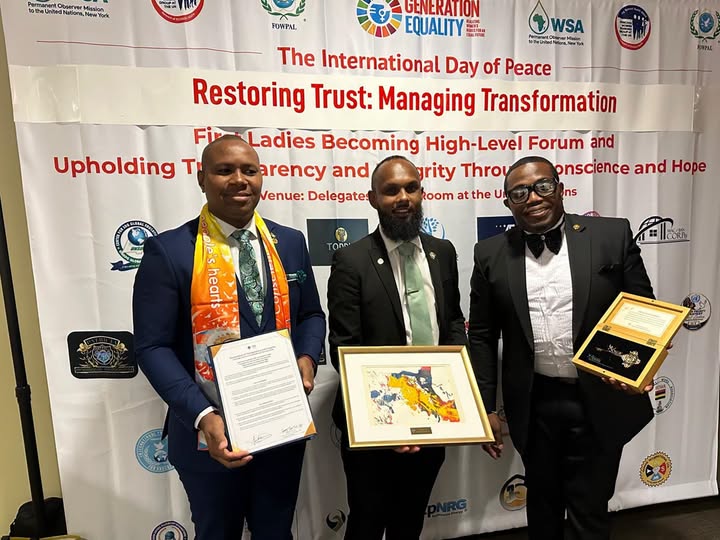
Three Members of Parliament representing A Partnership for National Unity (APNU) have been honoured in New York for their participation in an international peace initiative and have signed a declaration pledging transparency, integrity and accountable leadership—principles that take on added significance against the backdrop of a Parliament that has met only four times on dated occasions since it was inaugurated.
Dr Dexter Todd, Vinceroy Jordan and Dr, Riaz Rupnarain received Certificates of Honour in commemoration of the Ringing of the Bell of World Peace and Love, according to an APNU statement.
The three lawmakers also signed the Declaration of Transparency and Integrity – “Fostering Trust for a Sustainable and Thriving World,” reaffirming their commitment to transparency, integrity, accountability, peace, human rights, justice and sustainable development.
The certificates and declaration were presented and signed in the presence of Dr Hong Tao-Tze, president of the Federation of World Peace and Love (FOWPAL) and vice president of the Association of World Citizens.
APNU said the declaration emphasises that transparency is the cornerstone of trust and collaboration, while integrity remains fundamental to ethical leadership and responsible governance.
“This recognition represents a meaningful commitment to advancing peace, integrity, responsible leadership, and a more sustainable and harmonious world.”
A Parliament that rarely sits
The international recognition comes as Guyana’s 13th Parliament faces scrutiny over the pace of its legislative business.
According to the official Parliament of Guyana website, the 13th Parliament has recorded four dated sittings: November 3, 2025; January 26, 2026; February 2, 2026; and June 5, 2026. Parliament’s database also contains a 5th Sitting entry, but lists its date as “n/a.”
The gap became particularly pronounced after the February sitting. The National Assembly did not reconvene until June 5, with the Government announcing the date amid public comments from members of the diplomatic community about the prolonged absence of parliamentary sittings.
The June sitting saw the presentation of six bills, financing agreements and a G$54.9 billion supplementary financial paper, demonstrating the volume of legislative and financial business requiring parliamentary scrutiny.
The concern is not simply the number of days lawmakers occupy their seats. Parliament is the institution through which legislation is debated, public expenditure is scrutinised and the executive is subjected to political and constitutional oversight.
When the National Assembly sits infrequently, opportunities for sustained questioning of Government decisions are reduced. Extended gaps can also weaken public scrutiny of spending, delay legislative action and diminish the Opposition’s ability to keep issues before the nation.
The limited plenary record does not, however, capture committee meetings or other parliamentary activity. Thirteen parliamentary committees were constituted at the June sitting, including the Public Accounts Committee and committees responsible for constitutional reform, security-sector oversight and sectoral scrutiny.
APNU’s parliamentary responsibility
Todd, Jordan and Rupnarain are among 12 APNU MPs in the 65-member elected Parliament. The People’s Progressive Party/Civic (PPP/C) holds 36 seats, while the Opposition holds 29—comprising 16 We Invest In Nationhood (WIN) MPs, 12 APNU MPs and one Forward Guyana Movement (FGM) MP.
That composition gives the Opposition a substantial constitutional role in scrutinising the Government, even though the governing party retains a clear majority.
Against that backdrop, APNU’s decision to publicly associate its parliamentarians with a declaration centred on transparency, integrity and accountability places those principles squarely alongside their responsibilities at home.
The declaration states that transparency builds trust and that integrity is fundamental to ethical leadership. In a functioning parliamentary democracy, those principles are tested not only at international ceremonies but through the daily work of lawmakers: questioning ministers, examining expenditure, debating legislation and demanding answers from institutions exercising public power.
The New York recognition therefore carries a challenge beyond ceremony. The commitments signed before an international audience must ultimately be demonstrated in the conduct of Parliament and in the willingness of elected representatives to hold power to account.