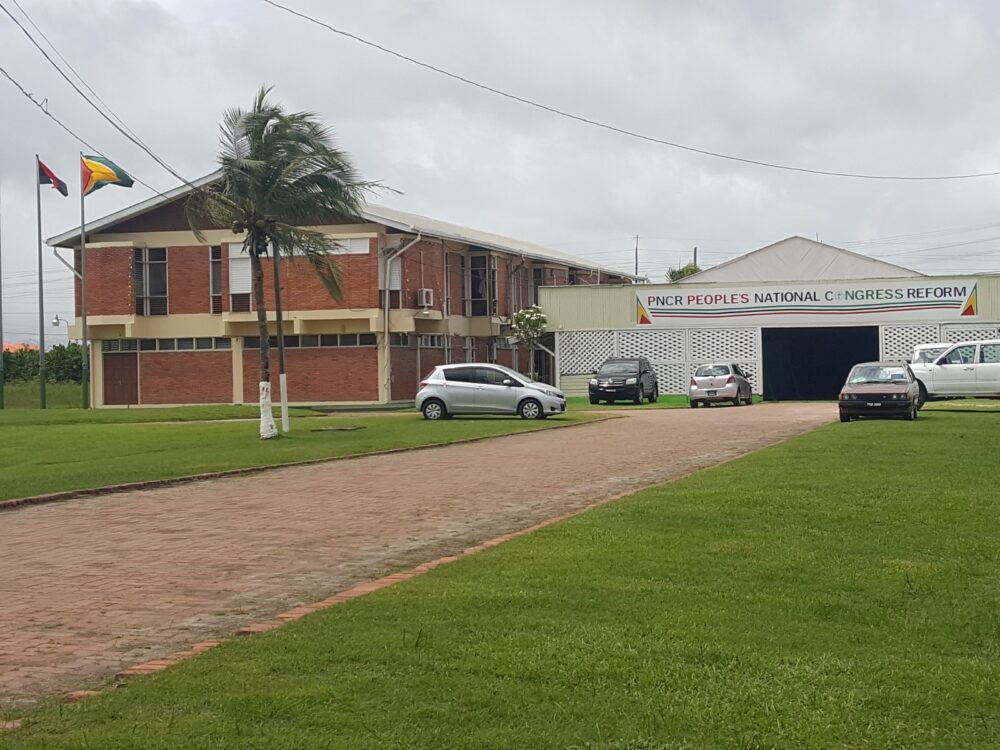
By Mark DaCosta- The People’s National Congress Reform’s (PNCR) decision to lease part of the land surrounding its Congress Place headquarters in Sophia, reportedly for a hotel development, has opened a debate extending well beyond property management. The arrangement, which the party says is intended to generate income rather than dispose of the historic site, places a valuable political asset at the intersection of financial necessity, internal party accountability and the enduring symbolism of one of Guyana’s most consequential political locations.
The reported lease concerns the northern portion of the extensive Congress Place property, with the proposed development understood to form part of a wider effort to turn PNCR-owned assets into sources of recurring revenue through Maikwak Limited, the party’s business vehicle. The move has prompted speculation that the PNCR might be preparing to sell property, but General Secretary Sherwin Benjamin has rejected that interpretation. He said the headquarters has not been sold and would not be sold, while urging party members to have confidence in the leadership and its management of the organisation’s assets.
The distinction between a lease and a sale is significant. A sale would permanently transfer ownership, whereas leasing land can allow an organisation to retain the underlying asset while deriving income from it. In the PNCR’s case, the stated objective is therefore commercial exploitation without surrendering ownership of Congress Place. News reports indicate that businesses have expressed interest in renting portions of the party’s properties and available land, suggesting that the proposed hotel is part of a broader commercial strategy rather than an isolated transaction.
That strategy, however, comes with a historical burden. The PNCR’s own constitution identifies Congress Place as the party’s headquarters, and the Sophia compound has long served as a venue for major organisational gatherings. The headquarters therefore carries an importance that cannot be measured solely by the acreage involved or the income a commercial development might generate.
Its symbolism is particularly tied to 14 December 1974, when Forbes Burnham addressed a special PNC congress at Sophia in what became known as the Declaration of Sophia. The original publication is catalogued as Burnham’s address to a special congress held at Sophia on that date. The declaration marked a major ideological and institutional turning point, formally advancing the doctrine of party paramountcy and committing the PNC to a programme identified as Co-operative Socialism. Academic research likewise identifies 1974 as the point at which the doctrine of party paramountcy was formally declared, making the PNC inseparable from the state in Burnham’s political conception.
That history makes the current commercial question unusually sensitive. Congress Place is not simply another parcel of urban land. It is associated with a political doctrine that profoundly shaped the governance of post-independence Guyana.
The PNCR’s present financial circumstances provide another dimension to the decision. Maikwak Limited has been linked to the Congress Place property in a continuing dispute over rates and taxes. Recent reporting indicates that an earlier assessment of the company’s liability was substantially reduced, with the amount currently being discussed placed in the tens of millions of Guyana dollars. PNCR officials have also said that the party’s business arm has been activated to generate revenue.
Benjamin’s defence of the leasing arrangement also comes amid questions about internal party decision-making. The General Council, an important body within the PNCR’s organisational structure, has not met since the 2025 General and Regional Elections, according to the General Secretary. He has said that the council is expected to convene before the end of 2026, when decisions taken by the Central Executive are to be presented for discussion and ratification. The issue is therefore not simply whether the party may commercially use its property, but also how such decisions are authorised, communicated and ultimately subjected to the organisation’s internal processes.
The electoral backdrop makes the question more consequential. The 2025 Election, left the A Partnership of National Unity (APNU)- which the PNCR is the major force- with 12 seats in the National Assembly, compared with 16 for the newly established We Invest in Nationhood (WIN) and 36 for the People’s Progressive Party/Civic (PPP/C); the Forward Guyana Movement (FGM) secured one seat.
The proposed lease consequently presents the PNCR with a complicated balancing exercise. Commercialising underused land could provide an established political organisation with revenue at a time when maintaining large properties is costly. At the same time, development on the Congress Place compound inevitably raises questions about how a party preserves the physical setting associated with its institutional memory while adapting to contemporary financial realities.
For the PNCR leadership, the central issue may therefore be less whether Congress Place is technically being sold than whether members believe its commercial use is compatible with the meaning they attach to the site. The proposed hotel could become a practical source of income while the headquarters remains intact. But because the ground carries the memory of the Declaration of Sophia and decades of PNC political history, any transformation of the property is bound to be judged not only in financial terms, but also against the party’s understanding of its own past and its responsibilities to the future.