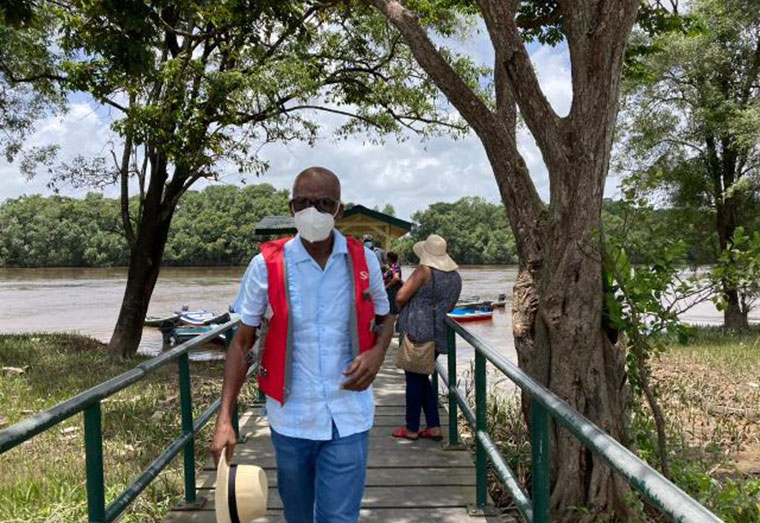
By Mark DaCosta- Veteran trade unionist and General Secretary of the Guyana Trades Union Congress (GTUC), Lincoln Lewis, is warning that the treatment of Guyana’s parliamentary Opposition is raising increasingly serious questions about representative democracy, constitutional safeguards and the Government’s commitment to inclusionary governance.
Lewis told Village Voice News that the Government’s recent invitation for Opposition parliamentarians to meet President Irfaan Ali without prior consultation and a clearly established agenda was another troubling development in the relationship between the Executive and the Opposition.
He described the approach as a sign of what he considers contempt for the legislative arm of government and the constitutional obligation to practise inclusionary democracy.
The issue came to a head on September 15, when Opposition MPs did not attend a meeting of the Parliamentary Sub-Committee on Foreign Relations with President Ali. We Invest In Nationhood (WIN) declined to participate, while the A Partnership for National Unity (APNU) said it was willing to engage but required a clear agenda and relevant documentation sufficiently in advance.
WIN said Opposition MPs operate collectively under the leadership of the Leader of the Opposition, a constitutional office established to provide oversight and accountability to the Executive. The party objected to what it viewed as an attempt to engage individual parliamentary committees without meaningful engagement with that office.
The Office of the President has given a different account, saying all committee members were invited through the Speaker and that the meeting was intended to discuss matters of national importance, including Guyana’s proceedings before the International Court of Justice and the Third Country National Agreement with the United States. The President’s Office said President Ali intends to strengthen engagement with parliamentary committees in an “open, transparent and accountable manner.”
For Lewis, however, the controversy is part of a wider pattern in the treatment of political opponents.
He warned against what he described as authoritarian tendencies and a disregard for Guyana’s representative democratic system, arguing that such an approach could “breathe unnecessary conflict” into the country rather than foster peace and harmony.
September 3 detention
Lewis’ concerns about the treatment of the Opposition were given particular urgency following the September 3 detention of Opposition Leader Azruddin Mohamed.
Mohamed was arrested twice that day following an incident involving a suspected unauthorised drone near President Ali’s private residence. Lewis addressed the episode in his September 6 Eye On Guyana column, framing it as evidence of what he described as an intensifying attack on the Opposition Leader and a wider erosion of democratic safeguards.
Lewis wrote:
“We are witnessing a full-scale abuse of the Constitution and citizens’ rights by the PPP to settle political scores or target persons it deems enemies.”
He argued that the issue should not be viewed simply as a dispute involving one Opposition politician.
“The PPP’s tentacles are in every arm of the state and non-state sector, snuffing life out of every facet of society.”
Those are Lewis’s political characterisations, rather than findings by a court or independent inquiry.
His central concern is that the treatment of one political opponent can establish a precedent affecting citizens more broadly.
“The violation of anyone’s rights is a threat to all.”
Lewis has argued that the police and other public institutions must operate within their constitutional and professional responsibilities, particularly when their actions involve elected political representatives.
His September 6 column also warned against citizens becoming indifferent to perceived violations simply because the person affected belongs to another political camp. He contended that democratic rights cannot depend on political affiliation.
Opposition and Parliament
That argument now intersects with the dispute over the President’s meetings with parliamentary committees.
The Opposition’s refusal to participate was not presented simply as a rejection of dialogue with the President. WIN said the absence of meaningful prior engagement and a clear agenda raised institutional concerns, while APNU said meaningful participation required sufficient information and preparation.
The President’s Office, meanwhile, maintained that the meetings formed part of an effort to improve cooperation between the Executive and Legislature.
Lewis argues that meaningful inclusion must go beyond inviting Opposition MPs to meetings. In his view, it requires respect for the constitutional status of the Opposition and Parliament itself.
Guyana’s Constitution states at Article 13 that the principal objective of the political system is to establish an inclusionary democracy by providing increasing opportunities for citizens and their organisations to participate in the management and decision-making processes of the State.
Lewis’s warning is stark:
“Guyana is no longer a democratic state. Let’s face this reality.”
That statement represents Lewis’s political assessment, rather than an established judicial or constitutional finding.
He further cautioned against silence in the face of what he considers abuses of state power.
“To remain silent is to demonstrate complicity with the oppressive acts of government.”
Lewis says the dispute goes far beyond Mohamed, WIN, APNU or any single confrontation with the Government. At its core is the question of whether Guyana’s constitutional democracy can function when the elected Opposition is excluded from meaningful participation, consultation is diminished and institutional boundaries are blurred.
He warns that constitutional democracy depends not only on elections, but on respect for the institutions, rights and political voices that give those elections meaning. Where the Opposition is marginalised or treated as an adversary rather than a legitimate constitutional participant in governance, Lewis argues, the foundations of representative democracy are placed under strain.
Such a course, he cautions, risks deepening political conflict and weakening the constitutional order intended to protect every Guyanese, regardless of political affiliation.