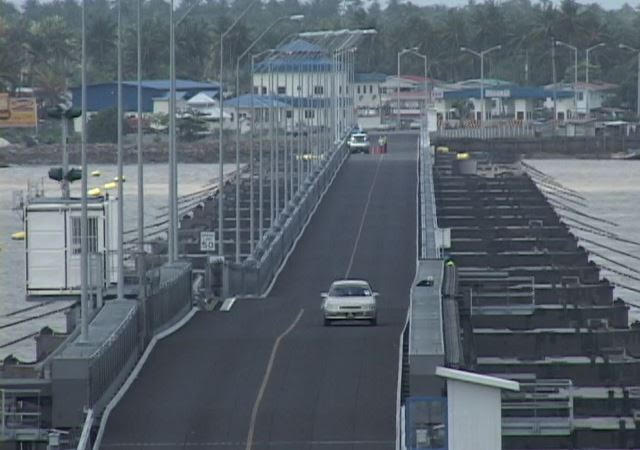
The Government of Guyana has acquired the Berbice River Bridge for G$400 million, bringing an end to the operations of the Berbice Bridge Company Inc. (BBCI), which has privately operated the 1.57-kilometre crossing since it was commissioned in 2008.
Former BBCI Board Chairman Paul Cheong confirmed the transaction on Wednesday, telling Demerara Waves Online News that the bridge had been handed over to the government and that the G$400 million purchase price was paid on Wednesday.
“It has been handed over to government,”
The acquisition was confirmed by Public Works Minister Juan Edghill, according to News Room Guyana. The G$400 million price represents about five per cent of the bridge’s original reported G$8 billion construction cost.
The transaction comes as BBCI formally winds up its corporate affairs.
Company wound up
Notices published in the Official Gazette state that BBCI’s members passed a special resolution on August 21, 2026, to wind up the company from that date. BBCI Secretary Amarnauth Singh signed the notice published on September 12.
A separate notice dated September 4 identified chartered accountant Raan Motilall as the company’s liquidator.
With the private company exiting, responsibility for the bridge has shifted to the Ministry of Public Works. A source described by Demerara Waves as reliable said the ministry is now responsible for operations and maintenance, with former BBCI employees continuing to work on the bridge.
From G$8 billion project to G$400 million acquisition
The takeover brings into focus the unusual financial history of the bridge.
The structure was developed under a public-private partnership, with financing coming from government-linked institutions, private investors, preference shares and loans. Contemporary records put the overall financing at more than G$8 billion.
Among the principal shareholders were the National Insurance Scheme (NIS), New GPC Inc., Queens Atlantic Investment Inc., Secure International Finance Co. Ltd., Hand-in-Hand Fire Insurance Co. Ltd. and NICIL.
BBCI’s 2018 shareholder breakdown listed NIS with 20.2 per cent, New GPC with 20 per cent, Queens Atlantic Investment with 20 per cent, Secure International Finance with 20 per cent, Hand-in-Hand with 10 per cent and NICIL with 10 per cent.
The ownership structure has been politically contentious over the years. Reporting in 2018 identified businessman Dr. Ranjisinghi “Bobby” Ramroop as controlling New GPC and Queens Atlantic, which together represented 40 per cent of BBCI’s shares.
The NIS investment was particularly significant. Parliamentary and financial records show that NIS was among the major financiers of the bridge, while NICIL also represented the State’s interest at various stages of the company’s development.
In 2016, the then APNU+AFC Government acquired the 10 per cent interest previously held by Demerara Contractors, a subsidiary of Demerara Distillers Limited, reportedly for more than G$40 million. At the time, government said the purchase would make the State the largest shareholder, after NIS had acquired NICIL’s shares.
New bridge planned
The acquisition also comes while the government is preparing to construct a new four-lane Berbice River Bridge at another location.
President Irfaan Ali has announced plans for the new crossing, which the government says will be a much larger modern structure. The new bridge forms part of a broader infrastructure programme for Region Six, including planned highway development along the Corentyne corridor.
The immediate consequence, however, is that the existing bridge—once a major public-private infrastructure investment—is now a State-owned asset.
The G$400 million acquisition closes the chapter on BBCI’s private operation, but the history of the bridge leaves significant questions about the billions originally invested, the returns received by public and private investors, the company’s financial performance and the ultimate value transferred to the State.
With the Ministry of Public Works now responsible for the bridge, those financial and operational questions are likely to remain part of the public debate as Guyana moves toward construction of its proposed replacement.