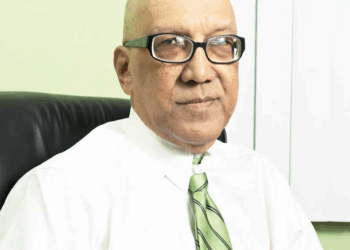
Senior Counsel Roysdale Forde has challenged what he described as a dangerous interpretation of the law by the State in defending the decision to keep Opposition Leader Azruddin Mohamed behind bars, arguing that the mere existence of criminal charges cannot, without more, justify depriving an individual of liberty.
Forde, accompanied by attorney-at-law Siand Dhurjon, made the remarks while addressing reporters on Tuesday following more than five hours of legal arguments before the High Court in Mohamed’s challenge to the refusal of bail.
Justice Priscilla Chandra-Hanif is scheduled to deliver her ruling at 11:00 a.m. today, Wednesday, November 18.
Forde said the defence had spent much of Tuesday’s proceedings establishing the applicable legal principles and demonstrating what he described as serious errors in the magistrate’s decision.
He maintained that the errors were not simply disagreements over the exercise of judicial discretion but involved fundamental legal principles governing individual liberty and the circumstances under which a citizen can lawfully be deprived of freedom.
According to Forde, legal authorities dating back more than a century, together with constitutional jurisprudence, support the defence’s position on the protection of individual liberty.
The senior counsel took particular issue with what he characterised as the Government’s argument that the existence of pending criminal charges, by itself, could provide sufficient grounds for refusing bail.
He warned that accepting such an interpretation would have serious implications for every citizen, potentially allowing individuals to remain imprisoned simply because they had been charged, even before the allegations were tested at trial.
Forde stressed that a charge must not be confused with a conviction and argued that the State must establish legally sufficient grounds to justify continued detention.
The defence’s arguments were also advanced during Tuesday’s hearing, where Forde challenged the prosecution’s reliance on Mohamed’s other pending criminal matters to establish the possibility of further offending if he were released.
Attorney General Anil Nandlall, SC, argued that judicial review was not an appeal and that the High Court should restrict itself to determining whether Magistrate Abigail Gibbs acted lawfully and within her authority when she refused bail on October 30.
Nandlall defended the magistrate’s consideration of Mohamed’s other pending charges and the ongoing United States extradition proceedings as relevant to assessing potential risks.
King’s Counsel Darshan Ramdhani, representing the Director of Public Prosecutions, also argued that magistrates should be allowed to consider credible information supplied by prosecutors without requiring every allegation to be established through a full evidential hearing.
However, Forde maintained that substantial grounds supported by credible information must exist before an individual’s liberty can be restricted on the basis of an alleged likelihood of further offending.
During the hearing, Justice Chandra-Hanif questioned both sides about how previous charges and conduct should inform an assessment of future offending.
Dhurjon dismisses reports about changes to legal team
The attorney also used Tuesday’s media engagement to dismiss reports suggesting that attorney Damien DaSilva had been fired or removed from the defence team.
Dhurjon explained that DaSilva remained an integral member of the legal team but had to be removed from the court record because of legal restrictions governing an attorney swearing an affidavit in proceedings in which that attorney is involved.
He explained that an attorney who swears an affidavit in a matter in which he represents a client may become a witness in those proceedings, creating a legal and procedural difficulty.
Dhurjon also addressed reports concerning attorney Herbert McKenzie, referring to similar issues surrounding affidavits in separate proceedings. He rejected suggestions that the developments reflected a breakdown within the legal team.
The judicial review application was filed by Mohamed’s mother, Bonita Mohamed, seeking to have Magistrate Gibbs’ October 30 decision overturned.
Mohamed has been detained at Lusignan Prison since that decision. He and Police Constable Ryan Greene were charged under the Cybercrime Act in connection with the alleged unauthorised acquisition and transfer of footage from the Guyana Police Force’s Safe Country surveillance system.
Prosecutors allege that the footage, connected to an October 12 incident outside the residence of Special Branch Head, Senior Superintendent Prem Narine, was transferred to Mohamed. He has denied the allegations.
The Opposition Leader also faces separate proceedings involving allegations of unlawful possession of firearms and ammunition and attempting to obstruct the course of justice. He has pleaded not guilty to the firearm-related charges.
Dhurjon said the defence remained confident as it awaited the court’s determination.
Today’s ruling will determine whether the magistrate’s refusal of bail stands or is overturned, potentially opening the way for Mohamed’s release in the cybercrime matter.
The decision will also address important legal questions concerning the evidential threshold for refusing bail and the protection of individual liberty before conviction.