In 2025, Guyana earned US$2.5 billion from oil. The government withdrew US$2.46 billion of it, ninety-eight cents on every dollar, and called it national development. Then Guyanese went home to darkened houses, crowded hospitals, crumbling schools, and wages that still cannot cover the month.
This is not a savings problem. This is not a transparency technicality. This is a betrayal in plain sight, executed legally, through the budget, with the receipts published in a report nobody in power expects you to read. So let us read it for them.
The Natural Resource Fund report tells you the money came in and the money went out. What it does not tell you, what the government has refused to tell you year after year, is where it went. Vice President Jagdeo says you cannot balkanise revenue, that every cent is appropriated by the National Assembly. Fine. Then name the hospital. Name the school. Name the road that was built with the oil money.
They cannot, because the major projects, the roads, the hospitals, the new Demerara River Crossing, even the Gas-to-Energy project, were financed with loans. So Guyanese are being asked to believe that the oil money was spent on development, while simultaneously borrowing billions for the development they were told the oil money would pay for. That is not a budget. That is a shell game. And the shell is empty.
The blackouts are the tell. GPL admits the problem. The grid cannot carry the load. Demand climbed and the wires did not. This is not a mystery, not a natural disaster, not a global price shock. It is a foreseeable, fixable failure of planning in a country producing nearly a million barrels a day. You cannot earn US$2.5 billion in a year and still have children doing homework by phone light. You cannot withdraw ninety-eight percent of your oil revenue and still have patients dying in hospital corridors. You cannot call yourself a green economy while diesel generators rattle through the night because the distribution network was neglected.
These are not inconveniences. These are the conditions that kill people. A woman in labour during a blackout. A diabetic whose insulin spoiled in the heat. A child whose school has no lab, no library, no functioning toilet. Every one of those outcomes was purchasable. The money was there.
The oil belongs to the Guyanese people. The constitution says so. The NRF Act says so. Withdrawals are supposed to finance national development priorities, not the comfort of the connected, not the margins of contractors, not another loan to do what the oil money was supposed to do. You are not being governed. You are being managed, kept just comfortable enough not to revolt, just poor enough to stay dependent.
Consider what we already know. A 2018 study by the Inter-American Development Bank found that fifty-eight percent of Guyanese lived in poverty. Whatever has changed since, it has not changed enough to be seen from the inside of a one-room house with no reliable power. Wages are low. Prices are high. Services are broken. Stop litigating surveys and start asking why a country with this much money per person still has this much suffering per person.
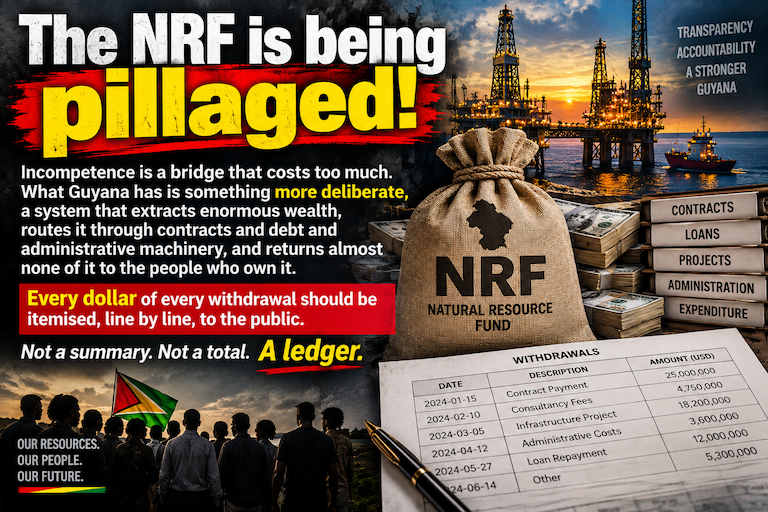
This is not incompetence. Incompetence is a bridge that costs too much. What Guyana has is something more deliberate, a system that extracts enormous wealth, routes it through contracts and debt and administrative machinery, and returns almost none of it to the people who own it. Every dollar of every withdrawal should be itemised, line by line, to the public. Not a summary. Not a total. A ledger. If the law allows the finance minister to be jailed for late reporting, it should also require him to show you where the money landed. A defined share of oil revenue should go directly to wages, transfers, and utility relief this budget cycle, not to another feasibility study, not to another contractor. Fix the wires before cutting another ribbon. Generation is not the crisis. Delivery is. And stop borrowing for what oil already paid for. If oil revenue is being spent on development, the loans for that same development must be explained, because otherwise you are being charged twice.
This is not about numbers. It is about the grandmother who died in a corridor because the hospital had no bed. The student who failed because the school had no teacher and no light. The worker whose wage buys less every year while the treasury fills and empties and fills again. They were told oil would change everything. It changed the balance sheet. It has not changed their lives. That is not a development story. That is a heist with paperwork, and the paperwork is public. Read it. Then ask them, loudly, where the rest went.