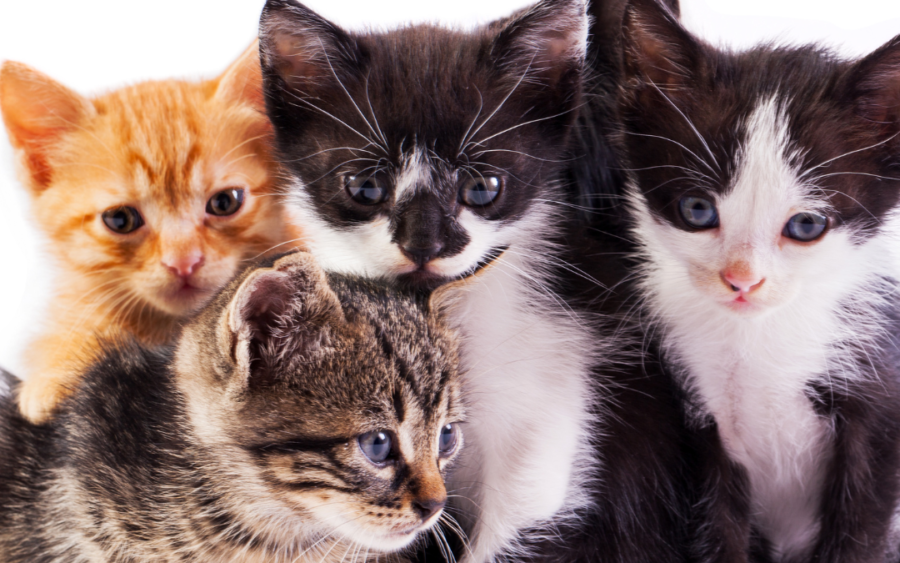
By Mark DaCosta- Accumulated research across paleogenetics, evolutionary biology, and zooarchaeology presents a striking inversion of conventional wisdom: the ordinary cat was never subdued by deliberate human effort. Instead, approximately ten thousand years ago, the African wildcat independently started a relationship with early agricultural communities, exploiting the rat populations that flourished around stored grain.
Over the years, this self-directed integration reshaped human behaviour, conditioning our species to respond to cat needs through engineered vocalisations and exploited nurturing instincts. The scholarly consensus is clear — Felis catus (cats) did not surrender its wild identity to serve mankind; rather, it adapted human society to accommodate its own survival. In other words, cats domesticated humans.
The standard account of animal domestication positions humanity as the master breeder, deliberately moulding wild creatures into useful servants. Yet the history of the house cat dismantles that assumption with remarkable thoroughness. Some ten thousand years past, as Near Eastern communities abandoned wandering existence in favour of permanent cultivation, the stockpiling of harvested grain produced an unforeseen consequence: an extraordinary proliferation of mice and rats.
It was this serendipitous banquet, rather than any human scheme, that drew the African wildcat from its solitary haunts into the edges of human settlement. Dr Melinda A. Zeder of the Smithsonian Institution observes that “In the commensal pathway to domestication, animals were drawn to human habitats by the food refuse or prey species concentrated near human settlements… animals like cats initiated the interaction themselves to exploit a new ecological niche.” The felid arrived not as a prisoner, but as an entrepreneur seizing an unoccupied commercial position.
No cages or leashes compelled this transition. Dr Claudio Ottoni, paleogeneticist at the University of Rome Tor Vergata, remarks that “Cats are really peculiar in a way because they have adapted a lot to humans, but without really changing their nature… It’s not that humans took some cats and put them inside cages; people more or less allowed cats to domesticate themselves.”
The creature’s marginally greater tolerance for human closeness — initially almost imperceptible — sufficed to convert granaries into hunting territories, and ultimately into permanent addresses. Across generations, this pragmatic arrangement deepened into genuine reciprocity: villagers acquired mute vermin controllers, while cats obtained refuge, warmth, and prey delivered with minimal exertion.
Genetic analysis sustains this narrative of minimal human interference. Dr Wesley Warren of the University of Missouri notes that “You don’t have the true differentiation you see between wolf and dog. Using the dog as the best comparison, the modern cat is not what I would call fully domesticated.”
Canines underwent intensive selective pressure to perform labour, herding, and guarding; cats experienced no such engineering. Dr Eva-Maria Geigl of the CNRS in Paris confirms that “Overall, cats became a domesticated companion of humans without changing much… Domestic cats look similar to wildcats, but they aren’t solitary, tolerating both humans and other cats.”
The most persuasive demonstration of feline autonomy appears in their calculated vocal control of human neurology. Among wild adult felids, the meow is virtually nonexistent as an intraspecific signal; communication relies upon smell markers, bodily posture, and facial nuance. Kittens alone employ the cry to summon maternal attention. The domestic cat, however, preserved this juvenile vocal mechanism into maturity and weaponised it exclusively for human consumption. Recognising that our species is largely insensitive to pheromonal messages and subtle ear movements, the cat fashioned an sound vocabulary calibrated to our perceptual vulnerabilities.
The begging purr conceals a high-pitched element — acoustically resembling the distress signal of a human infant — within a lower-frequency rumble. This combination, resonating typically between twenty and one hundred and forty hertz, activates an involuntary caregiving reflex in the human brain, rendering the sound extraordinarily difficult to disregard. The animal did not merely learn our language; it constructed a sonic key specifically to unlock our compulsions.
Dr Carlos A. Driscoll of the National Cancer Institute states plainly that “Cats were not domesticated on purpose; they domesticated themselves by choosing to live alongside humans when early agricultural communities attracted mice.” Archaeological evidence from early farming villages corroborates this self-willed trajectory. Dr Fiona Marshall of Washington University in St. Louis explains that “Our data suggest that cats were attracted to ancient farming villages by small animals, such as rodents that were living on the grain… the relationship between humans and cats was commensal, or advantageous for the cats.” Even at the dawn of agriculture, the primary beneficiary was indisputably the cat.
Dr Jean-Denis Vigne of the CNRS and Muséum National d’Histoire Naturelle adds that “The pathway to domestication does differ from one species to another… with cats, it was a specially strong ecological interaction between humans and the species, subsequently reinforced by human intentionality.” Meanwhile, Dr Leslie A. Lyons of the University of Missouri notes that “Unlike other domesticated creatures, the house cat contributes little to human survival… cats started making themselves at home around people to take advantage of the mice and food scraps found in their settlements.”
Civilisations have treated the cat with wildly divergent regard. Pharaonic Egypt deified it, linking the animal to Bastet and enshrining protections in law. Medieval Christendom, conversely, persecuted it as a demonic accomplice — a hysteria that rebounded disastrously when plague-bearing rodents multiplied unchecked. Yet the creature’s indispensable service upon maritime trading vessels guaranteed its preservation.
Within our own country, the cat maintains an understated yet vital station. From the wooden dwellings along our coastline to the shaded concrete galleries of Georgetown, the cat is inseparable from domestic routine. In a tropical setting where louvred windows and ventilated architecture blur the boundary between interior and exterior, a proficient ratter remains an honoured part of homes.
These creatures circulate between properties with total independence, acknowledged by the neighbourhood yet subordinate to none, personifying that distinctive balance between household belonging and self-governance that characterises their kind. They offer no tricks for our amusement; they appear, assess, and determine whether we merit their company.
Dr Jonathan Losos, evolutionary biologist at Washington University in St. Louis, contends that “Cats have, from their evolutionary origins in Africa, been transformed into one of the most successful species on the planet — not because we changed them through intensive breeding, but because they adapted themselves to thrive alongside us.” Their juvenile facial proportions — disproportionate eyes, short muzzles — exploit our parental instincts, whilst their reserve obliges us to win their confidence. When a feline elects to occupy one’s lap, the sensation resembles an earned distinction precisely because it was never assured.
Dr John Bradshaw of the University of Bristol observes that “Cats really aren’t terribly domesticated… because they were never bred to play some specific role in the domestic life of humans, they didn’t go through some radical evolutionary change.” They persist fundamentally as autonomous hunters who permit our society on negotiated terms. The rhythmic purr diminishes our vascular tension, their tranquil presence soothes our agitation, and their undemanding society tethers us to biological rhythms in an accelerating digital age. Nevertheless, the contractual conditions were drafted by the cat.
We constructed the settlements, sowed the food and unfastened our thresholds. The cat strolled inside, inspected the accommodation, and resolved to remain. Within that elementary exercise of feline discretion resides the true character of our ten-millennium association: we never subdued the cat. The cat subdued us.