Guyana’s oil wealth is increasingly finding its way into citizens’ hands through a rapidly expanding system of cash grants, allowances and targeted payments, with the government committing tens of billions of dollars to direct assistance since 2021.
What began largely as targeted relief for vulnerable groups has evolved into increasingly broad transfers, culminating in the $100,000 National Cash Grant for every Guyanese citizen aged 18 and over.
But behind the headline numbers lies a bigger question: are the billions being distributed creating a sustainable pathway out of poverty, or are they becoming a substitute for one?
From targeted relief to universal payments
In 2021, the government restored the Because We Care education grant, providing $15,000 in cash and a $4,000 uniform voucher, for a combined $19,000 per child.
The programme subsequently increased to $30,000 in 2022, $40,000 in 2023, $45,000 in 2024, $55,000 in 2025 and $60,000 in 2026, with an additional transportation grant bringing the current package for eligible schoolchildren to $85,000. (
Government figures indicate that approximately $26.9 billion had been disbursed under the education cash-grant programme between 2021 and 2024.
But schoolchildren were only one category.
In December 2021, more than 7,500 severed sugar workers received $250,000 each, at a reported cost of about $1.8 billion.
Pensioners, public-assistance recipients and persons with disabilities also received a $25,000 one-off payment that year.
In 2022, the government expanded its relief programmes.
Almost 8,000 fisherfolk received $150,000 each, with government reporting a total distribution of about $1.2 billion. Hinterland and riverain communities received a $25,000 one-off household grant, while more than 1,400 Uitvlugt sugar workers received more than $277 million following estate downtime.
Then came the $100,000 grant
The scale changed dramatically in 2024.
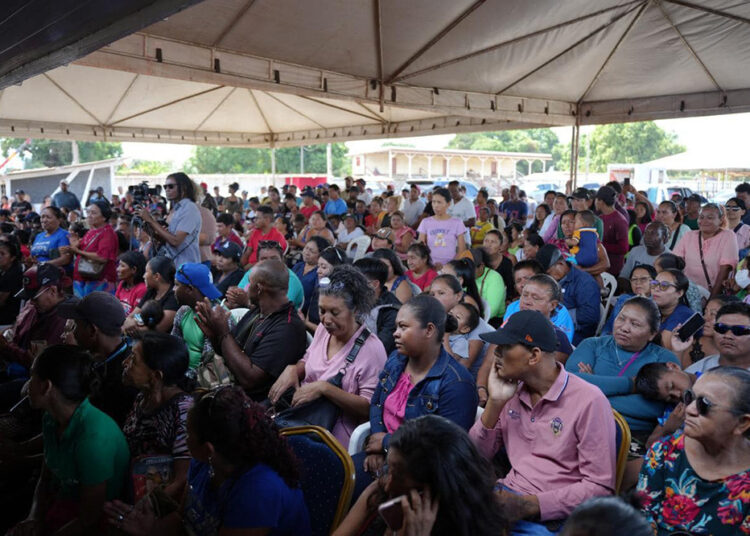
The government introduced a $100,000 payment to every Guyanese citizen aged 18 and over, moving from targeted assistance to a universal transfer.
The first rollout was expected to cost more than $60 billion, with more than 600,000 citizens eligible.
The programme returned in 2026.
The 2026 Budget again provides $100,000 for every Guyanese aged 18 and over, with the expected cost again exceeding $60 billion when fully distributed.
Unlike targeted welfare programmes, the payment is not restricted to low-income households. A citizen’s eligibility is based principally on age and citizenship.
More money for vulnerable groups
At the same time, recurring social benefits have continued to rise.
For 2026, the monthly old-age pension is $46,000, public assistance is $25,000, and the permanent disability benefit is $22,000.
A $100,000 newborn grant has also been introduced, while students and pensioners receive transportation assistance.
The 2026 Budget provides approximately $72.3 billion for vulnerable citizens and related social programmes.
These payments are separate from the universal $100,000 National Cash Grant.
But what about poverty?
This is where the cash-grant debate becomes considerably more complicated.
An Inter-American Development Bank (IDB) working paper, Ten Findings about Poverty in Latin America and the Caribbean, reported that 58 percent of Guyana’s population was living below the World Bank’s $6.85-a-day moderate poverty line, while 32 percent were living below the $3.65-a-day extreme-poverty line.
Those figures are stark.
They also carry an important methodological qualification: the IDB’s Guyana estimate is based on Labour Force Survey data, including 2016–2018 and 2021, rather than a new 2025 or 2026 nationwide poverty survey. The government has therefore rejected the 58 percent figure as a measure of current poverty, arguing that it does not capture the substantial changes in employment, wages and household incomes since then.
But whether the IDB figure is current or not does not make the underlying issue disappear.
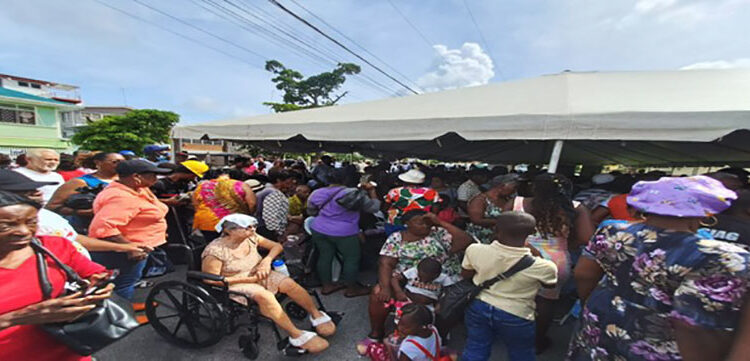
Guyana still needs a current, authoritative measurement of poverty.
Without that, it is difficult for the public to determine how many people remain poor, how many have escaped poverty, which groups remain most vulnerable and whether the government’s enormous expenditure on grants and social programmes is producing measurable reductions in poverty.
The government’s response is that cash transfers are only one part of a much broader strategy.
Officials point to job creation, tax reductions, housing, education, agriculture, public assistance, subsidies and infrastructure investment as measures intended to raise household incomes and improve living standards. Government has also argued that more than $200 billion was returned to citizens through various measures between 2020 and 2024.
The cost-of-living problem remains
Yet the government’s own recent statements acknowledge that prices remain high despite billions of dollars in interventions.
President Irfaan Ali has said that the cost-of-living crisis cannot be solved simply by giving households more money.
At an August 2026 press conference, Ali said “No amount of grant will address it”, arguing that Guyana needs a “multidimensional” response dealing with production costs, supply chains, retail mark-ups and consumer behaviour.
The President also pointed to changing consumption patterns, saying more Guyanese are eating out and shopping in supermarkets rather than traditional markets.
That explanation, however, does little to settle the central question confronting families whose income is already stretched by food, transportation, housing and utility costs: how much of the problem is consumer behaviour, and how much is the cost of surviving in an economy where prices remain high?
What happens when the cheques stop?
That is ultimately the uncomfortable question surrounding Guyana’s cash-grant revolution.
Cash transfers can provide immediate relief. They can put money into the hands of families, help parents meet school expenses and provide critical support to pensioners and vulnerable citizens.
But a grant does not by itself create a job, build a productive business, lower the cost of food or increase a family’s long-term earning capacity.
Guyana is now receiving billions of dollars from its oil resources. The country therefore has an opportunity that few developing nations have ever possessed: to use temporary resource wealth to permanently transform the economic circumstances of its people.
That requires more than measuring success by the size of the next cheque.
It requires current poverty data, measurable poverty-reduction targets, stronger productive sectors, better-paying jobs, affordable food and housing, and a transparent accounting of whether government programmes are actually moving households from dependence to economic security.
Until that happens, the uncomfortable contradiction remains: Guyana can afford to distribute billions of dollars in cash while still struggling to demonstrate, with current data, how many Guyanese have actually escaped poverty.
The real test of the country’s oil wealth will not be how much money the government can put into people’s hands.
It will be whether, in the years ahead, fewer people need the government to put money there at all.