Guyana has finally broken ground on a regional law school at the University of Guyana, moving a proposal that has been debated for nearly three decades from government offices and regional negotiations to an actual construction site.
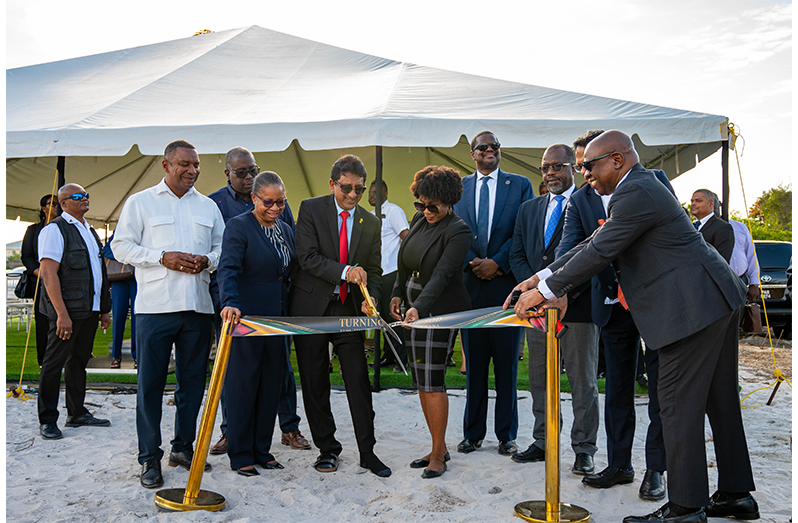
The sod-turning ceremony on Thursday at an eight-acre site at the University of Guyana’s Turkeyen Campus marked the latest—and potentially most significant—step in a long-running effort to establish a Council of Legal Education (CLE) law school in Guyana.
The project is expected to become the Caribbean’s fourth CLE law school, joining institutions in Trinidad and Tobago, Jamaica and The Bahamas. The new school will serve students from across the Caribbean rather than Guyanese students exclusively.
But the road to Thursday’s groundbreaking has been marked by competing proposals, political administrations and a protracted dispute over whether Guyana had already secured approval to establish a law school.
The idea dates back to 1996, when the need for a Guyanese institution emerged amid difficulties faced by University of Guyana law graduates seeking admission to regional law schools.
For years, Guyanese students have been constrained by limited spaces, particularly at Hugh Wooding Law School in Trinidad and Tobago. The CLE eventually provided a limited allocation of places for Guyanese graduates, but the arrangement did not meet demand.
The issue resurfaced forcefully under former Attorney General Basil Williams, who took office in 2015.
Williams became a prominent political driver of the effort to establish a law school in Guyana. In January 2017, he signed a Memorandum of Understanding with Jamaica-based University College of the Caribbean and the Law College of the Americas for the proposed JOF Haynes Law School of the Americas. The proposed institution was named after renowned Guyanese jurist Justice J.O.F. Haynes.
Williams argued that Guyana could no longer depend on limited places at overseas institutions and that a local law school was particularly important as the country prepared to enter the oil-and-gas era.
In 2017, his ministry also established a task force to examine the partners’ business plan and feasibility study. The University of Guyana subsequently approved 10 acres of land for the proposed institution, while Williams said designs had been prepared and construction was estimated at about US$6 million.
By September 2018, a feasibility study and business plan had been submitted to the CLE. Williams said the project had funding from the proposed joint-venture partners and that the institution would help reduce the substantial costs faced by Guyanese students studying abroad.
Williams’ role, however, should not be confused with the establishment of the institution now being built.
His proposed JOF Haynes public-private partnership ultimately did not become the present CLE law school. The proposal encountered resistance and a dispute over the extent of Guyana’s previous approval from the CLE. Contemporary records show that the Council maintained that Guyana had not received final approval to establish the school under the model being advanced by Williams.
The project was subsequently reworked under the current administration.
Attorney General Anil Nandlall and the CLE pursued a model under which the institution would be a regional school administered through the Council of Legal Education, rather than the earlier private-public arrangement.
The renewed process intensified in 2024, when Guyana and the CLE established a collaborative committee to conduct a fresh feasibility assessment.
That study examined the institution’s long-term viability, demand, infrastructure and sustainability. The completed report was submitted to the CLE in September 2025, and the Council formally endorsed Guyana’s proposal later that year through the Bahamas Resolution.
That approval paved the way for the current project.
Nandlall has described Thursday’s groundbreaking as the culmination of decades of work by successive governments, legal officials and regional institutions.
The eight-acre Turkeyen development is expected to expand access to professional legal education while strengthening Guyana’s position as a regional centre for education and training.
Plans also include collaboration with the Caribbean Court of Justice to establish the CCJ Academy of Law at the site.
For Guyana’s law students, the significance is immediate.
Instead of competing for a small number of places at regional institutions and absorbing the cost of studying overseas, graduates will eventually have access to professional legal education at home.
For the wider Caribbean, the project represents an expansion of the region’s legal-education capacity.
And for Guyana, it represents the latest chapter in a story that began almost 30 years ago—with Basil Williams among the political figures who helped push the long-standing idea back onto the national agenda, but with the final institution emerging under a substantially different CLE framework.