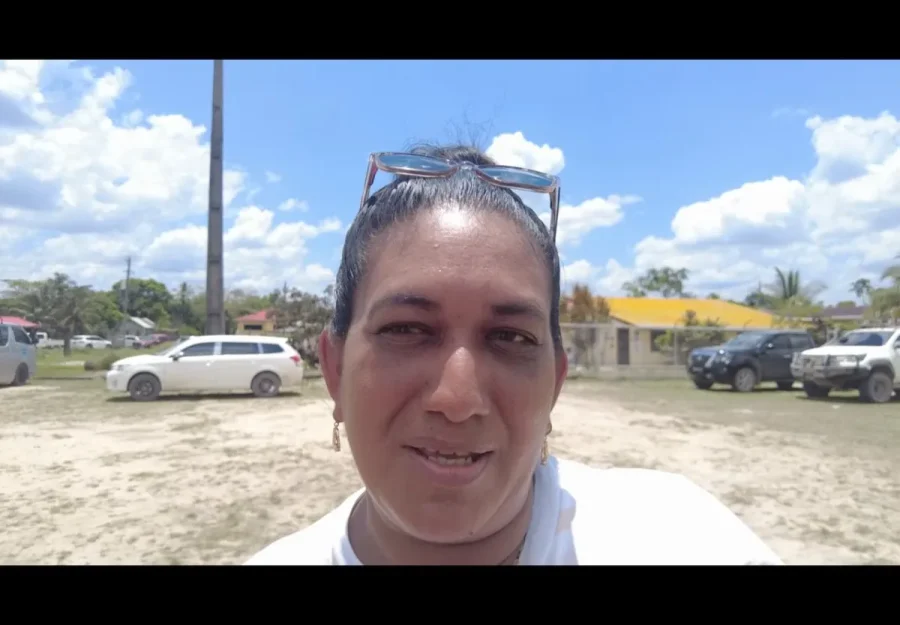
Guyana is earning billions of dollars from oil and pouring billions more into infrastructure, but for Wunita Garey, a mother of three in Coomacka Mines, one of the most basic needs remains a concern: getting her children to school reliably.
Garey, who lives at Three Friend Mine in Region Ten, raised the issue during President Irfaan Ali’s outreach to the community this week, saying reliable transportation remains a major concern for families in the area.
Her three children attend school in Linden, requiring them to travel from the remote mining community to access education.
The concern is particularly striking against the backdrop of Guyana’s unprecedented oil wealth.
Since oil production began in late 2019, Guyana’s Natural Resource Fund had received approximately US$7.57 billion in petroleum revenues by the end of 2025, including profit oil, royalties and a signature bonus. During the second quarter of 2026 alone, another approximately US$1.24 billion in profit oil and royalties was deposited into the Fund.
The country is therefore awash in revenues that were unimaginable before the oil era. Yet the experience of families in hinterland communities raises questions about how quickly that wealth is being translated into improvements in basic services.
Transportation in Coomacka is not a new problem.
In 2019, the Region Ten administration purchased a $15 million off-road school bus specifically to provide free transportation for children from Coomacka, Old England, Nottinghamshire and Three Friends attending schools in Linden.
Officials said at the time that transportation cost families about $500 per day and that the bus would help children attend school regularly and punctually. A previous bus donated in 2016 had developed mechanical problems because it was not suited to the rough terrain.
Seven years later, Garey’s concern demonstrates that providing a vehicle once is not the same as guaranteeing a dependable transportation service.
Government officials, meanwhile, say major investments are continuing.
President Ali announced that another two kilometres of road in Coomacka will be completed before the end of the year, extending works toward Old England. He also directed Guyana Water Incorporated to develop a successful well at Old England and extend the water supply to Coomacka Mines.
“It is non-negotiable,” Ali said, referring to the need to resolve the community’s water problems.
Public Works Minister Juan Edghill said more than $100 billion has been spent on infrastructure development in Region Ten in recent years.
The Government has also outlined plans to make Linden and Region Ten a production hub, with investments in agriculture, poultry, swine production, cold storage, transportation and tourism.
But development should ultimately be measured not only by the value of roads built or billions spent, but by whether residents can reliably access the services those investments are intended to support.
A practical approach would be for Government to establish dedicated, continuously funded hinterland-service programmes—rather than one-off interventions—with guaranteed budgets for school transportation, vehicle maintenance, water systems and access roads.
Such programmes could include published targets for reliability, maintenance and service coverage, allowing residents and taxpayers to see whether promised improvements are actually being delivered.
Garey’s experience provides a simple measure.
Guyana’s oil wealth is generating billions. The question for families in communities such as Coomacka is how much of that wealth is reaching them in the form of something as basic—and as important—as a dependable ride to school.
That is where the promise of Guyana’s oil boom must ultimately be tested: not only in Georgetown’s balance sheets, but in the daily lives of families far from the capital.