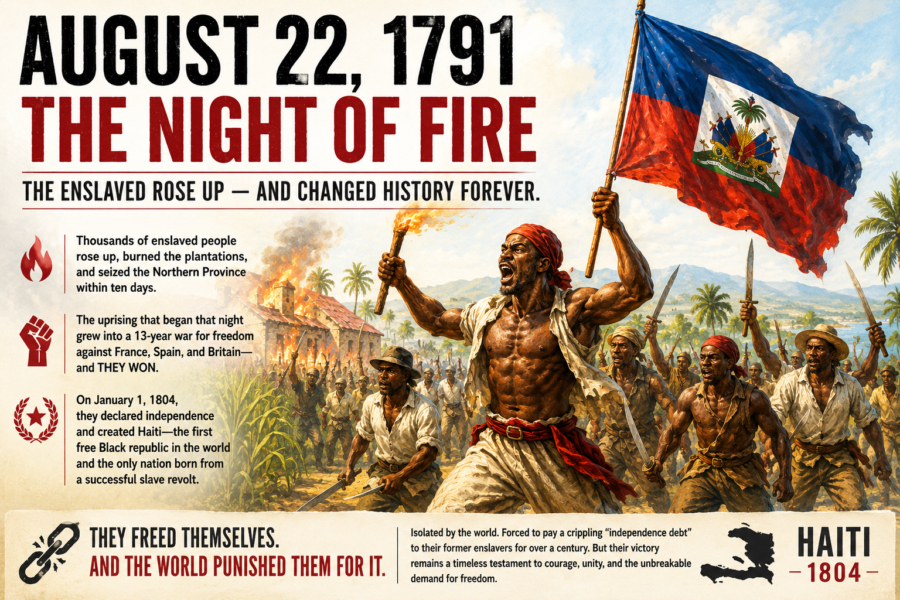
(RootsPreserved) On the night of August 22, 1791, the enslaved people of Saint-Domingue rose up — and lit the fire that would become the only successful slave revolt in human history.
Saint-Domingue, as Haiti was then called, was the richest colony on Earth. Its sugar and coffee plantations generated more wealth for France than all thirteen American colonies had for Britain — and that wealth was built on the backs of nearly half a million enslaved Africans, who outnumbered the white population roughly ten to one and were worked to death under some of the most brutal conditions in the entire slave world.
Days earlier, an enslaved Vodou priest named Dutty Boukman and a priestess named Cécile Fatiman had led a secret ceremony in the woods at a place called Bois Caïman, where the plans for revolt were sealed.
But the uprising was no sudden explosion — it was the result of months, even generations, of secret organizing. Their religion, Vodou, gave the enslaved a hidden network the French dismissed as mere superstition, a way to gather and plan under their enslavers’ noses. Trusted coachmen, foremen, and craftsmen who were allowed to travel carried word from plantation to plantation, while maroons who had escaped to the mountains tied it all together. Bois Caïman wasn’t the start of the plan. It was the signal that the time had come.
Then, on the night of August 22, the north erupted. Thousands of enslaved people rose at once, burning the plantations where they’d been held — and doing it methodically, cutting the roads and severing communication between the parishes so the whites couldn’t coordinate a response. They called it the Night of Fire. Within ten days, they controlled the entire Northern Province.
What began that night did not end for thirteen years. Out of the uprising rose Toussaint Louverture — a formerly enslaved man and a military genius so formidable his enemies called him the “Black Napoleon.” Under his leadership, the formerly enslaved fought the French, the Spanish, and the British — three of the most powerful empires on Earth — and defeated them all. Even after the French captured and killed Toussaint through treachery, his generals finished what he started.
On January 1, 1804, they declared independence and named their new nation Haiti. It became the first free Black republic in the world, and the only nation in history born from a successful slave revolt.
The world never forgave them for it. Terrified that the example might spread, the slaveholding powers — including the United States — isolated Haiti for decades. France went further: in 1825, it forced Haiti to pay a massive “independence debt” to compensate the very enslavers it had defeated, under threat of invasion. Haiti paid it for over a hundred years, a ransom for its own freedom that crippled the nation’s economy well into the twentieth century.
They did the impossible. They freed themselves. And they were punished for it for generations.