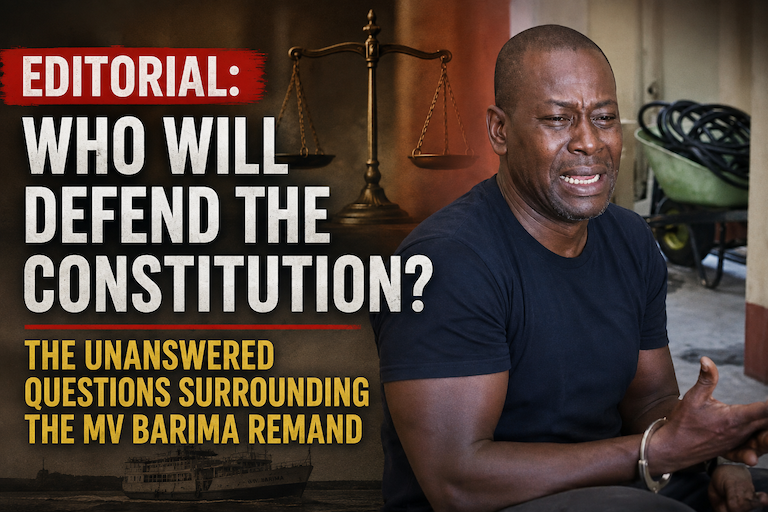
The MV Barima tragedy has left Guyana grieving. Dozens of lives were lost. Families continue to mourn. The nation rightly demands answers and accountability. But justice is measured not only by how we treat victims. It is also measured by how faithfully we uphold the constitutional rights of those accused of causing harm.
That is why an uncomfortable question must be asked. Where are Guyana’s constitutional lawyers? Where are the advocates with the intellectual courage and legal dexterity to mount a robust constitutional challenge to the continued remand of the three men charged with murder? This is not a plea for impunity. It is a plea for constitutional fidelity.
The Constitution does not cease to operate because a case is politically sensitive, emotionally charged, or attracts intense public attention. Indeed, those are precisely the moments when constitutional safeguards matter most. Guyana’s courts have said as much.
In the Dudson case, Justice Roxane George held that even a person charged with murder retains the full protection of the Constitution. When the criminal process violated the accused’s right to a hearing within a reasonable time, the Court intervened. Bail was granted. Constitutional damages were awarded. The Court made it unmistakably clear that liberty cannot be subordinated to administrative delay or prosecutorial inertia. That principle deserves renewed attention.
The MV Barima prosecution arises from one of the most technically complex disasters in Guyana’s history. Determining criminal responsibility requires far more than establishing that a tragedy occurred. It requires evidence capable of answering difficult questions.
Was the vessel seaworthy?
Who certified it?
Were previous inspection reports acted upon?
Was the vessel overloaded?
Were stability calculations properly performed?
Were lifesaving systems operational?
Were there mechanical or structural failures?
Were regulatory agencies aware of deficiencies?
Did management decisions contribute to the disaster?
What role, if any, did systemic failures play?
Many of these questions are the very subject of ongoing investigations.
If those investigations remain incomplete, an obvious constitutional question arises. Should citizens remain incarcerated while the State continues gathering the technical evidence necessary to determine where criminal responsibility actually lies?
That question deserves to be argued before the courts. Continued remand is not punishment. It is an exceptional measure that temporarily restricts the liberty of persons who remain presumed innocent. The presumption of innocence is not an empty phrase recited in courtrooms. It is a constitutional guarantee intended to have real meaning.
If the prosecution believes continued detention is necessary, it should be required to demonstrate why. If there is evidence that the accused present a genuine flight risk, that they are likely to interfere with witnesses, obstruct justice, or otherwise undermine the judicial process, those matters can and should be placed before the court. But if the principal justification for continued detention is simply the gravity of the tragedy itself, constitutional lawyers should be asking whether that satisfies the standards required by our Constitution.
One cannot help but recall the constitutional litigation brought by Senior Counsel Rex McKay on behalf of former Commissioner of Police Henry Greene. Whatever one thinks of the ultimate outcome of that case, it demonstrated an important principle. When counsel believed that prosecutorial decisions lacked an adequate legal foundation, they did not simply accept them as beyond challenge. They tested them before the courts. That is precisely what constitutional advocacy is supposed to do.
Likewise, the Dudson decision demonstrated that the High Court will intervene when constitutional rights are infringed, even in a murder case. These authorities do not guarantee success in the MV Barima matter. They do, however, demonstrate that constitutional remedies exist and that they are meant to be used.
Which brings us back to the central question. Why has there been no widely reported constitutional challenge to the continued remand? Why has there been no sustained public examination of whether Article 139, protecting personal liberty, and Article 144, guaranteeing a fair hearing within a reasonable time, are being fully respected? Why has there been so little public discussion about whether the extraordinary complexity of this marine disaster warrants renewed judicial scrutiny of continued detention?
These questions go to the heart of the rule of law. Every Guyanese should want those responsible for the tragedy to be identified through a fair, independent and evidence-based process. Every Guyanese should also want to ensure that no citizen loses his liberty except in accordance with the Constitution.
Those two objectives are not contradictory. They are inseparable. The true measure of our justice system will not be whether it secures convictions quickly. It will be whether it demonstrates that, even in the shadow of unimaginable loss, Guyana remains governed by law rather than emotion, by constitutional principle rather than public pressure, and by evidence rather than assumption.
If our constitutional protections are not tested in difficult cases, they become little more than words on paper.
The Constitution did not sink with the MV Barima. Neither should our commitment to defending it.




![Ongwen could now be imprisoned for life, though judges will address his sentencing at a later date [File: Peter Dejong/ANP/AFP]](https://villagevoicenews.com/wp-content/uploads/2021/02/Ongwen.jpeg)