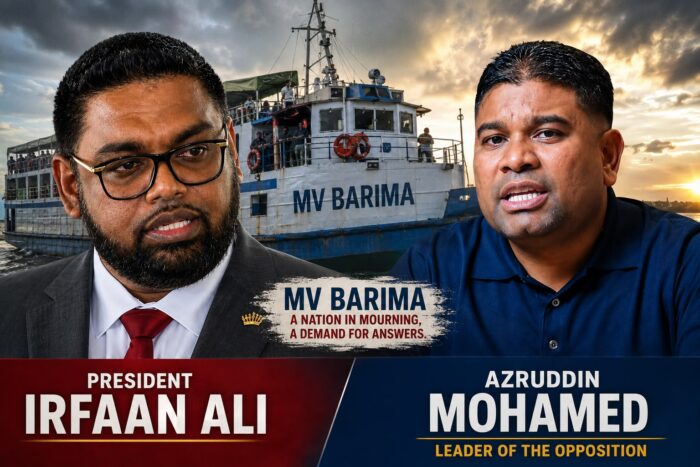
Opposition Leader Azruddin Mohamed has rejected President Irfaan Ali’s handling of the MV Barima tragedy, accusing the Government of excluding the parliamentary Opposition from the establishment of a Commission of Inquiry (COI) while urging Guyanese to prepare for nationwide protests in pursuit of accountability and justice.
Mohamed’s statement came just hours after President Ali announced on Saturday he will appoint a five-member Commission of Inquiry, comprising local and international experts in law, marine engineering, maritime safety and disaster investigation, to probe the circumstances surrounding the sinking of the MV Barima.
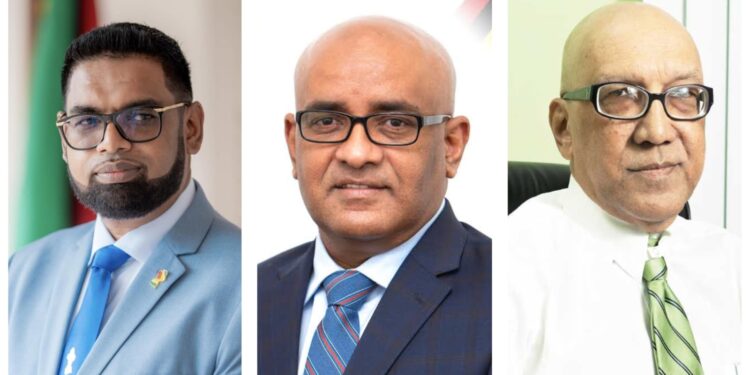
According to the President, the Commission will investigate the ferry’s seaworthiness, maintenance history, passenger boarding and loading procedures, compliance with maritime laws, crew competency, emergency response and whether negligence, misconduct, dereliction of duty or institutional failures contributed to the disaster. It will also recommend legislative and regulatory reforms to strengthen Guyana’s maritime safety framework. This morning President Ali named the five-member Commission
But Mohamed said the Government had already undermined confidence in the inquiry by shutting the Opposition out of its creation.
The President’s announcement came less than 24 hours after Mohamed travelled to Port Kaituma, where he met survivors and grieving relatives of those who died aboard the ill-fated ferry. During the visit, he called on residents to prepare for nationwide protests, saying Guyanese must unite to demand accountability from those responsible.
His visit, streamed live on the Team Mohamed ‘sFacebook page, began with residents taking him on a tour of the Port Kaituma wharf, where they complained that passengers are routinely forced to board and disembark under unsafe conditions. Survivors and relatives also expressed anger over what they described as the Government’s handling of the tragedy and the treatment they received in its aftermath.
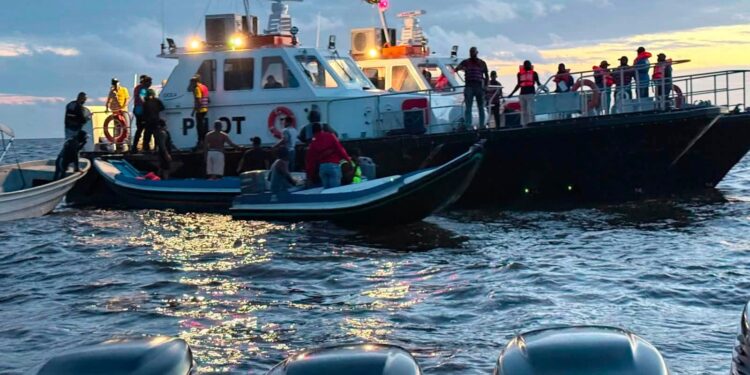
The 87-year-old state-owned MV Barima capsized on July 18 while sailing from Georgetown to Port Kaituma with an estimated 179 passengers and crew aboard. Authorities have confirmed 73 bodies recovered and 76 survivors, making it one of the deadliest maritime disasters in Guyana’s history. The tragedy has triggered mounting calls for accountability amid lingering questions over the vessel’s condition, maintenance, passenger manifest, emergency response and regulatory oversight.
While welcoming the decision to establish a Commission of Inquiry in principle, Mohamed said the process should never have been controlled solely by the Executive.
“I noted the announcement of a Commission of Inquiry into the MV Barima tragedy. However, given the magnitude of this national tragedy, I am disappointed that neither I, as Leader of the Opposition, nor any parliamentary opposition party was consulted in the establishment of the Commission. In an effort to build national confidence, this should have been an inclusive and transparent process.”
Mohamed argued that an inquiry into one of the country’s worst national disasters cannot command public confidence when the Government alone determines its composition, particularly when ministries and agencies under its control are expected to come under scrutiny.
He also renewed calls for Public Works Minister Juan Edghill and Minister Deodat Indar to step aside while the investigation proceeds.
“If the government is serious about ensuring a truly independent investigation, then Ministers Juan Edghill and Deodat Indar, whose ministries have responsibility for MARAD and the Transport and Harbours Department (THD), should be recused from any involvement while the inquiry is ongoing. They should also be required to appear before the Commission and answer all relevant questions.”
Edghill has ministerial responsibility for the Transport and Harbours Department (T&HD), which operates the government ferry service, while Indar oversees the Maritime Administration Department (MARAD), Guyana’s maritime safety regulator.
Mohamed also warned against another inquiry whose findings never reach the public.
“Previous Commissions of Inquiry have been completed without their reports being made public. I hope this Commission operates independently, conducts its work transparently, and that its final report is released in full to the people of Guyana.”
He further urged the Government to enlist the assistance of the International Maritime Organisation (IMO) and other internationally recognised maritime institutions to strengthen the investigation.
“Finally, as a member of the International Maritime Organisation, Guyana should seek the involvement of appropriate international maritime experts and institutions to support this investigation.”
Mohamed’s latest intervention intensifies political pressure on the Ali administration, with the parliamentary Opposition, trade unions, maritime professionals and civil society organisations increasingly insisting that accountability for the MV Barima tragedy cannot begin and end with a Commission of Inquiry. They argue that for public confidence to be restored, the investigation must not only be independent—it must also be inclusive, transparent and free from any perception of political influence.