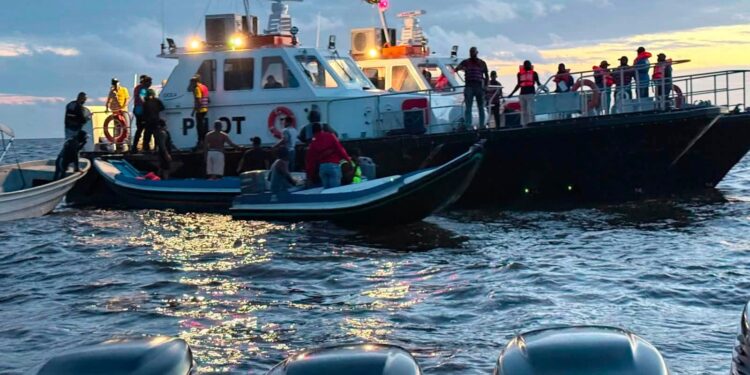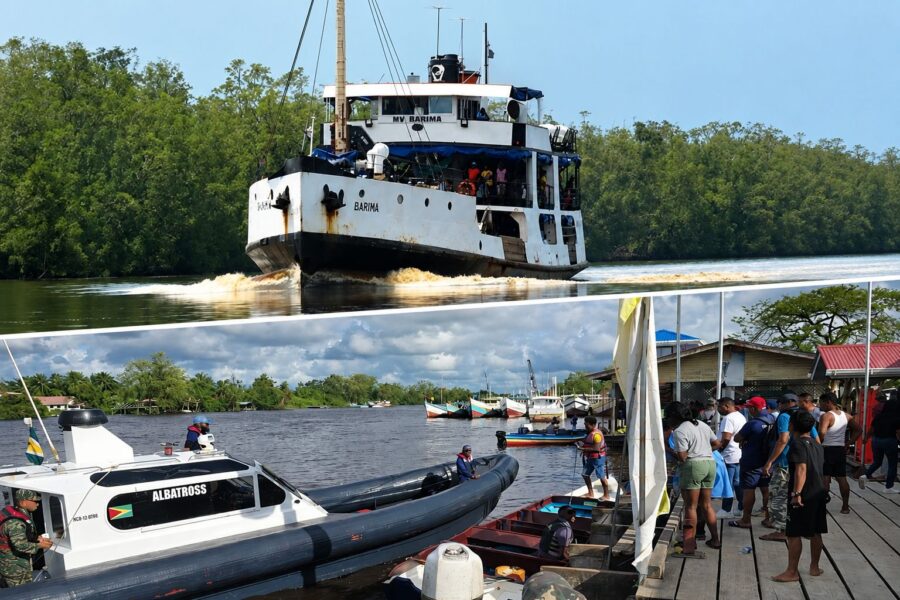
The Guyana Trades Union Congress (GTUC) has issued a forceful call for an independent Commission of Inquiry into the catastrophic sinking of the MV Barima off the Essequibo coast on the evening of Saturday, July 18, 2026, warning that the tragedy was not merely an accident but the foreseeable result of systemic neglect, regulatory failure, and political defensiveness that must not be swept under the carpet.
The organisation contends that the vessel had been operating in dangerous conditions for some time, with crew members and passengers reportedly forced to bail water during voyages and the engine suffering recurring mechanical failures, raising grave questions about how a state-operated ferry was permitted to carry human lives across treacherous waters in such a compromised state. The concerns and recommendations were contained in a statement issued by the GTUC, Tuesday.
The scale of the disaster is staggering. The MV Barima, an 87-year-old ferry built in 1939, was travelling from Georgetown to Port Kaituma when it capsised. Although the ship’s manifest listed only 116 passengers and 17 crew members, authorities now believe as many as 179 people were aboard the vessel, a discrepancy that points to decades of illegal overloading practices at state-run ferry terminals where ticket clerks have long been accused of selling seats off the books for cash.
As of this morning the death toll rises to 73 of that number 69 victims were identified— several of them children. Government said the rescued captain and at least one other crew member tested positive for marijuana and remain in police custody as part of the criminal investigation. The government has declared three days of national mourning, -July 22-July 24-and President Irfaan Ali has warned the nation to “brace yourself for the coming days,” acknowledging that “it is going to be a difficult period for us as a people and as a country.”
The GTUC, however, has refused to allow grief to substitute for scrutiny. In its carefully considered statement, the umbrella labour body explains that it deliberately took time since Saturday evening to observe the unfolding tragedy, engage workers, follow rescue and recovery operations, and assess publicly available information before speaking out. Having done so, the organisation is “deeply disturbed by what has emerged.” The GTUC argues that “accidents do not simply happen. They are caused. They are the consequence of decisions made, warnings ignored, standards neglected, and responsibilities abandoned.”
The GTUC’s statement raises a litany of deeply troubling questions that strike at the heart of maritime safety governance in our nation. Who certified the vessel as seaworthy? When was it last inspected? What defects had been identified? Were repairs recommended but delayed? Were workers instructed to continue operating the vessel despite known problems?
Were complaints by crew members ignored? These are not abstract concerns — they are matters of life and death for the men and women who place their trust, daily, in vessels operated by the state and regulated by agencies answerable to the public. The GTUC notes that the crew, represented by the Amalgamated Transport and General Workers Union, “were entitled to a safe workplace,” and that “every passenger was entitled to safe and reliable transportation.” The organisation is unequivocal: “These are fundamental rights, not privileges.”
The GTUC is also deeply troubled by the conflicting public accounts surrounding the distress call. The organisation points to “differing reports as to when the distress signal was transmitted, when the relevant authorities received it, and how much time elapsed before effective assistance reached those aboard the vessel.“
In a disaster where every minute mattered, the timeline from the moment the vessel encountered difficulty to the transmission of the distress signal, the receipt of that signal by the authorities, the mobilisation of rescue assets, and the arrival of assistance must be established with absolute precision. “Every minute matters when lives are at risk,” the GTUC insists, “and the nation deserves a complete and truthful account of the emergency response.”
But perhaps the sharpest edge of the GTUC’s intervention is reserved for the conduct of Minister of Public Works Juan Edghill. The union accuses the minister of appearing “more concerned with defending his administration than addressing the legitimate concerns of the public” at a time when grieving families deserved “transparency, empathy and accountability.” The GTUC contends that Edghill’s “repeated public interventions have done little to inspire confidence and have instead contributed to confusion and distrust.”
The organisation goes further, calling for the minister to step aside while an independent investigation is conducted, arguing that “his continued involvement can only deepen public concerns about political interference, particularly given his confrontational public posture.” The GTUC invokes a principle that should govern every official inquiry in a functioning democracy: “Justice must not only be done, but must be seen to be done.”
The GTUC’s demands are comprehensive and unambiguous. The organisation is calling for an independent Commission of Inquiry with full powers to subpoena witnesses and documents; the immediate preservation of all maintenance records, inspection reports, seaworthiness certificates, repair logs, voyage records, crew complaints, and communications relating to the MV Barima; a full accounting of the emergency response timeline; a determination of whether management, regulators, or public officials ignored warnings or permitted the vessel to continue operating despite known deficiencies; full protection for crew members and other workers who provide evidence to investigators; and an immediate inspection and safety audit of every government-operated passenger vessel.
These demands reflect a sober understanding that the MV Barima may not be an isolated case, but rather the most visible symptom of a broader culture of neglect that endangers workers and the travelling public across our nation’s waterways.
The GTUC extends its deepest condolences to the families who have lost loved ones and stands in solidarity with the survivors, the crew, the Amalgamated Transport and General Workers Union, and every family whose life has been forever changed. But solidarity, the organisation makes clear, is not the same as silence.
“If negligence, indifference or regulatory failure contributed to this tragedy, those responsible must be held fully accountable.” The GTUC is adamant that “the lives lost aboard the MV Barima must not become another statistic. They must mark a turning point in the way our country protects its workers, safeguards the travelling public, and demands accountability from those entrusted with the nation’s transportation system.“
For a nation that has endured decades of economic hardship and is now poised on the cusp of transformative oil wealth, the MV Barima tragedy is a brutal reminder that prosperity means nothing if it is not accompanied by the most basic protections for ordinary citizens. The GTUC’s intervention is a demand that our country does better — that workers are not treated as expendable, that regulators are not captured by political convenience, and that the powerful are not shielded from scrutiny by the very offices they hold.