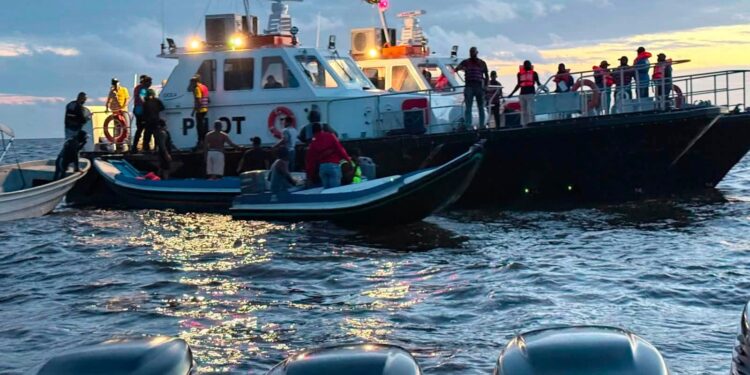
Good day, members of the media, and thank you for being here. I wish to address the serious concerns surrounding the MV Barima, its maintenance history, its operation, and the urgent need to protect the travelling public.
The MV Barima was commissioned in 1936 and served this country for many decades, including on routes from West Bank Berbice to Bartica. It is, however, best known for serving the North West District. By design, the vessel had an estimated passenger capacity of approximately 150 persons and a cargo capacity of approximately 290 tons.
For a vessel of this age, maintenance is not a routine administrative matter; it is a matter of public safety. From the 1990s until 2020, general and specific repairs were undertaken by established contractors, including GNIC, and Courtney Benn Contracting Services. Because of the age of the vessel, several structural components had to be specially fabricated overseas by specialist companies.
Those long-standing maintenance arrangements mattered. They helped ensure that the vessel had access to the specialist parts, knowledge, and technical support required to keep an ageing vessel operating as safely as possible.
After the change in administration, those arrangements were disrupted. Contracts previously awarded to Courtney Benn were withdrawn and the company forced into liquidation, GNIC was no longer operational after its dockyard was repossessed. As a result, maintenance and servicing of the MV Barima were handed to another company whose primary business was fishing.
Let me be clear: this is not a personal attack on any contractor. The real issue is whether the critical link to specialist fabrication, replacement parts, and proven maintenance systems for a vessel of this age was broken. That question must be examined carefully by independent maritime experts.
Records will show that the MV Barima was docked in November 2015 and underwent a comprehensive rehabilitation. That work included new engines, new shafts, hull works, and upgrades to the cargo and passenger areas. The vessel returned to full operation in March 2017. Between 2017 and 2020, records also indicate that the vessel underwent its required maintenance cycles and was deemed seaworthy up to that period.
However, even with those efforts, the administration at the time understood that the remaining effective lifespan of the vessel was limited. That is why, through a grant and loan arrangement provided by the Government of India, designs were advanced for the procurement of a new vessel for the North West route.
Following an independent tender process, a successful bidder was selected. That award was challenged by the unsuccessful bidder, and a further review was conducted. The review confirmed that the original decision was correct, as the vessel proposed by the successful bidder was superior in key respects.
On returning to office, the PPP reversed the decision made through that independent process and awarded the contract to the previously unsuccessful bidder. The result was the MV Ma Lisha, a vessel which, in our view, is not properly suited to the needs of the Northwest route because of its size and design. The public was told that the lower bid would allow savings to be used for the construction of new stellings to receive the new vessel. Years later, those promised facilities remain incomplete.
Port Kaituma wharf is a clear example of mismanagement. The wharf project was so poorly designed that it required major corrective works. Questions remain about whether adequate preliminary studies were conducted and whether taxpayers were forced to bear additional costs because of these design flaws. To date, the project remains incomplete and is now being given as the excuse why the MV Barima had to remain in operation.
We must also address the issue of ticketing, passenger control, cargo management, and vessel loading. The problem of persons attempting to travel without official tickets, whether with or without the collusion of staff, is not new. Between 2015 and 2020, independent inspectors were hired directly by the then Ministry of Public Infrastructure to verify that passengers, cargo, fuel, and related operational matters were properly accounted for and documented.
This independent inspection system was later disbanded. The inspectors were removed and, to the best of our knowledge, not replaced with an equivalent system of oversight. Had such a system remained in place, it may have helped prevent unsafe loading practices and other operational failures.
Today, we are calling for some urgent actions: first, a full and independent examination of maintenance, inspection, dry-docking, and certification records for the MV Barima in accordance with our maritime laws; second, every passenger vessel in the country’s fleet must be inspected to confirm its seaworthiness and suitability for the route on which it is being used.
We are also calling for the immediate modernization of docking facilities, the introduction of a secure and efficient ticketing system, and the urgent commencement of a credible programme to replace ageing vessels with a modern ferry fleet supported by upgraded terminals.
This is not only about one vessel. It is about public safety, accountability, and the right of citizens in riverain and hinterland communities to travel with confidence. The people deserve answers, and they deserve a transport system that is safe, modern, reliable, and properly managed.
Thank you!