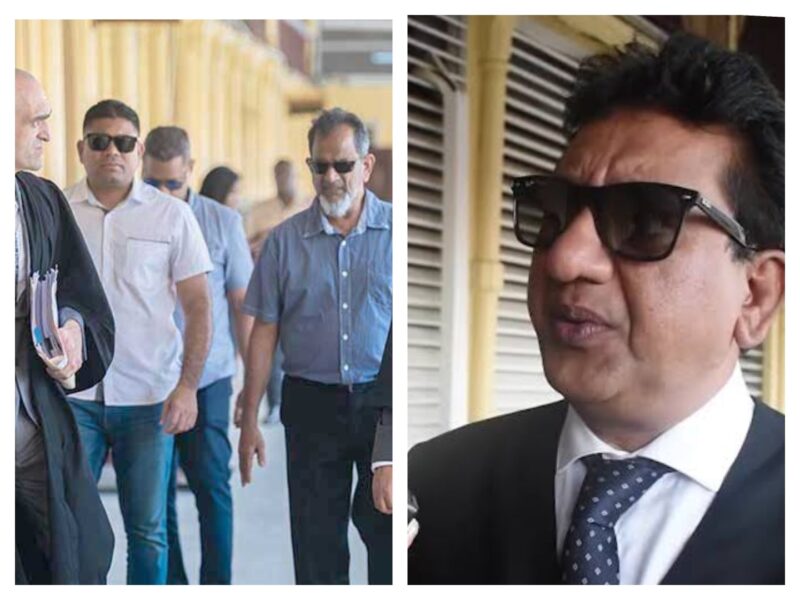
Attorney General Anil Nandlall’s public criticism of the defence lawyers representing Opposition Leader Azruddin Mohamed and his father, Nazar Mohamed, in their ongoing extradition proceedings raises an important question: when a matter remains before the courts, should the country’s chief legal adviser publicly assign blame for the pace of the proceedings?
In an interview with the state-owned National Communications Network (NCN), reported by Guyana News Pulse on November 9, 2026, Nandlall accused the defence team of deliberately prolonging the case.
He declared:
“The case is being stalled by the defence counsel.”
He went further:
“No extradition case has lasted a year. No committal hearing in an extradition case has lasted a year. Not a single witness has been completed yet in one year of hearings.”
Those comments warrant scrutiny because the extradition proceedings remain active and subject to judicial determination. Nandlall is not an ordinary political commentator. As Attorney General, he is the Government’s principal legal adviser and has personally appeared in related court proceedings defending the State’s position.
The issue is not whether Nandlall is entitled to discuss matters of public importance. It is whether publicly blaming one side in an unresolved judicial proceeding is consistent with the restraint expected of a senior law officer, particularly when the court must independently assess the conduct of both parties and manage the pace of the hearing.
The sub judice principle and the duty of restraint
The principle of sub judice — meaning “under judicial consideration” — is recognised in Commonwealth legal systems. It is concerned with protecting the administration of justice by guarding against public commentary that could prejudice pending proceedings, influence witnesses, exert pressure on parties or create the impression that a case is being tried in the court of public opinion.
Guyana’s legal framework addresses this issue through the Contempt of Court Act 2010. The Act defines contempt to include conduct that substantially obstructs, interferes with or prejudices, or tends to substantially obstruct, interfere with or prejudice, the administration of justice in proceedings pending before the courts. It also defines publication broadly to include speech, writing and broadcasts communicated to the public.
This does not mean that every public statement about a pending case automatically amounts to contempt or breaches the sub judice principle. Fair and accurate reporting of court proceedings is protected under the Act, and public discussion of matters of legitimate interest is not automatically prohibited. The nature, context and likely effect of the publication are important.
Nevertheless, the principle carries particular weight when commentary comes from a senior government law officer closely connected to the State’s position in the proceedings. Publicly characterising the defence as responsible for delaying the case risks creating a narrative before the court has completed its consideration of the evidence and legal arguments.
The concern goes beyond legal technicalities. It touches on the appearance of fairness and public confidence that the outcome will be determined by evidence and law, rather than by competing political or public narratives.
The court, not the Attorney General, determines the pace
The Mohamed extradition proceedings began with the arrest of the father and son on October 31, 2025. The committal hearing commenced on January 6, 2026.
Two prosecution witnesses have testified: Permanent Secretary Sharon Roopchand-Edwards, whose evidence addressed the diplomatic process and the United States’ extradition request, and Senior Superintendent Prem Narine, head of the Guyana Police Force Special Branch. Their cross-examinations have not both been completed.
The fact that witnesses have not completed their evidence does not, by itself, establish that the defence is abusing the process or deliberately obstructing justice. Cross-examination is a fundamental safeguard that allows the defence to test evidence, challenge inconsistencies and examine the credibility and reliability of witnesses.
The court is responsible for managing the hearing, determining the relevance of questions and ensuring that proceedings are conducted fairly. It is not for the Attorney General to publicly settle the question of who is responsible for the pace of the case.
A case still before the courts
The proceedings have also been complicated by constitutional challenges. On July 29, 2026, the Caribbean Court of Justice dismissed an appeal brought by the Mohameds, allowing the extradition proceedings to continue.
A separate constitutional challenge proceeded before the Guyana Court of Appeal. On August 27 and 28, the Court allowed the committal hearing to continue but restrained the Magistrate from making a final decision until the constitutional appeal was determined. The Court of Appeal heard arguments on October 13 and reserved its ruling.
Nandlall appeared for the State in that constitutional challenge. His involvement makes the need for careful public commentary even more significant. While he is entitled to defend the Government’s legal position, his public statements should not create the impression that the State is seeking to shape how ongoing proceedings are viewed or judged outside the courtroom.
The United States is seeking the extradition of the father and son under an 11-count indictment involving allegations of fraud, money laundering and customs-related offences connected to gold exports. US authorities allege that more than US$50 million in taxes and royalties were not paid. Both men deny wrongdoing, and the allegations have yet to be determined through the extradition process.
Justice must not become a public-relations exercise
There is a legitimate public interest in understanding why the extradition proceedings have taken so long. The public is entitled to ask questions about delays, the conduct of the parties and the use of judicial resources.
But accountability must not come at the expense of judicial independence. Public commentary, particularly from influential officeholders, can carry consequences beyond ordinary political debate.
Nandlall’s remarks do not, on their own, establish contempt of court or a breach of the sub judice principle. That determination belongs to the courts and depends on the applicable law and circumstances. However, publicly blaming the defence while the matter remains unresolved risks prejudging an issue that the court itself must assess.
The Constitution of Guyana, Article 144, guarantees a fair hearing within a reasonable time before an independent and impartial court. Article 122A also provides for the independence of the courts from the control and direction of other persons or authorities.
Those protections apply regardless of a person’s political position, public profile or the seriousness of the allegations being advanced.
The central question is whether the Attorney General’s public intervention helps preserve confidence in the judicial process or risks placing additional pressure on proceedings that must remain independent of political influence.
In a constitutional democracy, the Attorney General may argue the State’s case in court. He must also respect the court’s responsibility to determine it, without appearing to try the matter again in the court of public opinion while the judicial process is still unfolding.