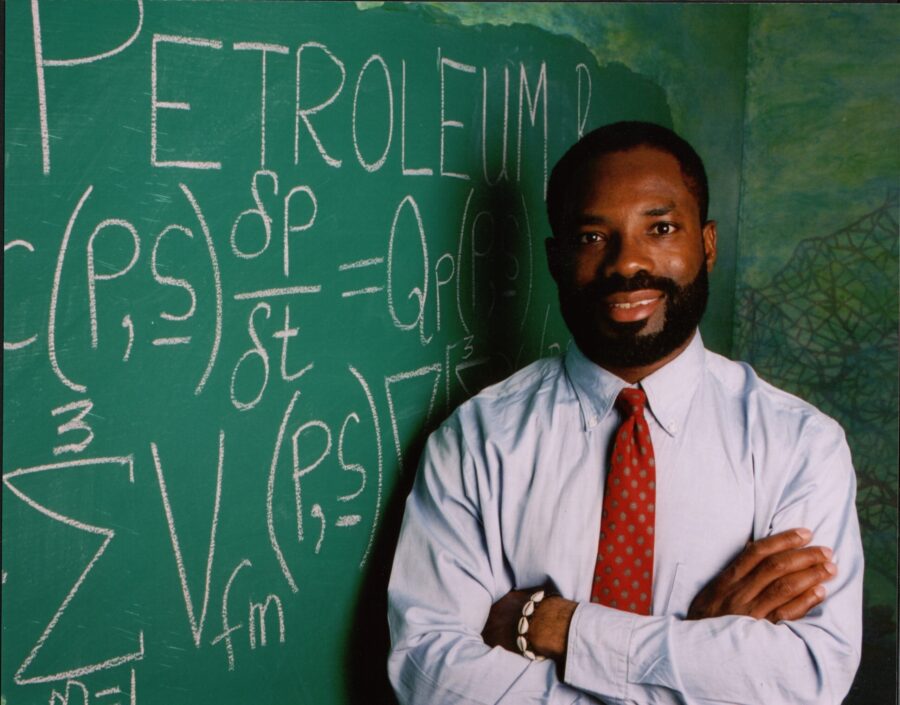
At a time when technology shapes nearly every aspect of modern life, few people realise that some of the ideas behind today’s supercomputers, cloud computing and large-scale data processing were advanced by a young boy from Nigeria who once had to abandon school because his family could no longer afford the fees.
Dr. Philip Emeagwali’s remarkable journey—from poverty and civil war to becoming one of the world’s most celebrated pioneers in high-performance computing—is a powerful reminder that talent knows no boundaries and that perseverance can overcome even the harshest circumstances.
Born in Nigeria on 23 August 1954, Emeagwali’s formal education came to an abrupt halt at the age of 14 when financial hardship forced him to leave school. For many children, that might have marked the end of academic ambition. Instead, it became the beginning of an extraordinary story.
Refusing to let his son’s education end, Emeagwali’s father transformed their home into a classroom. Every day he challenged Philip with demanding mental exercises, including solving as many as 100 mathematics problems within an hour. Those relentless lessons continued until, by Emeagwali’s own account, he had learned more mathematics than his father could teach him.
The experience instilled in him an unwavering belief that knowledge—not wealth—was the greatest pathway to opportunity.
His childhood unfolded against the backdrop of the Nigerian Civil War, one of Africa’s most devastating conflicts. Living in a building scarred by rocket shells, Emeagwali witnessed violence and uncertainty firsthand. Yet amid the destruction, he saw education as his escape.
Rather than allowing his circumstances to define him, he immersed himself in mathematics and science, convinced that intellectual achievement could carry him beyond the hardships surrounding him.
That determination paid off.
At just 17 years old, Emeagwali earned a scholarship to Oregon State University in the United States, where he completed a Bachelor of Science degree in Mathematics. His academic journey did not stop there. He went on to earn two master’s degrees from George Washington University before completing a Ph.D. in Scientific Computing at the University of Michigan, establishing himself as one of the leading minds in computational science.
His greatest breakthrough came in 1989.
Inspired not by another computer scientist but by nature itself, Emeagwali studied the remarkable efficiency of honeybees. He observed how thousands of bees work independently yet cooperatively within a honeycomb to achieve extraordinary results. That natural system sparked an idea: what if thousands of computer processors could work together in much the same way?
The result was a landmark achievement in parallel computing.
Using approximately 65,000 processors working simultaneously, Emeagwali demonstrated how complex scientific problems could be divided into thousands of smaller calculations and solved at the same time instead of one after another. His system achieved approximately 3.1 billion calculations per second—an extraordinary accomplishment for its time—and helped demonstrate the immense potential of massively parallel computing.
While computing technology has advanced dramatically since then, the principle that Emeagwali helped demonstrate remains fundamental to today’s digital world. Modern supercomputers, cloud computing platforms, artificial intelligence systems, weather forecasting models and big data analytics all rely on the concept of distributing massive computational workloads across multiple processors working in parallel.
His research showed that solving complex scientific problems did not necessarily require building one increasingly powerful processor. Instead, tremendous performance could be achieved by enabling thousands of processors to communicate and solve different parts of the same problem simultaneously.
That concept has become a cornerstone of modern computer architecture.
Emeagwali’s work also extended beyond computer science. His computational methods contributed to more efficient oil reservoir analysis, helping improve petroleum exploration and production. His innovations have also supported advances in weather prediction, environmental modelling and climate research, allowing scientists to process enormous quantities of data with unprecedented speed.
His contributions earned him the prestigious Gordon Bell Prize, widely regarded as one of the highest honours in high-performance computing. The award recognizes exceptional achievement in applying advanced computing to solve significant scientific and engineering challenges.
Over the years, Emeagwali has been widely celebrated as one of Africa’s most accomplished scientific innovators and has often been described as the “Bill Gates of Africa” for his influence on technology and his role in inspiring generations of young Africans to pursue careers in science, technology, engineering and mathematics (STEM).
His story continues to resonate because it demonstrates that innovation is not confined to wealthy nations, elite schools or privileged backgrounds. It can emerge from places marked by poverty, conflict and limited opportunity when determination is matched with curiosity and hard work.
For students around the world—particularly those facing economic hardship or seemingly insurmountable obstacles—Dr. Philip Emeagwali’s life offers an enduring lesson. Being forced out of school did not define his future. Living through war did not extinguish his dreams. Instead, each challenge strengthened his resolve to learn, create and contribute.
Today, every time scientists simulate climate change, engineers analyze massive datasets, researchers run sophisticated medical models or artificial intelligence systems process billions of pieces of information across thousands of servers, they are benefiting from principles that pioneers like Philip Emeagwali helped bring into the mainstream.
His journey is more than a story of personal triumph. It is a testament to the power of education, the importance of perseverance and the limitless possibilities that emerge when human curiosity refuses to surrender to adversity.
In an era increasingly driven by technology, Dr. Philip Emeagwali’s legacy stands as a reminder that the next world-changing innovator may be sitting in a modest classroom—or learning at a kitchen table—waiting only for the opportunity to realize their potential.