They had endured centuries of enslavement, survived the brutality of the plantation system and emerged from emancipation with little more than hope, determination and each other. Yet in one of the most remarkable acts of collective self-liberation in Caribbean history, freed Africans pooled their hard-earned savings to purchase the plantations on which they had once been enslaved, establishing independent villages that became the cradle of local democracy and one of the enduring foundations of modern Guyana. The Village Movement was more than a quest for land—it was a declaration that freedom, dignity and self-determination would never again be surrendered.
It was, historians have observed, a people buying not simply land, but dignity, liberty and a future.
Buying Freedom Twice
When full emancipation took effect on August 1, 1838, thousands of Africans left the plantations determined never again to live under the control of the plantocracy. Their freedom had not come easily. Four years earlier, on August 1, 1834, slavery had been legally abolished throughout the British Empire, but instead of immediate liberty, the British introduced the Apprenticeship (Amelioration) System, compelling formerly enslaved Africans to continue labouring for their former enslavers without wages for a prescribed number of hours each week.
Widely condemned as “slavery under another name,” the system was abandoned after sustained resistance by the apprentices and pressure from British abolitionists, paving the way for full emancipation on August 1, 1838. Through extraordinary sacrifice, freed Africans then pooled wages earned during the apprenticeship period and immediately after emancipation to purchase abandoned sugar and coffee estates.
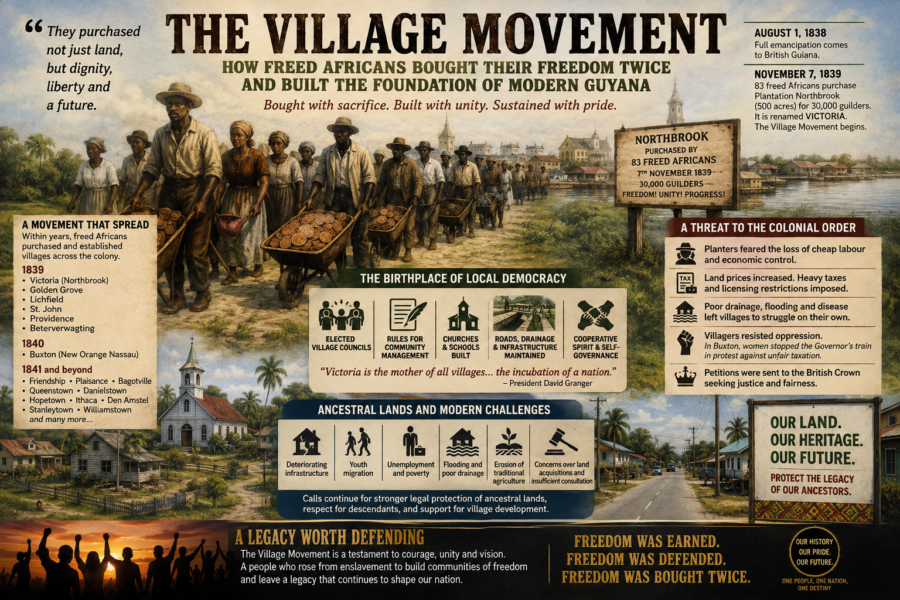
The defining moment came on November 7, 1839, when 83 freed Africans from Ann’s Grove, Dochfour, Hope, Paradise and Enmore collectively purchased Plantation Northbrook, a 500-acre coffee estate, for 30,000 guilders. They famously transported thousands of coins in wheelbarrows to Georgetown to complete the transaction before renaming the estate Victoria, in honour of Queen Victoria. Historians widely regard that purchase as the beginning of Guyana’s Village Movement.
The purchase ignited a movement that transformed British Guiana.
Within months, freed Africans acquired Golden Grove, Lichfield, St. John, Providence and Beterverwagting. In 1840, 128 freed Africans purchased Plantation New Orange Nassau, renaming it Buxton after British abolitionist Sir Thomas Fowell Buxton. Other villages soon followed, including Friendship, Plaisance, Bagotville, Queenstown, Danielstown, Hopetown, Ithaca, Den Amstel, Stanleytown, Williamstown and many others stretching from Essequibo to Berbice.
By the mid-nineteenth century, the coastline of British Guiana had been transformed from a chain of plantations into a network of African villages owned and governed by the descendants of those who had once been enslaved.
A Threat to the Colonial Order
The success of the Village Movement sent shockwaves through the colonial establishment.
For plantation owners, the villages represented more than lost estates. They threatened the very labour system upon which the sugar economy depended.
In a speech in the National Assembly marking National Day of Villages, former President David Granger noted that planters, facing declining sugar prices and labour shortages, “did everything possible to try to destroy the village movement.” He recounted that villagers had to fight “against the planter class and… a vindictive Government” determined to weaken the new communities.
Colonial authorities responded by raising land prices once they realised freed Africans had accumulated savings. Heavy taxes and licensing requirements were imposed, while many villages struggled with inadequate drainage, flooding and disease without meaningful government assistance.
Resistance became legendary.
In Buxton, women famously stopped the Governor’s train in protest against oppressive taxation, while villagers in several communities petitioned the British Crown over measures they believed were designed to cripple their newfound independence.
Yet despite every obstacle, the villages endured.
The Birthplace of Local Democracy
The Village Movement produced far more than settlements.
It gave birth to local government in Guyana.
The new villages established elected councils, drafted rules for community management, maintained roads and drainage systems, built churches and schools, and developed cooperative systems of governance decades before political self-government became a national reality. Scholars have described the movement as the genesis of local government in British Guiana.
Granger has described Victoria as “the mother of all villages,” arguing that the purchase of Northbrook represented “the incubation of a nation” because it transformed the colonial landscape from plantations into communities owned by free people.
Ancestral Lands and Modern Challenges
Nearly 190 years later, the descendants of the original purchasers continue to regard many of these villages as ancestral lands secured through sacrifice rather than inheritance.
Today, however, those communities face new challenges.
Many villages struggle with deteriorating infrastructure, youth migration, unemployment, flooding, inadequate drainage, and the erosion of traditional agriculture. At the same time, residents and community organisations have increasingly voiced concerns over government acquisition of village lands for development projects, compulsory acquisitions, transport corridors and other public purposes. Some argue that insufficient consultation with descendants of the original purchasers threatens a legacy painstakingly built by their foreparents after emancipation.
These debates have renewed calls for stronger legal protection of ancestral village lands, more robust local democratic institutions and greater recognition of the historical significance of the Village Movement.
A Legacy Worth Defending
The Village Movement remains one of Guyana’s greatest national achievements.
It demonstrated that people emerging from centuries of enslavement possessed the determination, discipline and vision to build prosperous communities, educate their children and govern themselves despite sustained opposition from colonial authorities.
The villages became more than places to live. They became symbols of economic independence, political participation, cultural resilience and collective ownership.
Nearly two centuries later, their story continues to remind Guyanese that freedom was never simply granted. It was earned, defended—and, in many respects, purchased twice.