What began as a dispute over the ownership, scale of expansion and acreage of President Irfaan Ali’s Long Creek farm has evolved into a much broader national debate about political privilege, transparency and the integrity of public office in oil-rich Guyana.
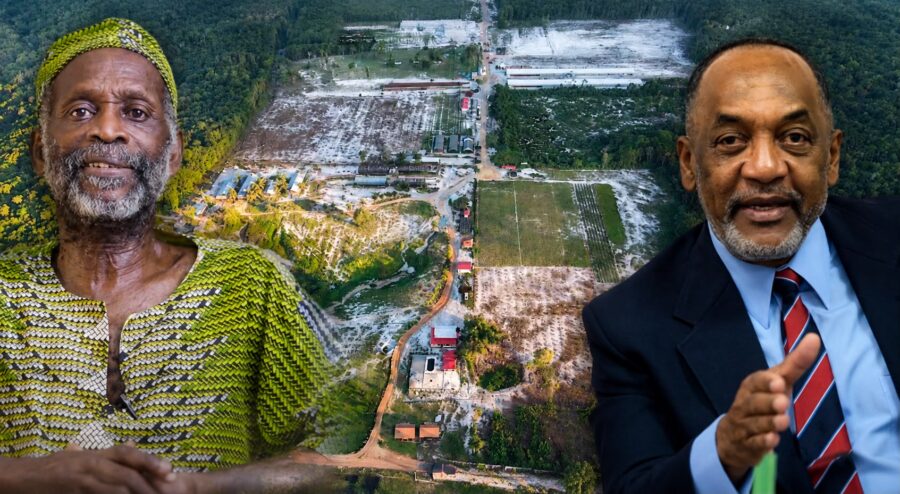
Last Friday, former Environmental Protection Agency (EPA) Executive Director Dr. Vincent Adams and veteran Working People’s Alliance (WPA) co-leader Tacuma Ogunseye argued that the controversy is no longer about the physical size of the property. Instead, they said it has become a symbol of deeper concerns over governance, corruption and the concentration of wealth and power among the country’s political elite.
The controversy erupted after Opposition Leader Azruddin Mohamed publicly questioned the ownership and scale of the Long Creek farm, alleging that the property spans approximately 150 acres. President Ali rejected that claim, maintaining that he owns less than half of the property. However, while disputing the acreage, the President has not publicly disclosed the actual size of his ownership.
Independent spatial analysis using satellite imagery has added another dimension to the controversy. Measurements conducted using geographic mapping technology have estimated the developed footprint of the farm at approximately 155 acres and more, while separate estimates have placed the value of the sprawling agricultural estate at more than $5 billion, further fuelling public scrutiny and calls for greater transparency.
Appearing on political commentator Dr. David Hinds’ Politics 101 programme, Adams said the President’s explanation has failed to resolve the central questions surrounding the property.
“The president is saying, ‘Well, no, it’s half of it,’ except that he didn’t say what that number is,” Adams observed. “You would think that if somebody is going to make a defence for themselves and say it’s much less, they would have said what that number is.”
According to Adams, independent assessments conducted by associates using satellite imagery produced estimates ranging from approximately 155 acres to more than 200 acres.
“One came up with 155 acres… and the other one came up with 209. All you got to do is use the technology,” he said, insisting that the President could end the speculation by fully disclosing the property’s size.
But Adams maintained that the acreage itself has become secondary.
“This is beyond the boundary,” he declared. “It is within the boundary of leadership. The leader of a country sets the moral tone for that country. If the leader is corrupt, you cannot expect the society to be different. That becomes the culture.”
He described the farm controversy as merely the latest manifestation of what he believes is an entrenched culture of political privilege.
“The farm is just one symptom of what is taking place in Guyana. It is an indication of morality and corruption. If we cannot fix those fundamental principles, then the country is in trouble regardless of Exxon or anyone else.”
Adams also linked the controversy to the government’s proposed legislation expanding benefits for former presidents, arguing that both developments reflect what he characterised as a broader pattern of political self-enrichment.
“Don’t take this bill in a vacuum,” he warned. “The common interest, as it appears, is to enrich those in power while the poor continue to suffer.”
He contrasted the reported amenities at the ranch with the living conditions of nearby residents.
“The animals on this farm are getting electricity 24 hours a day. They’re getting air conditioning and water. The people living nearby don’t even have water or electricity. They have to fetch water from the creek.”
Ogunseye said the public’s intense interest in the ranch reflects far more than curiosity about a private agricultural enterprise. Instead, he argued, it has become a focal point for widespread dissatisfaction with the People’s Progressive Party/Civic (PPP/C) administration and growing concern over how wealth is accumulated and distributed in Guyana’s oil economy.
According to Ogunseye, the controversy should not be viewed simply as a personal dispute between President Ali and businessman Azruddin Mohamed.
“It is not simply a fight between Mohamed and Ali,” he said. “It is a struggle over how wealth is acquired in Guyana, how wealth is distributed, and who enjoys unprecedented access to that wealth.”
Guyana’s unprecedented oil-driven economic boom has intensified public scrutiny of those in public office. The Long Creek farm controversy has evolved far beyond a dispute over acreage, becoming a flashpoint in the national debate over transparency, accountability, the accumulation of wealth, and whether those entrusted with political power are meeting the ethical standards expected in a modern democracy.