Dear Editor,
The 2025 Combined Financial Report for the Guyana oil consortium (Exxon, Hess/ Chevron, and CNOOC) show that total revenue is US$17.2 Billion; and the total profit is US$12.1 Billion. Given that profits are to be shared equally between the companies and Guyana, it is clear that Guyana and the companies should each receive US$6.1 Billion. Additionally, with royalties of 2 percent of total revenue, which works out to US$344.3 Million, this means that Guyana total take home is US$6.4 Billion. However, noting that Guyana pays the taxes from its share for the consortium, this amount (US$2.3 Billion) is subtracted from Guyana’s share of benefits (Profits, and Royalties); and it is added to the consortium’s benefits (profits and taxes paid by Guyana). Given these distributional specifications, the total combined benefit for the oil consortium is US$8.4 Billion, or 66.9% of the total Benefits (US$12.4 Billion), compared with US$4.1 Billion (33.1%) for Guyana (Table 1).
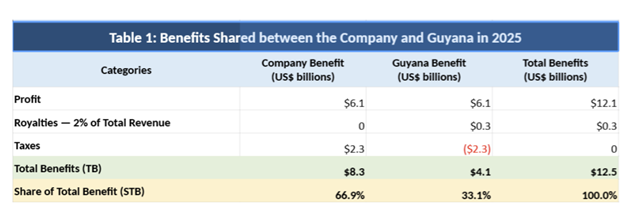
It should also be stated that this distribution of total benefits of US$ 4.1 Billion for Guyana (33.1% of total benefits of US$12.5 Billion) is overstated. This is because Guyana’s profit is not US$6.1 Billion, but only US$2.1Billion in 2025 (Ram: https://kaieteurnewsonline.com/2026/06/28/part-1-six-to-one-is-not-50-50/). Furthermore, there are additional costs, including amounts for insurance, loss of fishermen’s income, and environmental balance; but the budgets for these cost categories are unknown. When the tax payment for the oil consortium and other cost adjustments are included, along with the other costs, Guyana’s benefit in real terms is reduced from US$4.1 Billion to no more than US$100 Million (Table 2).
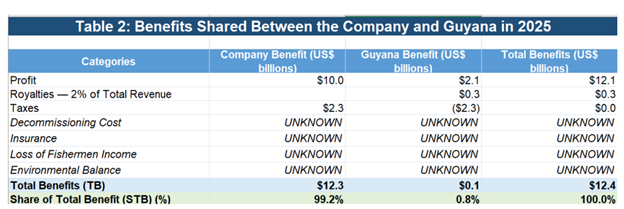
Another troubling outcome of this arrangement is that the taxes (US$2.3 Billion) paid by Guyana is greater than the profits that Guyana receives (US$2.1Billion). What is also disconcerting with this arrangement is the fact that Guyana’s share of total benefits (US$100 Million) is only 1% of the total benefits (US$12.5 Billion), when compared with the US$12.3 Billion that is captured by the company. Consequently, Guyana’s share of oil revenue in 2025 is no more than a drop of oil in a US$17.2 Billion Revenue Bucket. The underlying cause for this outcome is not only the tax payment made by Guyana for the company; but the cost recovery formula which inflates the average cost of a barrel of oil and reduces the profit that Guyana receives. This issue will be presented in a subsequent letter, where the cost will be analyzed in conjunction with the benefits.
Yours truly,
Kenrick Hunte
Joe Persaud
Darsh Khusial
On behalf of OGGN (www.oggn.org)
a 501(c)3 organization.