by Randy Gopaul
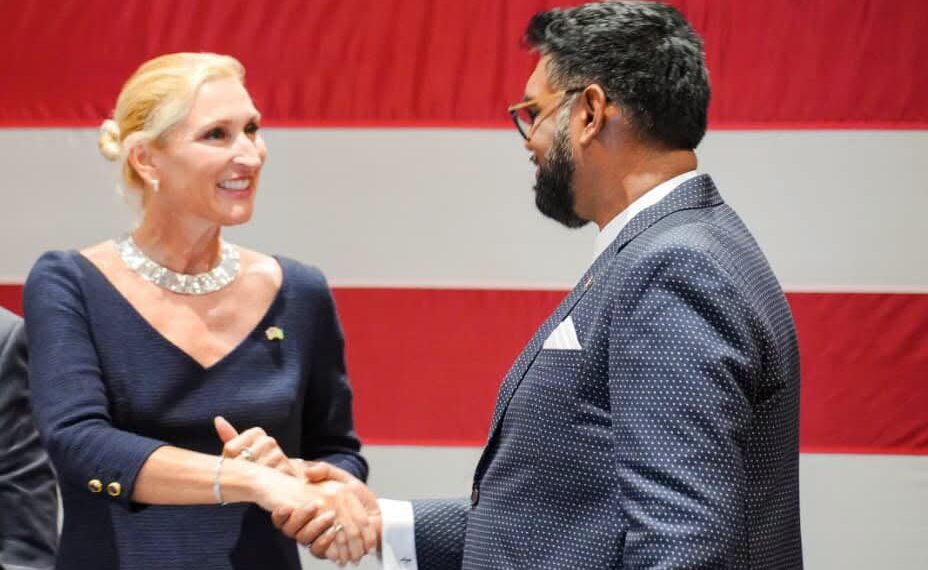
The images were striking. At the Four Points by Sheraton this week, as the United States Embassy rolled out the red carpet for America’s 250th independence anniversary, Guyana’s political class and ‘everyone who is anyone’ turned out in force . The scene was one of mutual admiration U.S. Ambassador Nicole Theriot lauding the bilateral relationship, President Irfaan Ali hailing the United States as a “trustworthy and reliable partner” .
Yet beyond the champagne and diplomatic toasts, something more revealing was on display. The gala offered a stark lesson in just how coveted proximity to power has become in Guyana.
Consider Minister of Local Government Priya Manickchand. In 2014, as acting Foreign Minister, she used an American Independence Day reception at the ambassador’s residence to deliver a blistering public dressing-down to then-U.S. Ambassador Brent Hardt. Her remarks were proudly described as a “feral blast” by none other than PPP Chief Spokesperson, Dr. Roger Luncheon. A ‘feral blast’ that reportedly reached the wider world . It was a moment of defiance a small nation refusing to be lectured by a superpower.
Now, however, Manickchand was in attendance once more. The intervening decade has seen her political ambitions grow, and she appears to have reached an unmistakable conclusion: the path to the presidency of Guyana runs through the U.S. Embassy. Whether all is forgiven remains to be seen, but the optics of her presence alongside the very institution she once publicly rebuked speak volumes.
There is, however, a more uncomfortable question lurking beneath the mutual lauding between Ambassador Theriot and President Ali. As Washington deepens its embrace of Georgetown, one has to wonder: does the United States truly understand the depth of the accusations that have long dogged the People’s Progressive Party?
For years, critics have levelled serious charges against the PPP: corruption, refusal to obey the course when decisions go against them, human rights violations and refusal two years after to mount an inquiry as called for by the UN Human Rights Committee, extrajudicial killings, money laundering, oppression, and racism; the list is extensive. The party’s tenure is marked by scandals ranging from the billion-dollar fibre-optic cable debacle to the Pradoville land distribution controversy . More recently, the United States itself has sanctioned opposition figure Azruddin Mohamed and his businesses for gold smuggling and tax evasion exceeding US$50 million a case now before the courts . Ambassador Theriot has openly described Mohamed’s potential participation in Parliament in an official capacity as “concerning” and “problematic” for Washington .
Yet the administration that Washington is now embracing has been accused of presiding over the very environment that enabled such practices and many of this nation’s current leaders are accused of worse activities. The U.S. State Department, which has raised concerns about transparency and regulatory certainty in Guyana , seems to be attaching itself to a government with a complicated record on the rule of law.
Perhaps the attraction is Guyana’s natural resources and its breakneck economic growth. The country now exports around 1 million barrels of oil per day, and major American companies are turning their attention to its shores . Ambassador Theriot has praised the government’s use of oil revenues for infrastructure development, declaring that she sees “everything moving in the right direction” .
But resources alone are not enough. The U.S. State Department must recognize that a government which deals in oppression whether through the suppression of dissent, the politicisation of institutions, or a culture of impunity for the politically connected is a threat to economic stability. That stability is the foundation upon which foreign investors are willing to risk their stockholders’ wealth.
Economic growth built on shaky governance is not sustainable. Corruption erodes investor confidence, undermines the rule of law, and ultimately destabilises the very environment that makes investment attractive. The United States, with its own stated commitment to democracy and human rights, cannot afford to look the other way.
The embassy gala was a celebration of friendship. But friendship, like any relationship, must be grounded in honest assessment. If the United States is to be a reliable partner, it must be willing to acknowledge the shadows as well as the light to hold its allies accountable, even as it celebrates with them. Proximity to power is indeed coveted. But the price of that proximity should never be the abandonment of principle.