President Irfaan Ali’s assertion that it was “news to me” that Suriname intended to finance the proposed Corentyne River Bridge has been directly contradicted by the Surinamese government, which says the Guyanese leader was informed of its position during bilateral talks as recently as May this year.
The disclosure, contained in an official statement issued Saturday by Suriname’s Ministry of Foreign Affairs, International Business and International Cooperation and first reported by Demerara Waves, raises fresh questions about whether President Ali misled the nation regarding one of the most significant infrastructure projects between the two neighbouring countries.
In the statement, the Surinamese Foreign Ministry said its intention to finance the bridge had been clearly communicated to Guyana during several rounds of official discussions.
“During the last discussions, Suriname clearly indicated its intention to take on the financing of the bridge over the Corantijn River,” the ministry stated.
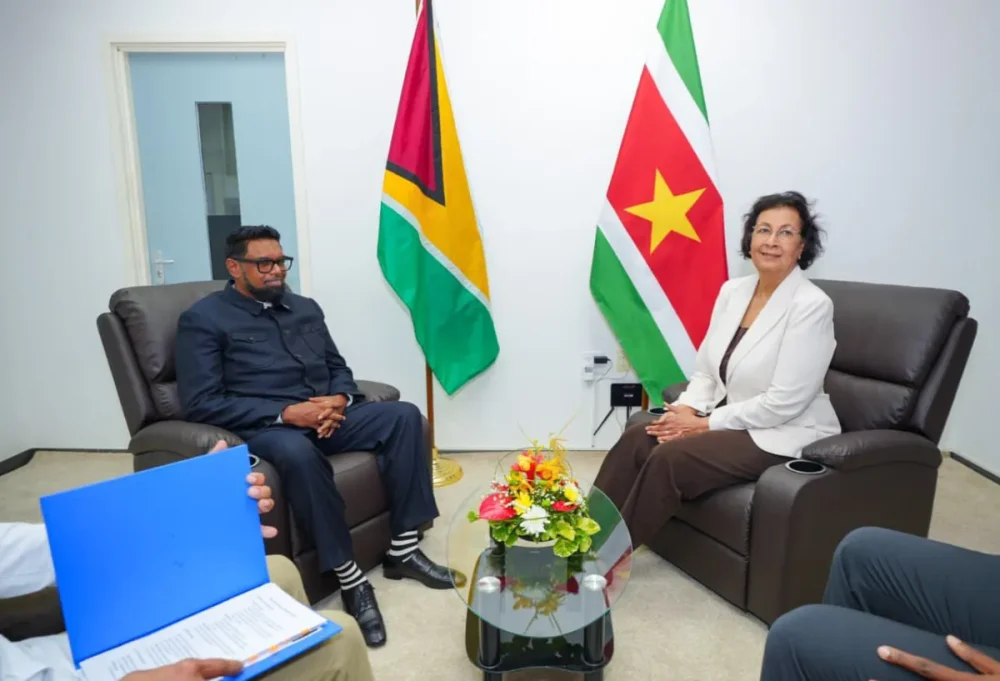
According to Paramaribo, the issue was discussed during President Jennifer Geerlings-Simons’ meeting with President Ali in Nickerie on September 13, 2025, at their bilateral meeting on the sidelines of the 50th CARICOM Heads of Government Meeting in St. Kitts and Nevis, and again during a virtual meeting between the two leaders on May 15, 2026.
The statement sharply contradicts comments made by President Ali earlier this week after reports emerged that Suriname planned to build the bridge independently and recover its investment through tolls.
Responding to questions from reporters, Ali insisted he had received no official communication on any change to the longstanding joint arrangement.
“It was news to me,” the President said. He maintained that Guyana’s position remained unchanged.
“The Corentyne River bridge is a bridge that is being discussed jointly. It’s a joint project by the Government of Guyana and the Government of Suriname, and that is how it will be,” Ali said.
He further argued that any proposal to alter the arrangement would have to be communicated through official diplomatic channels before Guyana could consider its response.
However, Suriname’s Foreign Ministry dismissed any suggestion that its financing proposal was a recent development.
“Contrary to the impression created by the reporting, the financing of the bridge has already been a fixed part of the bilateral consultations between Suriname and Guyana for some time,” the ministry said.
It added that the intention of the current Surinamese administration to finance the project had been reaffirmed during the most recent discussions between the two Heads of State.
“These principles and the intention of the current Surinamese government to finance the bridge were confirmed by Suriname during the most recent bilateral consultations between the two heads of state,” the statement added.
The ministry explained that because of the scale and strategic importance of the project, both governments had agreed that technical working groups would continue developing the financial, technical and operational framework for the bridge, including its future management.
The contradiction surfaced days after Suriname’s Minister of Public Works and Spatial Planning, Stephen Tsang, informed the country’s National Assembly that the government had decided to finance the bridge in its entirety.
“The government has decided to finance the bridge 100 per cent,” Tsang told legislators, adding that authorities were examining financing models, including a toll system to recover construction costs.
The Surinamese government’s timeline raises difficult questions for the Guyanese administration.
If, as Paramaribo states, President Ali was advised during official bilateral engagements—including one less than two months ago—that Suriname intended to finance the bridge, his claim that he first learned of the proposal through media reports appears inconsistent with the official record presented by Suriname.
The contradiction also raises broader concerns about transparency in the handling of a flagship regional infrastructure project. Rather than informing the public that Suriname had advanced a new financing proposal that remained under discussion, President Ali publicly suggested that no such official position had ever been conveyed to him.
The proposed 3.1-kilometre bridge, linking Moleson Creek in Guyana with South Drain in Suriname via Long Island, is expected to significantly strengthen trade, tourism, investment and the movement of people between the two countries. Guyana has already allocated GY$5 billion for the project, while the two governments signed a US$2 million contract in 2022 to undertake feasibility studies and detailed designs.
Despite the disagreement over financing, Suriname reaffirmed its commitment to what it described as an open, constructive and results-oriented dialogue with Guyana, saying the bridge remains a strategic project capable of advancing the socio-economic development of both countries.
Its official statement, however, leaves President Ali facing renewed scrutiny over why he told Guyanese that Suriname’s financing plan was “news” to him when the neighbouring government insists that position had already been communicated directly through official diplomatic and presidential channels.