Conflicting statements from the governments of Guyana and Suriname have cast uncertainty over the future of the proposed Corentyne River Bridge, with President Irfaan Ali insisting the project remains a joint initiative while Suriname says it intends to finance and construct the bridge on its own.
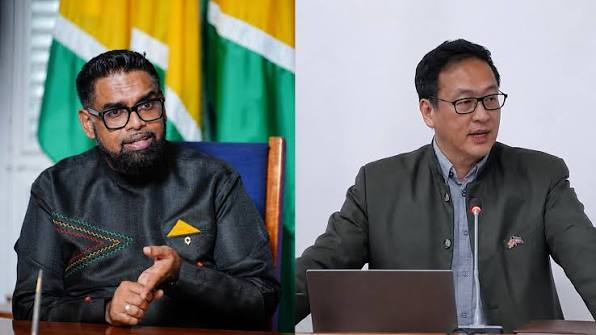
Speaking to reporters on Wednesday, President Ali said his government has received no official communication indicating that the longstanding agreement between the two countries has changed.
“I have not received anything officially other than what is in the media,” the President said in response to reports that Suriname plans to proceed independently.
Ali stressed that Guyana’s position remains unchanged.
“The Corentyne River bridge is a bridge that is being discussed jointly. It’s a joint project by the Government of Guyana and the Government of Suriname, and that is how it will be,” he said.
The President added that any proposal to alter the existing arrangement would have to be conveyed through official diplomatic channels before Guyana would consider its response.
“Guyana is interested in being part of a project that covers two sovereign spaces in a joint manner. That has always been our position. There is no other official position before me,” he said.
However, Suriname’s Minister of Public Works and Spatial Planning, Stephen Tsang, told that country’s National Assembly on Monday that the Surinamese government has decided to fully finance the bridge, abandoning the earlier plan to undertake the project jointly with Guyana.
“The government has decided to finance the bridge 100 per cent,” Tsang told legislators while responding to questions about the proposed crossing.
He said the government is still evaluating financing options, including a toll system to recover construction costs, and noted that a new tendering process may be required depending on the financing model selected.
The contrasting positions raise questions about the future of a project long viewed as a major step toward improving transportation, trade and economic integration between the neighbouring countries.
The proposed bridge would span approximately 3.1 kilometres, linking Moleson Creek in Guyana with South Drain in Suriname, with a landing on Long Island in the Corentyne River. Guyana has allocated GY$5 billion toward the project, and in 2022 the two countries signed a US$2 million contract for the feasibility study and design.
The bridge also carries broader historical significance for Guyana and Suriname. Relations between the two countries have not always been without tension. For years, they were embroiled in a dispute over their offshore maritime boundary, an area believed to contain significant oil and gas resources. The dispute escalated in 2000 when the Surinamese Navy forced an oil exploration rig operating under a Guyanese licence to leave the disputed waters.
That controversy was ultimately settled in 2007 when a United Nations arbitral tribunal issued a final ruling establishing the maritime boundary between the two countries. The decision cleared the way for offshore petroleum development and removed one of the most contentious issues in bilateral relations.
With that longstanding dispute now resolved, the Corentyne River Bridge has been widely viewed as a symbol of closer cooperation between Guyana and Suriname, making the two governments’ differing positions on its development particularly significant..