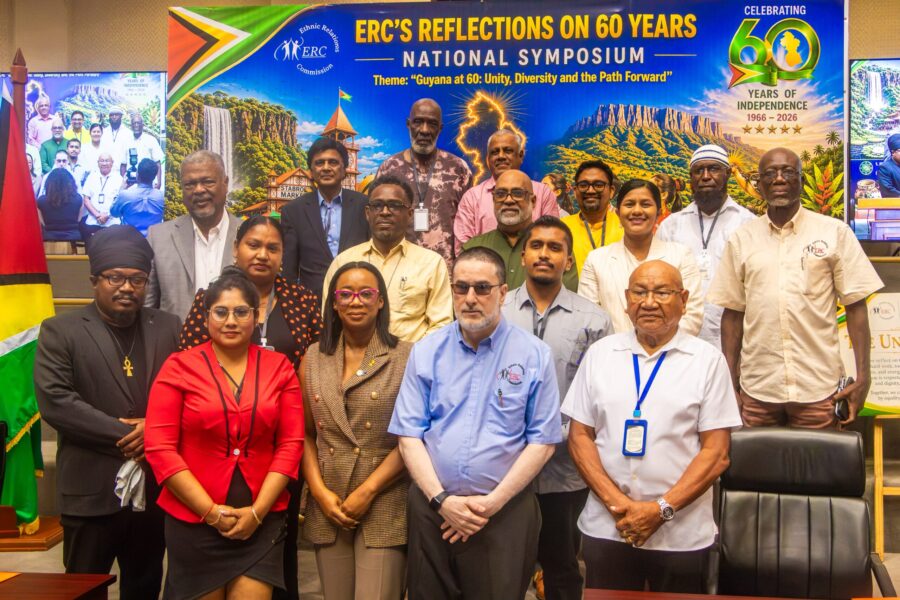
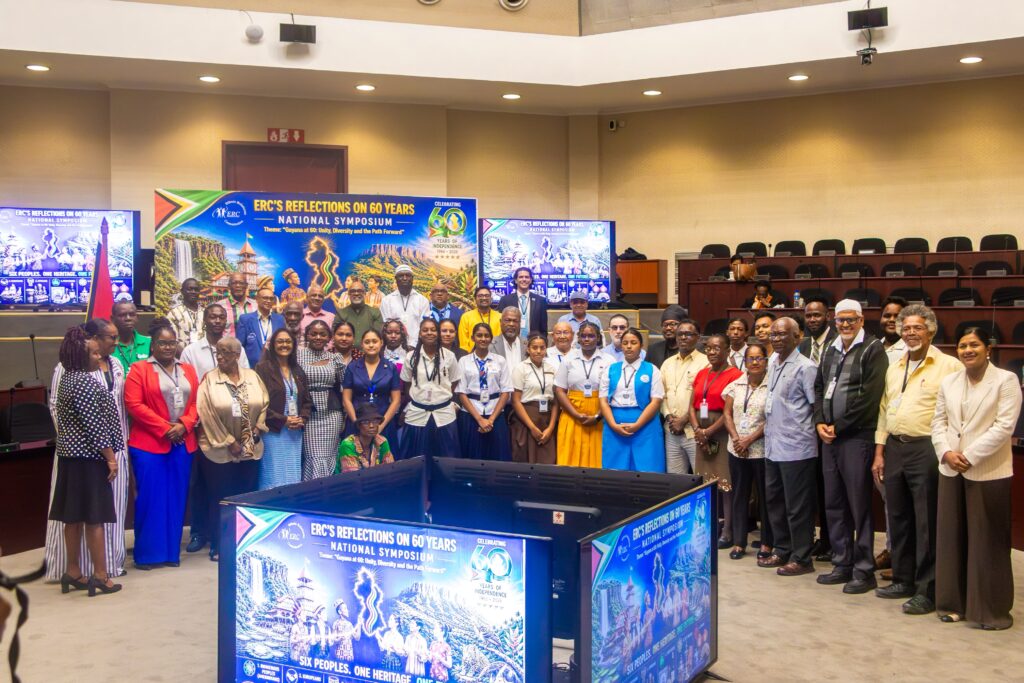
The Ethnic Relations Commission (ERC) today convened a landmark National Symposium, “Guyana at 60: Unity, Diversity and the Path Forward,” at the Arthur Chung Conference Centre, bringing together leaders from the Government, the Parliamentary Opposition, the Diplomatic Corps, private sector, academia, civil society, faith communities, and youth to reflect on six decades of independence and to chart a course towards greater unity.
The Symposium was designed to combine high-level dialogue with broad participatory engagement. The day’s proceedings were anchored in the Commission’s constitutional mandate to promote ethnic harmony and good relations, to eliminate discrimination, and to foster a culture of tolerance, mutual respect, and a shared national identity.
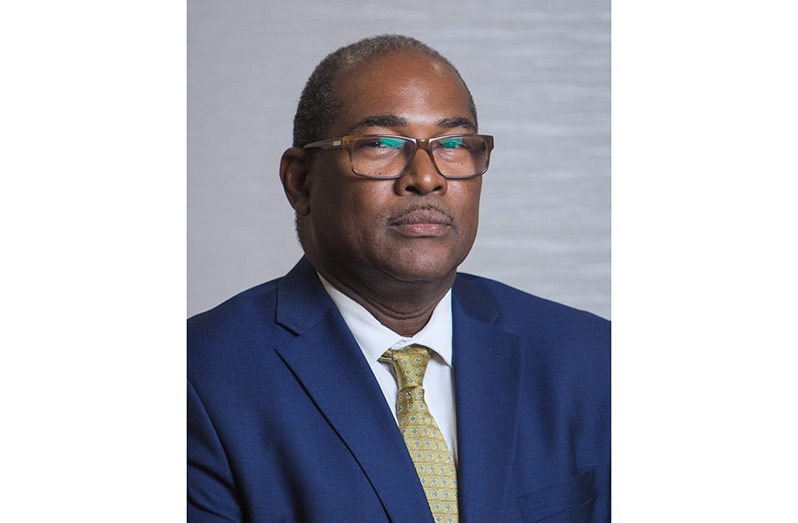
The official opening ceremony featured multi-faith invocations from the Christian, Islamic, and Hindu faiths, reflecting the nation’s spiritual diversity. In his opening remarks, the ERC Chairman Shaikh Moeenul Hack reminded the gathering that national unity is not a monument built once, but a garden that must be tended in every generation.
“This Symposium has shown that the work of unity belongs to every Guyanese. The honest reflections shared today, and the recommendations they have produced, will not end with the applause; they will shape the policy and the conscience of our nation for years to come,” he declared while noting that meaningful progress had been made but that the work of unity must continue, stressing that it cannot be left to chance. “Harmony, and the everyday tolerance that sustains it, cannot be manufactured in a vacuum… It requires active, deliberate work,” he told the gathering, adding that when the Commission succeeds in its mission, “Guyana succeeds.”
Senior Minister in the Office of the President with Responsibility for Finance, Hon. Dr. Ashni Singh, M.P. providing remarks on behalf of the Government, posited that the country has advanced its melting pot of cultures since independence. “If you look around today, you see a country comprising peoples of different ancestry, different ethnic origins, different religious persuasions, different denominations. But notwithstanding all these historic distinctions, they live together very cohesively and very harmoniously in a country that I believe is beautifully diverse,” he observed.
Opposition Member of Parliament and Chief Whip Hon. Tabitha Sarabo-Halley reflected that “As we celebrate sixty years of independence, it is fitting that we ask ourselves a simple but uncomfortable question: How far have we truly come?” She acknowledged that, while significant progress has been made, the historical legacies of slavery, indentureship, and colonial “divide and
rule”, with the perceptions they have left behind, continue to shape community trust, underscoring why the shared work of building fairness and inclusion must continue.
The Featured Address was delivered by Her Excellency Ms. Jean Kamau, United Nations (UN) Resident Coordinator in Guyana, who situated the country’s journey within the wider global pursuit of peace, human rights, equity, and sustainable development. “Unity and diversity are not merely ideals. They are essential ingredients for building peaceful, inclusive and resilient societies. They remind us that nation-building is an ongoing process, one that requires commitment, dialogue, understanding and a willingness to embrace differences while working toward a common future. I know that for Guyana this is not a new process; rather it is one that has been underway for decades,” she said.
A defining moment of the morning was the unveiling and collective recitation of the Symposium’s Unity Pledge, as participants reaffirmed their shared commitment to the national values of mutual respect, fairness, dignity, and unity.
Two concurrent panel discussions then followed. The first, held in the Dome and moderated by Mr. Linden Davidson, examined “Sixty Years: Challenges and Progress in Race and Ethnic Relations in Guyana,” and featured Mr. Carl Greenidge, Ms. Indranie Chandarpal, Hon. Tabitha Sarabo-Halley, M.P., and Hon. Keoma Griffith, M.P. The second, held in the Lula Room and moderated by Dr. Dylan Kerrigan of the UN, explored “Identity and National Cohesion: What Makes Us Guyanese,” and featured former President Mr. Donald Ramotar, Hon. Amanza Walton Desir, M.P., Mr. Kit Nascimento, and Mr. Stanley Ming.
In a session devoted to Constituency Voices, representatives of the Commission’s constituency bodies, spanning the African, Indian, Indigenous constituencies alongside Religious, Labour, Women’s, Youth, and Private Sector, each offered remarks and solutions on the way forward.
Throughout the day, participants completed a structured questionnaire, the data from which will form the empirical foundation of the Commission’s forthcoming report, “ERC’s Reflections on 60 Years,” which the Commission intends to lay before the National Assembly of Guyana.
The Symposium closed with a summary of findings and a vote of thanks delivered by the Deputy Chairman of the Commission Mr. Charles Ogle. The ERC extended its sincere gratitude to all the panellists, moderators and participants, whose voices, the Commission noted, are the true foundation of the national conversation held.