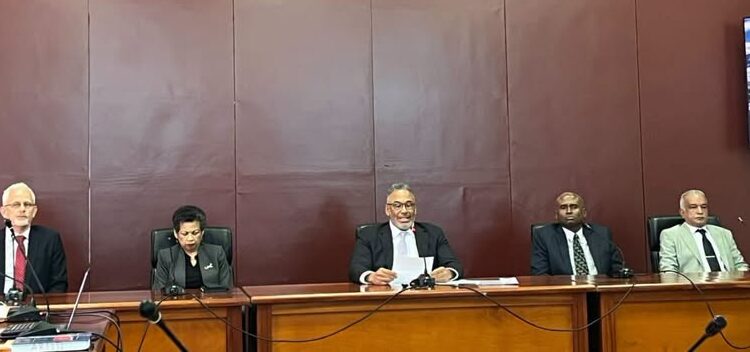
The Vigilant Political Action Committee (VPAC) has unveiled a proposal for a technology-driven National Housing Management System (NHMS), arguing that artificial intelligence (AI) and digital technology can help eliminate longstanding inefficiencies, reduce the housing backlog, and restore public confidence in Guyana’s housing allocation process.
The proposal, developed under the leadership of VPAC Chairman Dorwain Bess, comes as thousands of Guyanese continue to wait years for house lots despite the government’s multi-billion-dollar investment in the housing sector.
In a statement, VPAC announced the completion of what it described as “a comprehensive national blueprint designed to fundamentally modernise the administration of housing in Guyana through the responsible use of artificial intelligence, and digital technology.”
The organisation said that while the government has invested heavily in housing, many applicants continue to face uncertainty.
“Despite substantial public investment over many years, tens of thousands of applicants continue to wait without certainty, while concerns have repeatedly been raised about lengthy delays, outdated records, inconsistent allocation practices and so on,” the statement said.
According to government figures, more than 78,000 housing applications remain pending nationwide, even after the allocation of more than 53,000 house lots since 2020. Applicants have also complained about years-long waiting periods, delays in receiving transports, and housing areas where roads, drainage, water and electricity remain incomplete after allocations.
VPAC contends that many of these longstanding problems stem from outdated administrative systems and can be addressed through technology.
Its proposed National Housing Management System would create a single digital platform to manage every stage of the housing process—from application and verification to land inventory, infrastructure readiness, allocation, documentation, and title issuance.
“A key pillar of our proposal is the principle that access to housing should be governed by objective rules rather than discretion,” VPAC stated.
The proposal introduces an AI-assisted priority framework that would rank verified applicants using transparent criteria, including the length of time spent waiting, income level, disability, age, single-parent status and displacement caused by flooding.
“This would ensure that every applicant is treated according to established policy rather than personal influence or political connection,” the organisation said.
VPAC also proposes a tamper-resistant digital audit system that would permanently record every housing application, allocation and decision, making records effectively impossible to alter or erase without detection.
Applicants would also gain access to an online citizen portal where they could monitor the progress of their applications, update documents, receive SMS notifications, verify official correspondence and track decisions in real time, reducing the need for repeated visits to housing offices.
The organisation is also proposing that house lots should not be allocated until basic infrastructure—including roads, drainage, potable water and electricity—has been completed and independently verified, an issue that has generated complaints from allottees in several new housing developments.
In addition, VPAC’s proposal calls for a live national land inventory covering all administrative regions, allowing policymakers to monitor available lands, housing demand, infrastructure development and future planning needs in real time.
“Every Guyanese family, regardless of political affiliation, deserves confidence that the system responsible for allocating one of the most valuable public benefits is fair, transparent and beyond manipulation,” VPAC said.
VPAC has invited the Ministry of Housing and Water, the Central Housing and Planning Authority, the Guyana Lands and Surveys Commission, Members of Parliament, civil society, the private sector and technology professionals to examine the proposal and participate in what it described as “a constructive national conversation on the future of housing administration.”
VPAC said the initiative forms part of its broader vision of using technology to modernise government services and improve accountability.
“Our proposal reflects VPAC’s broader vision for a modern Guyana, where technology improves service delivery and ensures that government works efficiently, fairly and openly for all,” the statement concluded.
While the government has promoted housing as one of its flagship programmes, concerns have persisted over bureaucratic delays, limited transparency and inconsistent administration, with many applicants reporting lengthy waiting periods and infrastructure delays.