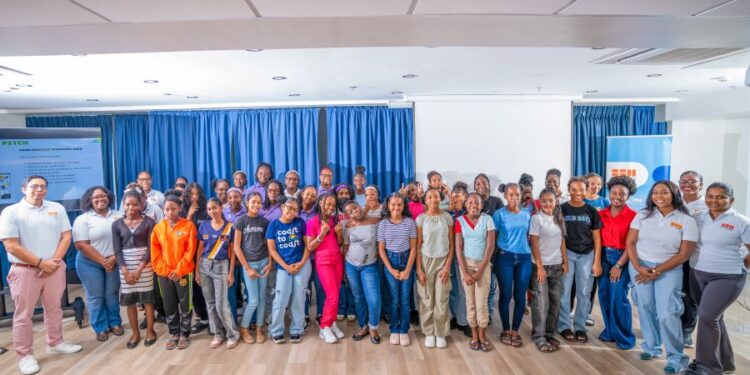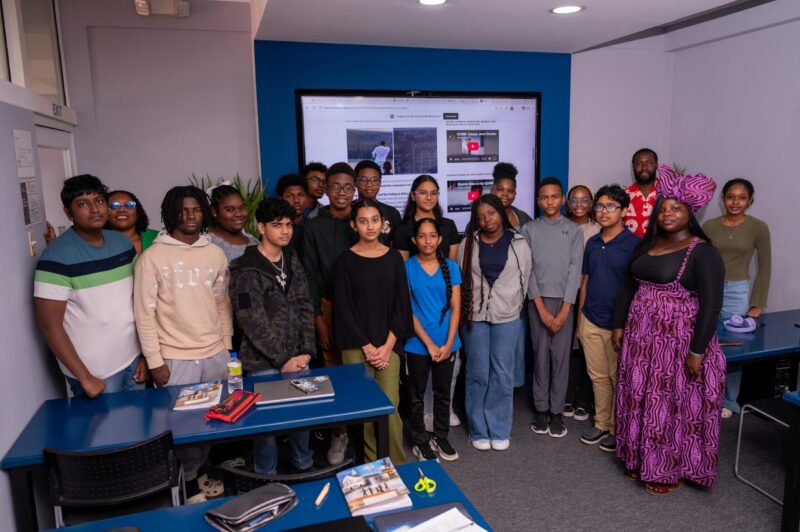
Seventeen young Guyanese spent five days discovering that mathematics is more than numbers on a page—it is a way of questioning, reasoning, solving problems and understanding the forces shaping their country.
The students participated in the Blackman-Waddell Summer Math Institute, held from July 27–31, 2026, marking the programme’s tenth anniversary and the beginning of its second decade.
The programme concluded Friday at the Centre for Local Business Development on South Road, where certificates were presented to students from 16 schools across Georgetown, Berbice and Bartica.
Founded in Georgetown in 2016 as the Queen’s College Summer Mathematics Institute, the programme has now entered a new chapter under the Blackman-Waddell name and the auspices of STEMGuyana, Founder and Exceutive Director, Dr. Karen Abrams
Its central belief is simple: mathematical talent exists in every community, but opportunity does not always do so.
That belief came alive on the programme’s opening day when a girl from Bartica was given a problem she had never been taught to solve: how many numbers from 1 to 2,026 share no common factor with 2,026?
She wrote down her best guess, sealed it in an envelope and began the week.
Five days later, the envelope was opened.
The transformation was not simply about whether she had found the right answer. In between were five days of learning how to confront unfamiliar problems, test ideas, recognise patterns and reason through uncertainty—the very habits that define mathematical thinking.
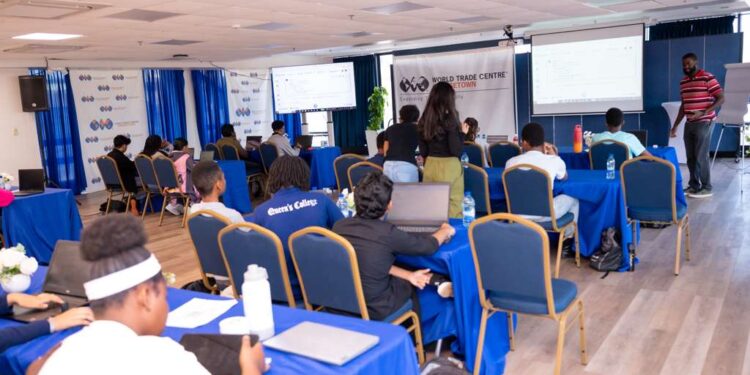
This year’s curriculum, “Five Days, Five Ideas,” took students through prime numbers, cryptography, mathematical modelling, proof and statistical literacy.
They calculated the remainder when 7 raised to the power of 2,026 is divided by 11—a number containing 1,713 digits if written in full—and discovered the modular arithmetic underlying modern public-key cryptography.
They also explored mathematical modelling using a simplified scenario based on Guyana’s oil-revenue growth. From the same two facts, they constructed three possible futures and learned to challenge the assumptions behind projections and percentages.
The lesson was as much about citizenship as mathematics: What does the number assume? What evidence supports it?
Students were also encouraged to make mistakes openly. In the programme’s classrooms, being wrong is not treated as failure; it is part of the journey toward being right.
The students represented schools including Queen’s College, Saint Stanislaus, Bladen Hall Multilateral, North Georgetown Secondary, Mae’s, St Joseph High, St Rose’s High, Austin Castello Tutorial and Chase’s Academic Foundation.
Some arrived with strong mathematics grades. Others came to strengthen their foundations. By the end of the week, those distinctions mattered less than the shared experience of tackling difficult problems.
The programme’s decade-long legacy is already visible.
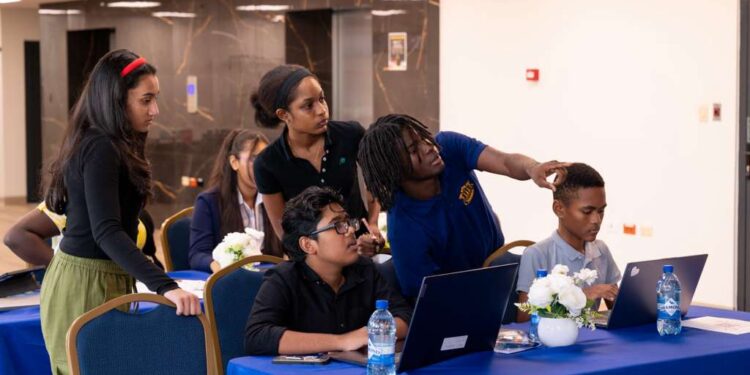
A former participant, now a young professional in the energy sector, returned to speak to this year’s cohort. Another alumnus is studying engineering at Rensselaer Polytechnic Institute in New York, while his younger brother joined this year’s programme.
STEM Guyana’s national robotics team also demonstrated its work. Three members are former mathematics campers.
For organisers, that is what ten years of opportunity can produce: in 2016, robotics was introduced to the campers; in 2026, former campers are members of the national team preparing for international competition.
The programme was co-founded by Dr Terrence Richard Blackman, Professor and Chair of Mathematics at Medgar Evers College, CUNY, and Dr Cleveland Waddell, an applied mathematician and Senior Member of the Technical Staff at Sandia National Laboratories. Waddell was once Blackman’s student at Queen’s College.
Their work reflects a broader investment in Guyana’s future at a time when the country is making decisions involving oil revenues, contracts, budgets, economic forecasts and development projections.
For the organisers, mathematical literacy is therefore more than an academic skill. It is part of national capacity. A country needs citizens who can read the numbers governing their lives, test assumptions and challenge conclusions when the evidence demands it.
Some of the people who may one day analyse Guyana’s economy, audit its contracts, design its infrastructure or develop its technology are approximately 14 years old today.
Seventeen of them spent July 27–31 learning to think like mathematicians.
Before receiving their certificates, each student completed the sentence:
“The question I will now ask of every number is…” Their answers belonged to them.
But perhaps the most important lesson of the week was not found in a textbook or on a blackboard. It was the realisation that a difficult question is not something to fear—it is an invitation to think.
For Guyana, that may be the most important investment of all.
These 17 students are not simply the recipients of mathematics certificates. They are potential problem-solvers, innovators and future leaders. Among them could be the mathematician who helps build the next great technology, the engineer who solves a national infrastructure challenge, the scientist who makes a breakthrough, or the analyst who asks the question that changes how Guyana understands its wealth.
The envelopes were opened on July 31.
But what was opened was bigger than an answer. A door was opened—to possibility, to confidence and to a future in which Guyanese minds are not merely consumers of other people’s numbers, but creators, interpreters and challengers of the numbers that shape their nation.
The tenth anniversary has ended.
The second decade has begun. And somewhere among these 17 young minds, Guyana’s next mathematician may already be doing the calculation.