Dear Hon. Minister Dr. Singh,
Guyana stands at a historic moment. Our GROWTH in OIL and GAS has placed GUYANA on the GLOBAL map, and the QUARTERLY GDP figures rightly inspire pride.
But GDP alone cannot tell us if a mother in Region 5 can feed her children, if a young graduate in Region 10 can afford a home, or if the air, rivers, and forests our children will inherit are being protected.
To truly LEAD as the FASTEST DEVELOPING Country , we MUST MEASURE what matters to PEOPLE LIVES..
With ALL DUE RESPECT, do Respectfully urge YOU and the Government of Guyana to Adopt and Publish a QUARTERLY “Beyond GDP” Well-being Dashboard alongside GDP. This dashboard should include the Human Development Index (HDI), a Cost-of-Living Index, and an Environmental Sustainability Indicator.
Countries like New Zealand, Scotland, Bhutan, and Iceland now use well-being budgets because they learned that GDP COULD RISE while people’s LIVES STAGNATE. We have the chance to build it right from the start.
Cost-of-Living Reality: HDI and a localised Cost-of-Living Index will show if wage growth, housing, and food prices are keeping pace with oil revenues.
People Before Barrels: The HDI tracks Health, Education, and Income. It ensures oil wealth translates into classrooms, clinics, and skills — not just barrels.
Protect Our Future: An environmental indicator safeguards our Low Carbon Development Strategy, forests, and fisheries — our long-term economic base.
Global Leadership & Investment: Investors and development partners are shifting capital to countries that prove they manage growth responsibly. A well-being dashboard signals that Guyana is a stable, forward-thinking destination.
We do not ask to replace GDP. We ask to complete the picture. Publish it quarterly, make it public, and let Guyanese see how policy decisions affect their daily lives.
Guyana can be the FIRST major OIL PRODUCER to say: “We will not repeat the mistakes of the past. We will grow, and we will grow well.”
GLOBAL ECONOMIC MODELS: YES to Singapore, Doha, and Dubai. NO, NO, NO, to Angola 2.0
We stand ready, along with many Guyanese Professionals AT HOME and in the DIASPORA, to support the Technical Design of this DASHBOARD for TRANSPARENCIES.
For the Prosperity and Well-Being of all Guyanese, Now and for Generations to come.
Yours truly,
Dr. Shamir Andrew Ally
————————————–
WHAT IS “BEYOND GDP” and WHY Guyana NEEDS IT
What measures: Health = life expectancy. Education = years of schooling + expected schooling. Income = GNI per capita.
Why Guyana needs it: GDP can boom from OIL while clinics and schools’ lag. HDI forces us to ask: “Is oil money turning into longer, healthier, smarter lives for Guyanese?”
Target: Track HDI by region so we know if Region 1 is reaching Region 4.
Cost-of-Living & Inequality Index
What it measures: Food, housing, transport, and utilities vs. median wages. Also shows the gap between top 10% and bottom 40%.
Why Guyana needs it: GDP growth means little if rent in Georgetown doubles faster than salaries in Linden or New Amsterdam. This index keeps policy focused on affordability.
Target: Quarterly “Guyana Affordability Score” so citizens can see if life is getting easier or harder.
Environmental & Natural Capital Indicator
What it measures: Forest cover, river water quality, carbon emissions, and depletion of natural resources.
Why Guyana needs it: Our LCDS 2030 and carbon credits are a national asset. If we grow GDP by depleting forests or fisheries, we are borrowing from our children. This indicator keeps growth sustainable.
Target: Net Natural Capital — are we richer or poorer in natural wealth each year?
HOW IT WORKS IN PRACTICE
Every QUARTER , the Bureau of Statistics would release 4 numbers:
GDP Growth – How fast the economy grew.
HDI Change – Did health, education, and incomes improve?
Affordability Score – Can the average family afford basics?
Natural Capital Balance – Did we protect or deplete our environment?
THE BENEFIT TO GUYANA
Better Decisions: Ministers can see if a new policy helps people, not just profits.
Public Trust: Citizens see transparency — government is accountable for well-being, not just oil.
International Credibility: Guyana becomes a model for resource-rich nations. That attracts ethical investment and climate finance.
GDP tells us the SIZE OF THE PIE. HDI, Affordability, and Natural Capital tell us how the SLICES are shared, and IF there will be PIE for our GRANDCHILDREN.
DO Let us build a Guyana that is NOT JUST RICH but WELL.
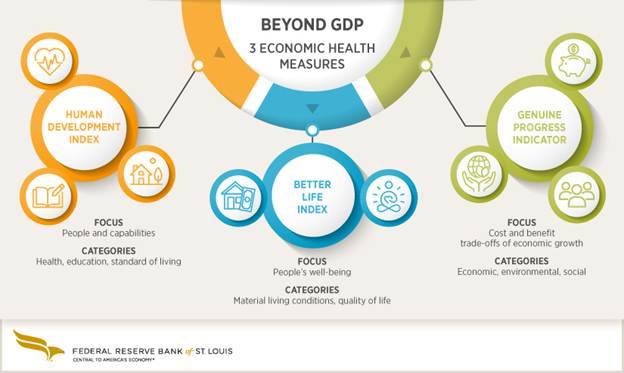
The Federal Reserve Bank of St. Louis, USA ; GDP, HDI, BLI and GPI.
GDP: Measures the total value of all goods and services produced in a country — basically, HOW FAST THE ECONOMY IS GROWIN.
HDI: Measures HUMAN DEVELOPMENT — life expectancy, education, and income to show how healthy, educated, and wealthy people are.
BLI: Measures WELL-BEING — housing, jobs, health, community, safety, and work-life balance to show quality of life beyond money.
GPI: Measures REAL PROGRESS— GDP adjusted for things like inequality, pollution, crime, and unpaid work to see if life is actually getting better.
The Federal Reserve Bank of St. Louis highlights that while( GDP)is the most common measure of a country’s economic output, it is incomplete because it ignores factors like pollution, health, education, and inequality. To get a fuller picture of economic health, policymakers and organizations use alternative indicators such as the Human Development Index (HDI), the Better Life Index, and the Genuine Progress Indicator (GPI) Federal Reserve Bank of St. Louis+1.
Emphasizing People and Capabilities: Human Development Index (HDI)
- Human Development Index (HDI)
- Focus: People and capabilities, not just economic growth.
- Categories:
- Health – measured by life expectancy at birth.
- Education – measured by mean years of schooling for adults aged 25+ and expected years of schooling for children.
- Standard of living – measured by gross national income (GNI) per capita, adjusted for diminishing returns as income rises.
- Benefit: More comprehensive than GDP alone, as it incorporates human development.
- Limitation: Does not fully account for inequality, empowerment, or other well-being factors Federal Reserve Bank of St. Louis+1.
- Better Life Index (BLI)
- Focus: People’s well-being, with flexibility in choosing what matters most.
- How it works: The OECD compiles 11 indicators (e.g., income, housing, health, work-life balance) and lets users “toggle” priorities to see how different values affect the score.
- Benefit: Allows customization to reflect personal or policy priorities.
- Limitation: May not track progress over time as effectively as other indices economic life.
- Genuine Progress Indicator (GPI)
- Focus: Cost–benefit trade-offs of economic growth.
- How it works: Adjusts GDP by adding positive factors (e.g., leisure, environmental quality) and subtracting negative ones (e.g., pollution, income inequality).
- Benefit: Reflects both economic and non-economic factors, aiming to approximate “Gross National Happiness.”
- Example: States like Hawaii, Maryland, and Vermont use GPI to measure progress beyond GDP Federal Reserve Bank of St. Louis+1.
Why these matter:
These measures complement GDP by addressing aspects of well-being and sustainability that GDP overlooks. They help policymakers balance economic growth with social and environmental health, ensuring that PROSPERITY is measured in ways that MATTER to PEOPLE.
Beyond GDP: Three Other Ways to Measure Economic Health | St. Louis Fed
COUNTRIES around the world measure their PROSPERITY. One of the most common measures, though imperfect, is gross domestic product, or GDP. Besides GDP, there are other measures of economic health.
GDP measures the value of the final goods and services produced within a country. That is, GDP is the sum of CONSUMPTION, INVESTMENT, Government SPENDING, and net EXPORTS.
Although GDP and its changes are the most popular indicators of a nation’s overall economic output, economists have long recognized that it is an imperfect measure of overall economic well-being. For example, GDP does not account for the production of pollution or consider the health and education of the population and other factors tied to well-being.
Because of this, various governments and organizations have started following alternative measurements such as the Human Development Index, Better Life Index and Genuine Progress Indicator. These are some of the most prominent measures that go hand in hand with GDP. For example, Hawaii, Maryland, and Vermont have started implementing a Genuine Progress indicator.
Photo: Three economic health measures beyond GDP: The Human Development Index focuses on people and capabilities, the Better Life Index focuses on people’s well-being, and the Genuine Progress Indicator focuses on cost and benefit trade-offs of economic growth.
Emphasizing People and Capabilities: Human Development Index (HDI)
Focus: People and capabilities
Categories: Health, education, standard of living
Benefit: More comprehensive approach
Limitation: Some crucial factors not included
The United Nations created the Human Development Index (HDI) to provide an alternative indicator that emphasizes people and their capabilities, instead of economic growth alone, for assessing the development of a country.
The HDI consists of three categories: health, education, and standard of living, as the United Nations Development Program states in an overview of the index on its website. “The health dimension is assessed by life expectancy at birth, the education dimension is measured by mean [average] of years of schooling for adults aged 25 years and more and expected years of schooling for children of school entering age,” according to the website.
Gross national income (GNI) per capita is used to measure the standard of living dimension. A logarithm of GNI reflects the diminishing importance of income as GNI increases. The three dimensions are then pulled together in a composite index.
HDI takes a more comprehensive approach than GDP growth with a view of the economy that includes human development. However, the indicator is not perfect.
For example, the HDI assumes that certain components are equal trade-offs, thus allowing two countries to get the same HDI score, when in reality one of those trade-off components might be considered to be more important, under some circumstances, than the other.
Also, the indicator does not reflect other important human development factors such as inequalities, empowerment, or poverty, as the program website points out. Empowerment is providing people who are perceived as being less fortunate or disadvantaged the ability to improve their situations.
The U.N.’s development measure could also be viewed as subjective. For example, the development measure rewards choosing more academic education over trade school or work. Further, GNI is very highly correlated with GDP and subject to most, if not all, of the critiques of GDP as a measure of development.
Comparing Ingredients for Well-being: Better Life Index (BLI)
Focus: People’s well-being
Categories: Material living conditions, quality of life
Benefit: Allows for personalized rankings
Limitation: No comparisons over time
The Better Life Index (BLI), created as part of the Organization for Economic Cooperation and Development’s (OECD’s) Better Life Initiative, provides a comparison of the ingredients for people’s well-being across 11 “topics” for 41 countries.
Topics the OECD identified as essential to well-being relate to material living conditions (housing, income, jobs) and quality of life (community, education, environment, governance, health, life satisfaction, safety, and work-life balance).
The data for community, for example, are based on the “perceived social network support,” or the percentage of people who “report having someone to count on for help in times of need.” Along with the emotional toll, having a weak social network can limit economic opportunities, according to the OECD.
One to four indicators are used to measure each of the topics.
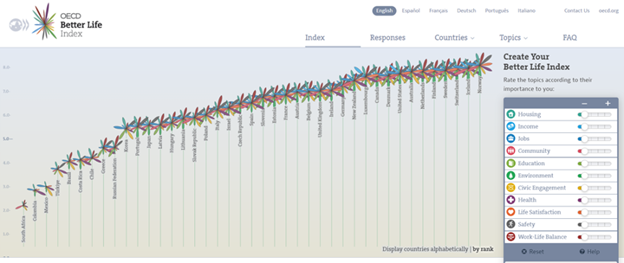
This interactive index allows users to decide on which topic matters to them the most and to personalize their rankings accordingly. The index also allows a comparison across genders.
One drawback is that the index is only available for a fraction of the countries in the world and does not allow for comparisons over time. For that reason, the BLI may not be comprehensive enough. The categories also could be deemed arbitrary.
Weighing Environmental and Social Factors: Genuine Progress Indicator (GPI) .
Focus: Cost and benefit trade-offs of economic growth
Categories: Economic, environmental, and social
Benefit: Includes costs like pollution, values like volunteering
Limitation: Variables perceived as subjective
The Genuine Progress Indicator (GPI) is designed to measure the well-being of a country by considering economic, environmental, and social factors, as described by Gross National Happiness USA, a network of activists, analysts, and advocates.
The factors for each aspect might vary depending on the entity using or creating a GPI. The version shown on the Gross National Happiness USA website, for example, is different than that used by Hawaii’s Department of Business, Economic Development and Tourism. The economic aspect may include variables such as personal expenditures and income inequality. For the environmental aspect, the index mostly includes factors such as ozone depletion and climate change. Crime, family breakdown, and more are included in the social aspect.
The data that goes into the calculation of the GPI reflects the impact of externalities such as the negative effects of pollution. However, that could also lower the scores of oil- and gas-producing countries that export those products in exchange for other countries’ goods whose production doesn’t generate as much greenhouse gas emissions.
The index also assigns values to societal contributions like volunteering and higher education.
At least three states—Hawaii, Maryland, and Vermont—have started reporting their GPI.