


Attorney General Anil Nandlall has been emphatic that the Government’s proposal to regulate children’s use of social media is “devoid of any ulterior motive“ and carries “no intention to censure or to interfere with anyone’s freedom of expression.” He argues that the initiative is solely about protecting children from pornography, violent material and other harmful online content.
Few would dispute that protecting children online is a legitimate responsibility of any government.
What is open to question, however, is whether the Government has demonstrated that Guyana actually faces a social media crisis requiring legislative intervention. On that point, the Attorney General’s argument is remarkably thin.
The Government has offered no empirical evidence showing that children’s exposure to social media has become a widespread public health or child welfare problem in Guyana. No national survey has been published. No epidemiological data have been presented. No local academic research has been cited. No evidence has been released linking social media use among Guyanese children to measurable increases in self-harm, mental illness, cyberbullying, sexual exploitation or declining educational outcomes.
Instead, the Government has largely relied on a general proposition—that harmful material exists online. That proposition is true almost everywhere in the world. But the existence of harmful content alone is not evidence that Guyana requires sweeping new legislation.
That distinction fundamentally weakens the Government’s case.
Borrowing Global Solutions Without Local Evidence
Nandlall has sought to place Guyana’s proposal within what he describes as a global movement, noting that the United Nations has produced model legislation and that countries across Europe, Australia, Brazil, parts of Asia and CARICOM are strengthening laws governing children’s online activities.
But invoking international trends does not, by itself, justify domestic legislation.
The countries driving this shift have generally relied on years of research before acting.
Australia’s decision to strengthen restrictions on children’s access to social media followed parliamentary inquiries, extensive mental health research, testimony from child psychologists, technology experts, educators and parents, and years of evidence documenting the impact of digital platforms on children.
European countries have similarly relied on data collected by regulators, universities and child protection agencies before introducing reforms.
Guyana has produced no comparable evidence.
The Government has effectively begun consulting on solutions before publicly demonstrating the scale of the problem.
Good public policy works in the opposite direction: define the problem, gather evidence, consult widely, then legislate.
Guyana Is Not Australia
Perhaps the most glaring omission from the Government’s narrative is Guyana’s own socioeconomic reality.
According to the Inter-American Development Bank, 58 percent of Guyanese live in poverty, while 32 percent live in extreme poverty. Independent analysts contend that the true figures may be even higher.
Those statistics matter because they directly affect children’s access to technology.
Unlike wealthier countries where smartphones, tablets and unlimited broadband are commonplace, many Guyanese households continue to face financial barriers that naturally limit children’s online activity.
Many families simply cannot afford:
- smartphones for every child;
- continuous internet service;
- monthly mobile data plans;
- multiple digital devices.
Even households with internet access experience another uniquely Guyanese challenge: frequent power outages that interrupt connectivity for hours at a time.
These structural realities significantly reduce children’s exposure to social media compared with developed countries whose legislation the Government now cites as precedent.
Yet no evidence has been presented showing how many Guyanese children actually use social media daily, how long they spend online, what platforms they access or what harms they encounter.
Without that information, comparisons with Australia or Europe become more rhetorical than evidentiary.
What the Research Actually Says
Ironically, the very international research underpinning many overseas reforms does not support government regulation alone.
The American Psychological Association advises that children’s online wellbeing depends heavily on parental involvement, family communication and adults modelling healthy digital habits. Parents are encouraged to establish screen-free family time, discuss online experiences openly and demonstrate balanced technology use themselves.
Researchers increasingly conclude that children’s online experiences are shaped by a combination of family relationships, socioeconomic circumstances, education, sleep patterns and parental behaviour—not simply by whether governments regulate social media platforms.
That broader context has been largely absent from Guyana’s consultation.
Instead, public discussion has centred primarily on restricting children’s online access, while comparatively little emphasis has been placed on strengthening parenting support, improving digital literacy or helping adults reduce their own dependence on social media.
If government truly wishes to protect children, those measures deserve equal prominence.
A Consultation That Is Not Truly National
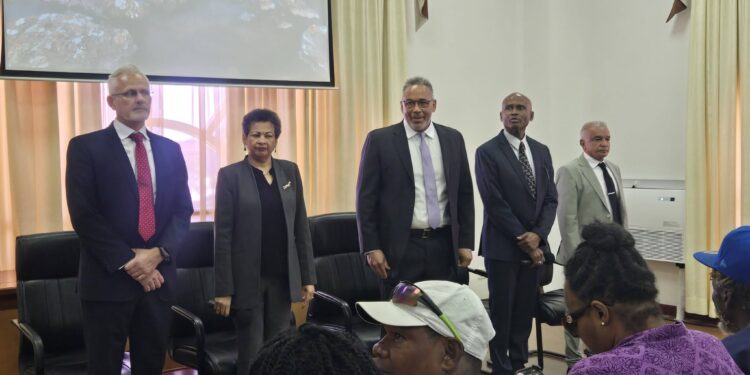
Nandlall says the consultation process has been broad-based, involving parents, teachers, guardians and legal professionals.
A genuinely national consultation would be expected to include voices that may challenge the Government’s assumptions.
There has been little evidence of structured engagement with:
- parliamentary opposition parties;
- trade unions;
- independent civil society organisations;
- media freedom advocates;
- digital rights experts;
- Mental health professionals;
- technology policy specialists.
When legislation touches constitutional freedoms, privacy rights and digital communication, excluding—or appearing to exclude—critical stakeholders inevitably fuels suspicion.
The Government may reject accusations of political intent, but confidence in legislation depends as much on process as on purpose.
Why Scepticism Persists
Nandlall insists the proposal is “not inspired or driven by any form of desire to control or censor.”
That assurance, however, cannot substitute for evidence.
Governments do not establish public trust simply by declaring that legislation carries no hidden agenda.
They establish trust by producing credible research, demonstrating necessity, inviting genuine scrutiny and ensuring that dissenting voices are heard.
On each of those measures, the current consultation remains incomplete.
The issue is therefore not whether children should be protected.
It is whether Guyana has demonstrated—through evidence rather than assertion—that legislation of this nature is necessary, proportionate and tailored to the country’s actual circumstances.
At present, that case has not been made.
Until it is, the Government’s repeated assurances that there is “no ulterior motive” will remain precisely that—assurances, unsupported by the empirical evidence that should ordinarily precede legislation affecting the digital rights of citizens.







![Officials have warned that a delay in the presidential transition could affect vaccine distribution [File: Dado Ruvic/Illustration via Reuters]](https://villagevoicenews.com/wp-content/uploads/2020/11/vaccine.jpg)

