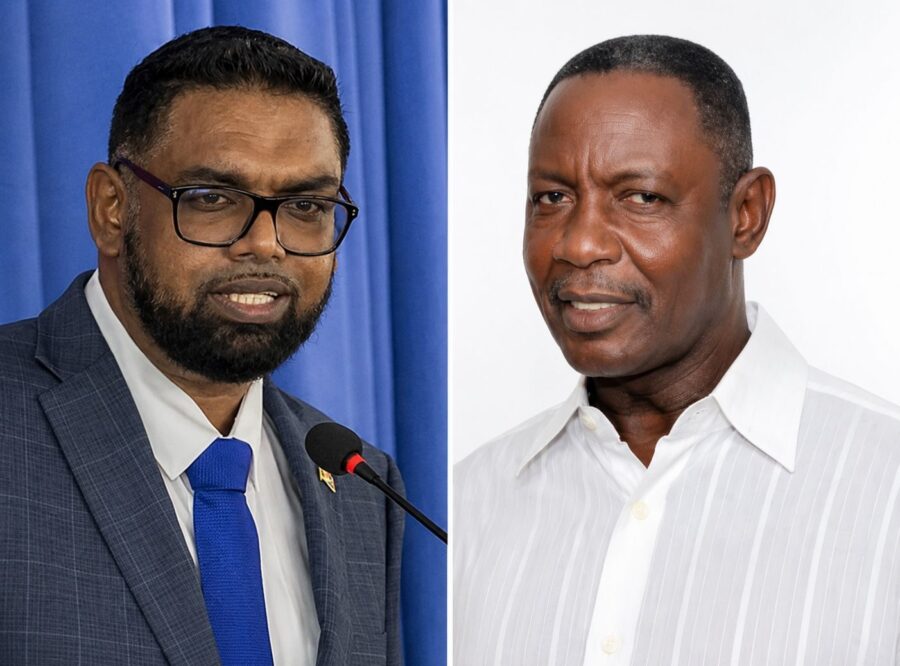
Veteran trade unionist Lincoln Lewis has questioned the government’s recent invitation for sugar workers and their union to participate in the management and possible ownership of a sugar estate, arguing that a similar proposal advanced years ago by bauxite workers was ignored by the People’s Progressive Party (PPP) administration.
In his Eye on Guyana column published on Sunday, Lewis said the experience of workers at the Berbice Mining Enterprise (BERMINE) remains one of the clearest examples of what he believes is unequal treatment when it comes to economic empowerment and ownership opportunities in Guyana.
His comments come less than a week after President Irfaan Ali used the June 16 Enmore Martyrs commemoration to publicly invite the Guyana Agricultural and General Workers Union (GAWU) to assume a direct role in managing a sugar estate, arguing that workers and their representatives should play a greater role in shaping the industry’s future.
“Just as we’ve invited proposals for the sugar estates, and we have coming in for Skeldon, we also invited the union, if you would like to take up the mantle of management and to take one of the estates and make it your model, we give you that challenge openly,” Ali told the gathering.
The President said the proposal reflected the government’s willingness to share responsibility for the future of the sugar industry.
“We invite you to be part of the management also, because that is what good, responsible government does, it invites everyone to be part of the table. Do not shy away from the opportunity. We are here to work with you,” he added.
Lewis, however, said the offer raises a fundamental question: why was a similar proposal from bauxite workers never entertained?
According to Lewis, when the Bharrat Jagdeo administration moved to divest BERMINE, workers, management and trade unions united behind a proposal to acquire the company themselves. The effort was spearheaded by the Guyana Bauxite and General Workers Union (GB&GWU), of which Lewis serves as General Secretary, together with the Berbice Mining Union.
“The workers were not asking for charity, handouts, or special treatment. They wanted to purchase the company they helped build and sustain,” Lewis wrote.
He said the workers established a company, secured the support of management and the trade union movement, and prepared a formal bid to acquire the operation. The proposal also included plans to secure mining rights over a ten-year period.
“The stakeholders also developed an arrangement to bid for the rights to mine bauxite over a ten-year period. Nothing happened.“
Lewis said what followed was not a rejection, but silence.
“Since that bid was submitted, no one—from management, the workers, or the trade union movement—has received a response from the government.”
“There was no acknowledgement. No rejection. No acceptance. No explanation.”
According to Lewis, the absence of any response remains one of the most significant unresolved issues in the country’s discussion about worker ownership and economic inclusion.
Today, he noted, the government is openly encouraging worker participation in the sugar industry and inviting proposals for estates, including Skeldon.
“If worker ownership is a good idea today, why was it not a good idea when the BERMINE workers proposed it? If workers can own in one sector, why were bauxite workers denied the same opportunity?” Lewis asked.
The trade unionist argued that the proposal advanced by BERMINE workers years ago may ultimately become the template for any future worker-owned sugar operation.
“I am also convinced that the bauxite workers’ proposal, now gathering dust on the desk of Jagdeo, the President, or some PPP minister, will eventually serve as the blueprint for helping sugar workers acquire an estate.“
While making clear that he has no objection to sugar workers benefiting from such an arrangement, Lewis said the public should know where the idea originated and why it was never given consideration when first advanced.
The issue, he argued, goes beyond the fate of a single company and raises broader questions about ownership, wealth creation and economic participation in Guyana.
“The workers of BERMINE wanted to buy the company they helped build. They organised themselves, submitted a proposal, and sought no handout from the State. They simply asked for an opportunity. The PPP denied them that opportunity.”
Lewis further contended that the overwhelmingly African-Guyanese workforce at BERMINE was seeking to move beyond dependence on wages and secure ownership of productive assets that could benefit future generations.
“It told bauxite workers that their aspirations did not matter. It told them that their efforts at economic empowerment were not worthy of engagement,” he wrote.
His remarks also come against the backdrop of continuing controversy surrounding the annual Enmore Martyrs observance.
The commemoration honours the five sugar workers killed by colonial police on June 16, 1948, while protesting working conditions at Enmore Estate. The Guyana Trades Union Congress (GTUC), of which Lewis is General Secretary, fought for decades to have the workers formally recognised as martyrs and to place the observance on the national calendar as a tribute to workers’ struggles for justice and better working conditions.
However, sections of the labour movement contend that the observance has gradually been transformed from a national tribute to workers’ sacrifice into a largely partisan political event. They note that since the return of the PPP to office following the death of former President Cheddi Jagan, successive administrations have routinely excluded the Guyana Trades Union Congress (GTUC) from official participation, despite the federation’s historic role in securing recognition of the Enmore Martyrs and establishing the commemoration as a national event.
This year, the GTUC was again absent from the official programme after not being invited to participate.
That exclusion has drawn attention, particularly as the government used the occasion to advance proposals for worker participation in the sugar industry while longstanding questions surrounding worker ownership in the bauxite sector remain unanswered.
Sixty years after Independence, Lewis contends that Guyana must judge its progress not by slogans and ceremonies, but by whether all communities have equal access to ownership and economic opportunity.
“Independence cannot be confined to political slogans. It must include economic empowerment. It must include ownership. It must include the right of every community to participate meaningfully in the nation’s wealth.”
Lewis maintains that the unresolved BERMINE proposal remains one of the clearest tests of whether opportunities for ownership and economic advancement are genuinely available to all Guyanese.
The timing of the debate, he argues, is significant. Just days after President Ali invited GAWU and sugar workers to become partners in managing sugar estates, Lewis is reminding the nation that bauxite workers made a similar proposal years ago and were met with silence.
Nearly two decades later, he contends, the unanswered BERMINE proposal remains more than a historical footnote. It stands as a lingering question about fairness, inclusion and who is permitted to participate in ownership of Guyana’s productive assets.