Guyana is now the world’s fastest growing economy, yet the country’s official poverty statistics tell a very different story. The Inter-American Development Bank’s 2024 poverty review shows that Guyana still ranks among the highest-poverty nations in Latin America and the Caribbean. More surprising is the fact that the country has not published updated household survey data since 2021. As a result, the IDB was forced to carry the 2021 numbers forward into 2022 and 2023. That means the impact of the oil economy on living standards is not visible in any international poverty measurement.
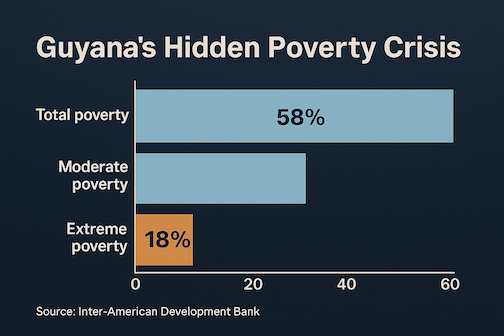
If we take the current published numbers at face value, they are troubling. The IDB estimates that almost 60 percent of Guyanese are living in poverty. Close to 18 percent are in extreme poverty. When translated into real population numbers, this equals about 460,000 people living below regional poverty thresholds, and roughly 130,000 to 140,000 living in severe deprivation. This is not just a statistic. It is a reflection of the reality many families face; rising prices, low wages, limited access to essential services, and widening inequality.
Guyana is positioned near the top of the regional poverty rankings. Only Venezuela and Honduras have consistently higher rates. This is a stark contrast to the narrative of national prosperity. The country’s rapid GDP expansion has not yet been matched by transparent and timely reporting on the living conditions of ordinary citizens. Without updated surveys, there is no way to determine whether the immense revenue from oil production is improving people’s lives or worsening disparities.
The absence of recent data does more than create uncertainty. It limits accountability. It restricts policymakers from responding to real needs. It prevents civil society from assessing whether resources are reaching vulnerable communities. It blocks investors and development partners from understanding the true social conditions within the country.
Guyana deserves better. Annual household surveys should be the foundation of evidence-based decision-making. With the economy expanding at record speed, the public needs clear information about whether health, education, food security, and employment opportunities are improving for the average family. Economies rise on numbers. Societies rise on people.
Until the government produces updated poverty data, Guyana will continue to appear in international reports as a paradox; an oil-rich state with poverty levels among the highest in the hemisphere. Updating the data is not just a technical task. It is a responsibility owed to the people of Guyana.