The Government of Guyana’s recent warnings about the impact of social media on children have sparked an important national conversation about youth behaviour, mental health and the influences shaping the next generation.
Yet while public attention has focused heavily on digital platforms, decades of research in psychology, sociology and media studies suggest that social media is only one part of the equation. Children learn not only from what they consume online, but also from what they observe in their homes, schools, communities and national leadership.
The question is particularly relevant in Guyana, where political discourse remains deeply polarized and public debate is often characterized by sharp partisan divisions, personal attacks and confrontational rhetoric.
According to Social Learning Theory, developed by renowned Canadian-American psychologist Albert Bandura, children acquire behaviours, attitudes and values by observing others. Bandura’s landmark Bobo Doll Experiments in the 1960s demonstrated that children readily imitate aggressive behaviour when they observe adults engaging in it, particularly when those behaviours appear to be rewarded or go unchallenged.
The principle remains one of the most influential findings in developmental psychology.
“Most human behaviour is learned observationally through modeling,” Bandura wrote, arguing that individuals learn what is socially acceptable by watching others and observing the consequences of their actions.
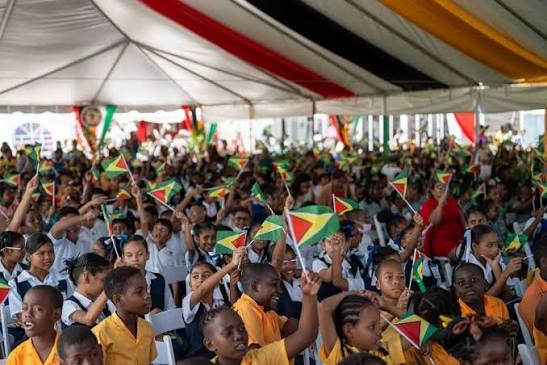
For children, the “others” they observe extend well beyond parents and teachers. Politicians, community leaders, media personalities, athletes, influencers and other public figures all become part of a child’s learning environment.
Research published in the journal Child Development and subsequent studies on political socialisation have consistently found that children begin forming views about leadership, authority, fairness and civic behaviour at surprisingly young ages. They are keen observers of how adults resolve conflict, exercise power and treat those with whom they disagree.
This is where Guyana’s political culture becomes part of the discussion.
For decades, the country’s politics have been shaped by intense partisan competition, ethnic polarisation and recurring accusations of misconduct from all sides of the political spectrum. Parliamentary exchanges, political rallies and social media commentary frequently feature language that is adversarial rather than conciliatory.
While robust disagreement is an essential feature of democracy, experts caution that the manner in which disagreements are expressed can influence young observers.
Researchers in developmental psychology have found that when authority figures repeatedly display hostility, ridicule, intimidation or disrespect, children may gradually come to view those behaviours as normal methods of resolving conflict. Conversely, when leaders model empathy, compromise, civility and mutual respect, children are more likely to adopt those traits themselves.
The effect is reinforced through what communications scholar George Gerbner called Cultivation Theory. Developed through Gerbner’s long-running Cultural Indicators Project, the theory proposes that repeated exposure to particular messages and behaviours gradually shapes an individual’s perception of reality. in the digital era, where children are exposed to a constant stream of political commentary, news content and social media interactions.
The cumulative message matters.
If children repeatedly encounter adults insulting opponents, dismissing criticism with hostility or treating political rivals as enemies rather than fellow citizens, those behaviours can become normalized. If, however, they see leaders engage respectfully despite disagreements, they learn that civility and democratic participation can coexist.
Recent international research on adolescent well-being reinforces the importance of positive role modelling.
The World Health Organsation’s 2024 report,“Teens, Screens and Mental Health,” found that while problematic social media use can contribute to anxiety, depression, poor sleep and social difficulties, positive online engagement can strengthen peer support and social connections.
Similarly, the 2025 study published in the United States National Library of Medicine, “The Impact of Social Media & Technology on Child and Adolescent Mental Health,” concluded that digital platforms can expose young people to risks such as cyberbullying and compulsive behaviours, while also providing opportunities for self-expression, support and community.
The common thread running through both studies is that environment matters. Children are influenced not simply by technology itself, but by the behaviours, norms and values they encounter through it.
That reality places a responsibility on adults far beyond regulating screen time.
The Michigan State University Extension, which has produced guidance for parents and educators based on observational learning research, emphasizes that adults must actively model the behaviours they hope to see in children. Respectful communication, empathy, patience and constructive conflict resolution are learned not through lectures, but through observation and repetition.
For Guyana, that message carries implications that extend well beyond social media policy.
If national leaders are concerned about rising behavioural challenges among young people, the conversation cannot stop at phones and screens. It must also address the broader social climate in which children are growing up.
The evidence from developmental psychology is clear. Children watch how adults behave. They watch how leaders treat opponents. They watch how disagreements are handled. They watch how power is exercised.
And, more often than not, they learn from what they see.
In a society seeking greater unity and social cohesion, that may be one of the most important lessons of all.