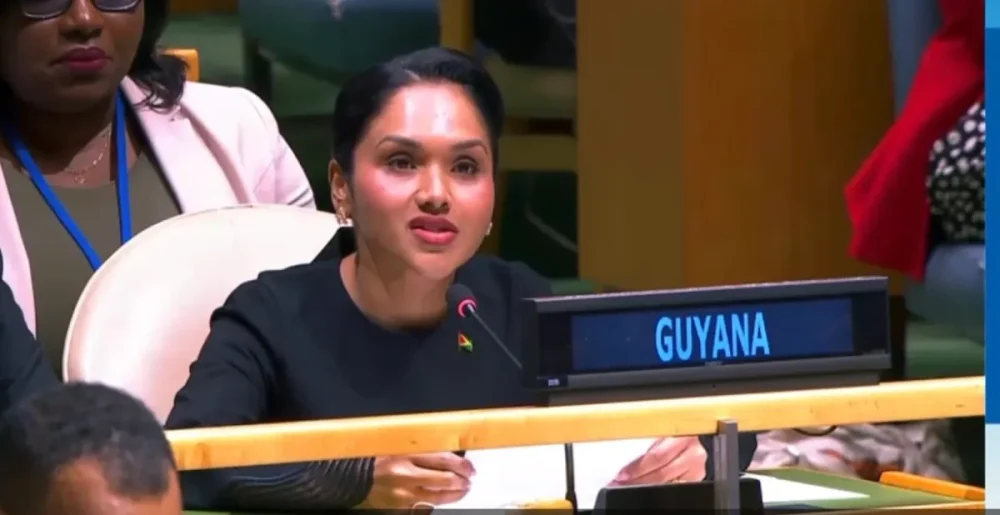
An announcement by First Lady Arya Ali on Tuesday that Guyana will establish its first specialised school for children with autism this year has been welcomed as a significant step towards expanding educational opportunities for children with disabilities. However, the initiative has also raised important questions about how a country with no comprehensive autism database, limited specialist resources, and a geographically dispersed population intends to ensure meaningful access for the children it seeks to serve.
Speaking at the 19th Session of the Conference of States Parties to the Convention on the Rights of Persons with Disabilities in New York, the First Lady announced:
“In 2025, we opened the country’s first school that offers specialised service for children with hearing impairments. This year we will establish Guyana’s first school specialised for children with autism.”
The announcement follows the opening in 2025 of Guyana’s first dedicated school for children with hearing impairments at Cummings Lodge, East Coast Demerara. The state-of-the-art facility was established to provide specialised educational services for deaf and hard-of-hearing students and serve as a resource hub for families and educators.
Prior to its opening, children with hearing impairments were accommodated through specialised units within mainstream schools and through services offered at the historic David Rose School. The new institution was widely welcomed as a milestone in Guyana’s efforts to strengthen inclusive education.
However, the hearing-impaired school also exposed unresolved questions about access and inclusion. While the facility offers specialised services, parents and advocates have questioned whether concentrating those services in a single location effectively requires children from distant regions to leave their homes, families and communities to receive an education tailored to their needs.
For families living in far flung Regions like One, Two, Seven, Eight and Nine, attendance at a specialised institution on the East Coast may require relocation, lengthy travel arrangements or separation from support networks. This has fuelled concerns that a highly centralised approach, despite its good intentions, may create barriers of its own. Many disability advocates argue that children should not have to leave their communities because of a disability in order to access appropriate education.
Those concerns are likely to arise again with the proposed autism school.
Autism Spectrum Disorder (ASD) is a neurodevelopmental condition that affects communication, social interaction, behaviour, learning and sensory processing. The condition exists on a spectrum, meaning that support needs vary considerably from one individual to another. Some persons with autism require intensive support throughout their lives, while others are able to function independently with targeted educational assistance.
That diversity of needs raises a fundamental question: who exactly is this school being built to serve?
At present, Guyana has no national autism registry, no comprehensive prevalence study and no publicly available database identifying where children with autism live, their ages or the level of support they require. Estimates based on international prevalence rates have suggested that approximately 4,800 Guyanese may be on the autism spectrum, but that figure remains an estimate rather than a verified national count.
This absence of data exposes a significant policy challenge.
In virtually every area of public planning, governments begin by identifying the population to be served. Yet in the case of autism, Guyana appears poised to build a specialised institution before establishing the size, geographic distribution and educational needs of the population it intends to support.
The issue becomes even more pronounced when viewed against the country’s geography.
Guyana spans 83,000 square miles, with communities scattered across coastal villages, riverain settlements and remote hinterland regions. If the autism school is established in Region Four, as many expect, it may serve children in Georgetown and surrounding communities effectively. But the question remains how it will serve children living in Mabaruma, Mahdia, Lethem, Annai, Aishalton, Bartica, Charity or other remote communities.
Will families be expected to relocate? Will children have to leave their communities to access specialised services? Will accommodation and transportation support be provided? To date, those questions remain unanswered.
The concern is not merely logistical but one of rights and equality. International disability-rights frameworks increasingly emphasise community-based and inclusive education, recognising that children with disabilities should, wherever possible, be educated within their communities and alongside their peers with appropriate support systems. Requiring children to leave their communities because of a disability risks creating a model that some advocates regard as restrictive and potentially discriminatory.
The challenge is even more significant in the case of autism because effective interventions typically depend on sustained family involvement, consistency and community support. Unlike some specialised educational programmes, autism services often require close collaboration among parents, teachers, therapists and caregivers. Separating children from those support systems may undermine some of the very objectives such programmes seek to achieve.
Guyana has previously experimented with a more decentralised approach.
During the People’s National Congress (PNC) administration, efforts were made to establish special education classrooms within mainstream schools to bring services closer to children. One example was the special education classroom established at Suddie Primary School on the Essequibo Coast, which sought to provide support within the community rather than requiring children to travel elsewhere. Those were dismantled by the People’s Progressive Party (PPP) when it came to office.
That model adopted by the PNC government reflected a growing international consensus that many children with disabilities can benefit from specialised support delivered within mainstream educational settings. Indeed, before the opening of the hearing-impaired school, Guyana relied heavily on specialised units embedded within regular schools to support children with varying needs.
This raises another critical question: will the autism school function as a stand-alone institution, or will it serve as a national resource centre supporting a wider network of special education units across the country?
Without reliable data, policymakers cannot accurately determine how many children require services, which regions have the greatest need, how many trained teachers and therapists are required, or what transportation and support systems must be developed.
Moreover, for many families raising children with autism, the greatest barriers begin long before school enrolment. Access to diagnosis, speech therapy, occupational therapy, behavioural interventions and educational psychology services remains uneven across the country, particularly outside Region Four.
A school may address part of that challenge. It does not by itself create a national autism support system.
The First Lady’s announcement nevertheless represents an important acknowledgement that children with autism deserve dedicated educational opportunities and support. The more difficult challenge will be ensuring that the initiative becomes more than a symbolic achievement and evolves into a comprehensive national strategy grounded in data, regional accessibility, professional training and community-based support.
Without those elements, Guyana risks creating a landmark institution that serves some children exceptionally well while leaving many others beyond its reach. The autism school may be an important first step, but its success will ultimately depend on whether it is accompanied by a broader plan that ensures geography, income and location do not determine which children receive specialised support and which are left behind.